banny07

~
Arms
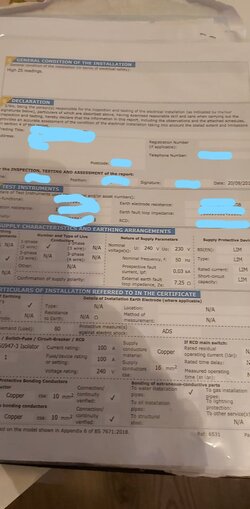
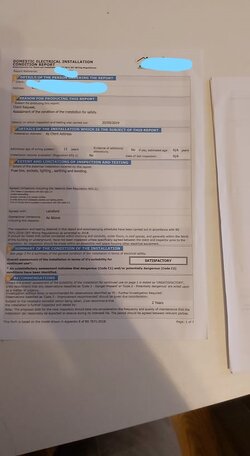
I had a message from a customer to sort out tripping akitchen circuit mcb. I asked him when was installation tested. He sent me a satisfactory EICR page. Under general condition it says high Zs reading. Ze is 7.25ohm. Could it be misprint? what are your thought guys.
 
Last edited by a moderator:
The fault current of 0.03kA matches the Ze recorded so unlikely they mistyped both.
First job is to check it and if correct and it’s TNCS notify DNO as 31 amps won’t blow the supplier fuse in a timely fashion!
 
Can you repost the page with the personal info removed, I have deleted the original.
 
Having a PFC of 30A would not trip the MCB on a L-E fault, but it could trip a RCBO.

However it could be a L-N fault that would take out the MCB as the supply PSCC would normally be something of the order of 600A or more (and ought to go in that table as the max value that the fuses/breakers have to clear).

EDIT: As above, double check the earthing as ~30A on any TN systems is seriously bad. Usual assumption is max 0.8 ohms but that is not set in stone, but supply fuse clearing should be considered.
 
However it could be a L-N fault that would take out the MCB as the supply PSCC would normally be something of the order of 600A or more (and ought to go in that table as the max value that the fuses/breakers have to clear).
I was thinking this, and also that whoever filled out the paperwork surely can't have taken the maximum of PEFC and PSCC for the PFC value...
Or to put it another way, if PSCC is that too then there's an even more serious condition pending....

The OP put on another thread he is fairly new to testing, and he's getting a lot more than his fair share of interesting situations. Hopefully he'll get some normal functional installations to test eventually! Otherwise "High Zs Specialist" will be on his business card soon....
 
The EICR bits shown don't have any final circuit Zs values for additional confirmation of its TT-ness.

It also possible that extraneous bonding is bringing the Zs at DB down to a low enough value as well (crap earth cable / cut-out here, but neighbours pipework bonded on good TN-C-S sort of thing).
 
EDIT: As above, double check the earthing as ~30A on any TN systems is seriously bad. Usual assumption is max 0.8 ohms but that is not set in stone, but supply fuse clearing should be considered.
Having looked around for the answer to the max Ze related to the supply fuse I found this:

Why on a TN-S earthing system is the maximum Ze given as 0.8 ohms by the supply authority when it’s often protected by a BS 88-3 100A fuse which has a maximum Zs of 0.38 ohms?

This maximum value for Ze of 0.8 ohms for a TN-S earthing system is a value that is quoted by the distributor and is commonly used for calculating likely Zs values within an installation at the design stage.

The main reason why you don’t need to change the BS 88-3 fuse within the supply cut-out when you have a measurement above the maximum value of 0.38 ohms for a 100A BS 88-3 fuse (T41.4) is because the Zs values given in the tables 41.2 to 41.4 BS 7671: 2018 are for protective devices providing fault protection (automatic disconnection in case of a fault).

The main fuse at the cut-out position is only providing overload protection for the incoming supply conductors. Fault protection is provided by the individual circuit breakers, fuses etc within the consumer unit which also provide individual overload protection for their own circuits.


So it seems the DNO side has no specific ADS requirements like a sub-main would. (If anyone with DNO knowledge can add to the please do so!) The related NICEIC guide booklet is here:
 
Think they have simple put the ze reading and PFC value the wrong way round . Ze is 0.03 ohms Pfc is 7.25 ka
I did wonder about that too, but there’s a comment about high Zs readings on the report, and unless the supply voltage was about 217 volts it seems that the maths don’t quite stack up.
Sadly I think it’s more likely there’s a problem.
 
I did wonder about that too, but there’s a comment about high Zs readings on the report, and unless the supply voltage was about 217 volts it seems that the maths don’t quite stack up.
Sadly I think it’s more likely there’s a problem.

I did wonder about that too, but there’s a comment about high Zs readings on the report, and unless the supply voltage was about 217 volts it seems that the maths don’t quite stack up.
Sadly I think it’s more likely there’s a problem.
Yes sorry does not look like that. May be worth getting a picture of the main head to give you a clue if it maybe TT
 
It would be interesting to see the whole EICR, if available. Apart from presumably not measuring PSCC, when putting down a value for PFC, I'm curious why the next inspection for what I presume is a domestic property with wiring only 11 years old is due after only another 2 years. Unless perhaps this is not a domestic property?
 

OFFICIAL SPONSORS

Back
Top