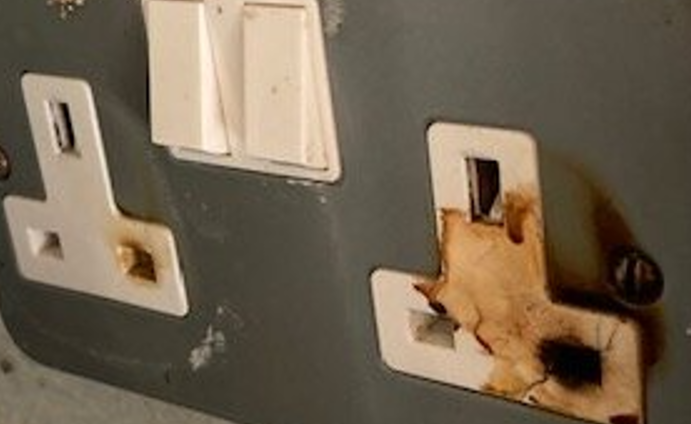
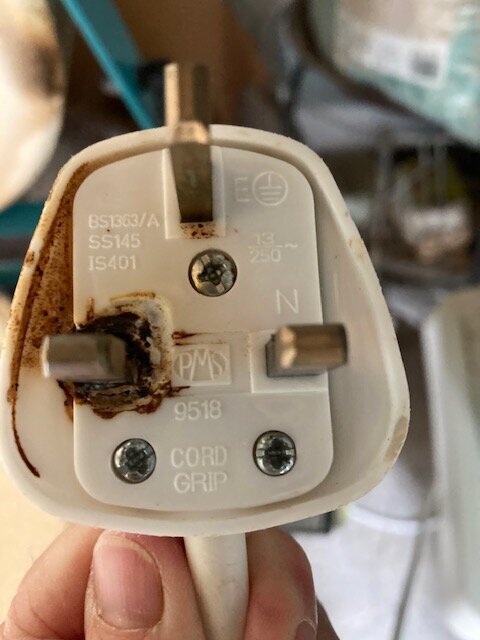
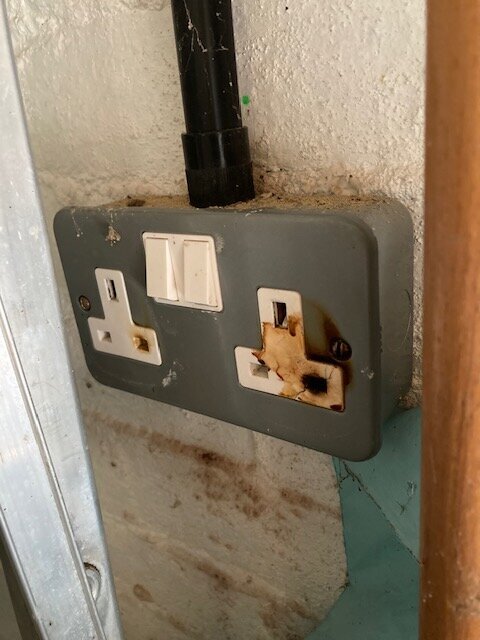
I'm trying to understand whether my problem is with a socket or a plug. I installed a pottery wheel and kiln in my garage in 2022 and 2 new double sockets were installed. Last year a heater plugged into one fried the heater and the socket and both were replaced. The kiln is plugged in at the other end of the garage and a couple of weeks ago the fuse in the plug fried and I replaced that. I noticed some brown singeing around the socket, but only a little. All seemed ok but when I unplugged it this morning the singeing was much worse and the plug also looks pretty fried although the kiln had successfully finished. The kiln uses a lot of electricity (2.9 kw output) but the electrician who installed the socket assured it it was ok. Having already had to replace one of his sockets I'm wondering if the socket isn't good enough. I don't want to replace something unecessarily, but I really don't want to damage my kiln. Should I try putting a new plug on first, or call out an electrician to replace the whole socket? Could the issue be something other than the socket?
IMG_6736.JPGIMG_6737.JPG
 

Attachments

  • IMG_6736.JPG
    IMG_6736.JPG
    47.5 KB · Views: 2
1780052612031.png
Both of the live socket holes are discoloured.
It could be the wiring of the socket that is at fault. Terminals not tight enough.
Yes, it could also be the plug...
IMO both need replacing.
 
2.9kw for long periods into a 13A socket isn't the greatest of ideas. Yes theoretically it should be fine but modern plugs and sockets go weak at the knees when they are subjected to such a load.
 
I don't want to replace something unecessarily, but I really don't want to damage my kiln. Should I try putting a new plug on first, or call out an electrician to replace the whole socket? Could the issue be something other than the socket?
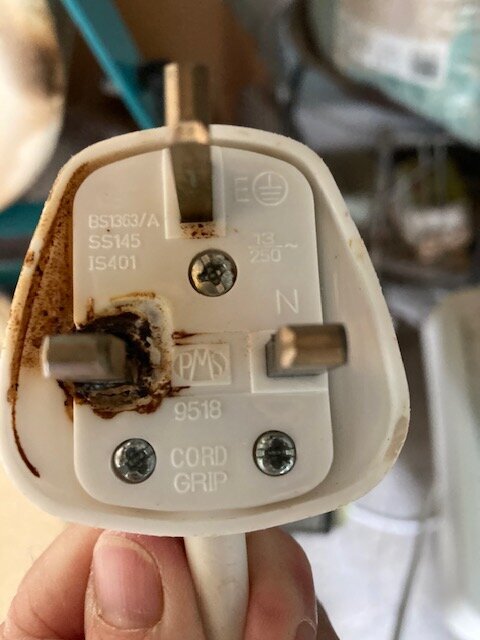
Don't just change the plug. The socket also needs changing.
The double metalclad socket you have appears to be a Contactum type - £6 from Screwfix at present.
In the light of the high demand from your loads, I suggest (pause for groans) that you ask for, preferably insist on, a more robust socket, I still rate the current MK version (I know, everyone shout Chinese, dropped in quality etc), but the MK metalclad - £18 from Screwfix, is more robustly made, allegedly in England if that counts. Also recommend the MK Logic safety plugs - (not available from Screwfix, probably because they are about £8 each).

It's most important, for both the plug and socket, to cut back 'burnt' cables if they have been affected by heat, and terminate them where the copper conductors are shiny and unaffected, otherwise you may have the same thing happening again, even with better components.
 
On top of the advice above, it would be my preference to power the kiln from a switched fused spur or even a 16A rotary isolator if it doesn’t require a fuse.
 
I'm trying to understand whether my problem is with a socket or a plug. I installed a pottery wheel and kiln in my garage in 2022 and 2 new double sockets were installed. Last year a heater plugged into one fried the heater and the socket and both were replaced. The kiln is plugged in at the other end of the garage and a couple of weeks ago the fuse in the plug fried and I replaced that. I noticed some brown singeing around the socket, but only a little. All seemed ok but when I unplugged it this morning the singeing was much worse and the plug also looks pretty fried although the kiln had successfully finished. The kiln uses a lot of electricity (2.9 kw output) but the electrician who installed the socket assured it it was ok. Having already had to replace one of his sockets I'm wondering if the socket isn't good enough. I don't want to replace something unecessarily, but I really don't want to damage my kiln. Should I try putting a new plug on first, or call out an electrician to replace the whole socket? Could the issue be something other than the socket?

View attachment 124858View attachment 124860
Put them both on a dedicated 16 amp supplies and 20 amp DP switches, high inrush currents when the wheel starts and heating the kiln is going to continue to cause this issue.
 
Put them both on a dedicated 16 amp supplies and 20 amp DP switches, high inrush currents when the wheel starts and heating the kiln is going to continue to cause this issue.
I'm not sure I'd be taking the 13A plug off that came with it and replacing for a commando type plug, you then lose the 13A protection for the flex.

Thinking about it... Does the 13A fuse offer any protection for internal components of the kiln as well? If not, could the cable be increased to 2.5mm and then put on a 16A commando socket? Probably not, but It would be interesting hear why not.
 
Does that include garages and outbulidings? Surely not.
I could be wrong, I have always read it as not suitable to put in to a ring final circuit, I.e. domestic socket circuit.
However I would consider it ok on its own circuit where the correct protection can be put in place.
 
Does that include garages and outbulidings? Surely not.
Its all about the commando not having shutters for use in a dwelling.

553.1.201 Every socket-outlet for household and similar use shall be of the shuttered type and, for an
AC installation, shall preferably be of a type complying with BS 1363.
 
Its all about the commando not having shutters for use in a dwelling.

553.1.201 Every socket-outlet for household and similar use shall be of the shuttered type and, for an
AC installation, shall preferably be of a type complying with BS 1363.
Question is, a garage or workshop etc.
Is that considered household use?
My take is no it’s not, although it is attached or close to a domestic dwelling, the usage is not what I would consider household use.
It’s closer to light industrial.
 

OFFICIAL SPONSORS

Back
Top