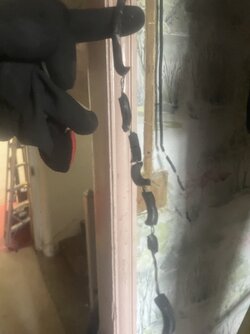
Massive stately home. Amazing property. Not so much fun rewiring after eicr.
 

Attachments

  • IMG_2403.jpeg
    IMG_2403.jpeg
    365.6 KB · Views: 121
Massive stately home. Amazing property. Not so much fun rewiring after eicr.
Hi Mate, do you mean vulcanized indian rubber? or I am so out of date your on about something else I have no idea what you are on about? if you mean Vulcanized Indian rubber I am very familliar with it and rewire thousands of circuits of the years made from it, if no apologies but I am a little confused.
 
Hi Mate, do you mean vulcanized indian rubber? or I am so out of date your on about something else I have no idea what you are on about? if you mean Vulcanized Indian rubber I am very familliar with it and rewire thousands of circuits of the years made from it, if no apologies but I am a little confused.
Yep that’s right
 
Yep that’s right
in that case I am amazed you found some, I started rewiring VIR circuits in the early 80s, found a few in the 90s, haven't seen any since, pretty amazing you have found some in the 20,20s, rip it out and start again, this must be a very rare things these days, I thought it had all been replaced 20 years ago at the very least.
 
Still in use now. Working through. Replacing in sections as we go. Could take months and months.
Wow! I have seen that stuff in museums, etc, but never actually in use.

In some ways it is not a surprise, as the VIR was fine in its day and when it hardens it remains OK until disturbed. Of course, sooner or later it will be disturbed and then a nightmare unfolds!
 
Still quite a bit in use in older houses - especially houses that haven't changed hands in some time. If it's working the homeowner won't know any better or ask to have the place rewired.

Think of those older houses in leafy suburbs that look as though an elderly person lives alone in or less well kept old houses in the countryside. The sort of places an electrician only sees if the power goes out completely.
 
I still come across it round our way. Two thatched cottages I have looked at recently had their lighting still wired in VIr and a farm was using VIR as a feed to an outbuilding until a couple of weeks ago when the fuse went with a big pop. There were just the cable winner tacked to the wall a few mm apart, no insulation left.
They had sagged in one spot and shorted!
Sy
 
in that case I am amazed you found some, I started rewiring VIR circuits in the early 80s, found a few in the 90s, haven't seen any since, pretty amazing you have found some in the 20,20s, rip it out and start again, this must be a very rare things these days, I thought it had all been replaced 20 years ago at the very least.
On the contrary I find a lot of Hessian covered VIR singles wired in it over this way. In public buildings it seems rife in the neglected BMS circuits.

Interestingly our on site substation had a transformer re-oil a few weeks ago and the DNO actually allowed me to stick my head in. You can see the bakelite battenholder was fed in singles from an old Crown fusebox. The single socket for engineers was even a 5a socket. The DNO guy had a 5a - 13 adapter and was charging his Makita.

Had a little chat with him and he said barely any subs have their local power upgraded - certainly in the smaller ones. So I imagine there'll be plenty there for years to come.
 
I've rewired a few VIR's and lead sheath over the years. It's always a shame because as people have said. whilst the materials may have finally failed the craftsmanship that installed them originally is often a thing of beauty in itself and would survive for millenia - not so much a lost art just things that people no longer pay the time to do.
 

OFFICIAL SPONSORS

Back
Top