banny07

~
Arms
Hi Guys.
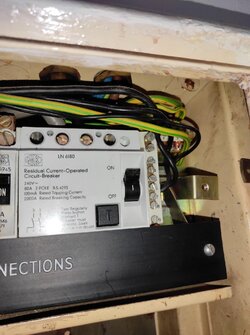
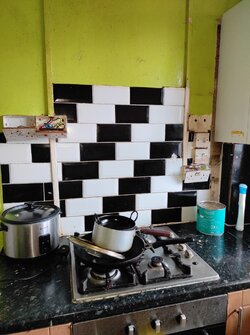
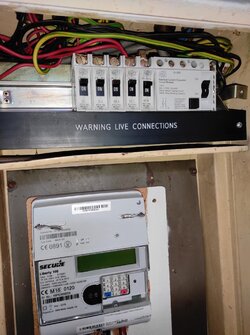
I went to see a job today where customer wanted to replace front plate of sockets and switches. Switches has no cpc but cpc is present in the cieling roses. As I opened consumer unit the main switch was 80A 2 pole RCOCB bs 4293 which has 100mA rated tripping current and 2000A breaking capacity. My question " Is it acceptable in dwellings". customer doesn't want to upgrade consumer unit. Please advise . Thanks in advanceccu4.jpgccu2.jpg
 
The switch drops may be contained in steel conduit which may in fact be the CPC. Worth getting the tester out to check. If not, then it may be possible to pull in a separate CPC.
If that is not possible, then replacing plastic switches for metal ones would be introducing a potentially dangerous situation.

The 100 mA main switch RCD does not provide additional protection where it is required, eg for sockets used for equipment outdoors. I would be reluctant to take on any changes at all in this situation.
 
nevertle less, you are modifying alighting circuit, so 30mA rcd protection must be provided.
1. for luminaires in a domestic, and
2. for cables buried in walls <50mm .

3. CYA when the shyte hits the fan. judge.
 
nevertle less, you are modifying alighting circuit, so 30mA rcd protection must be provided.
1. for luminaires in a domestic, and
2. for cables buried in walls <50mm .

3. CYA when the shyte hits the fan. judge.

Its like for like replacements, not modifying the circuit... so BS7671 doesnt usually apply.
Of course, it would be better to upgrade.

changing plastic to plastic is not making the installation "less safe" than it is now. whereas plastic to metal would
 
Its like for like replacements, not modifying the circuit... so BS7671 doesnt usually apply.
Of course, it would be better to upgrade.

changing plastic to plastic is not making the installation "less safe" than it is now. whereas plastic to metal would
as i read OP, customerwants to replacefaceplates.i assume this would be for metal, although not specified in OP.
 
The switch drops may be contained in steel conduit which may in fact be the CPC. Worth getting the tester out to check. If not, then it may be possible to pull in a separate CPC.
If that is not possible, then replacing plastic switches for metal ones would be introducing a potentially dangerous situation.

The 100 mA main switch RCD does not provide additional protection where it is required, eg for sockets used for equipment outdoors. I would be reluctant to take on any changes at all in this situation.
Sorry I forgot to mention it is first floor flat. It is mixed of conduit and pvc trunking . They put coving on top of trunking so its lid is not possible to remove.
 
Plastic to plastic will be ok, as long as you use nylon screws or get the ones with plastic screw covers. (I assume it’s metal back boxes? But looking at the kitchen, I’m not so sure)

I don’t believe there is a distance sockets are away from above the cooker, I just know they can’t be in the space directly above the cooker.
 
Is the pictured RCD main switch acceptable? I believe it should be 30mA in domestic installation not 100mA. What would you suggest in this situation? Thanks.
 
Is the pictured RCD main switch acceptable? I believe it should be 30mA in domestic installation not 100mA. What would you suggest in this situation? Thanks.
100mA (more so with some delay = type S), is common in TT systems to have earth fault disconnection on the rod's Ra value without too much risk of nuisance trips. Is it a TT or TN system?

30mA would be better from a shock protection point of view but (a) you won't find a new replacement and (b) even if you did there would likely be issues of it tripping on too much accumulated leakage taking out the lights so potentially more risk than the reduction in shock risk.
 
Plastic to plastic will be ok, as long as you use nylon screws
Realistically it is not worth worrying about.

The regs note that small parts that you can't grab are not really much risk as you would simply pull your fingers away. The real dangers for shocks are (1) things you can grab so the effects of the shock are to be unable to release (say handle of mower outside) and (2) areas with water where even momentary contact is likely to lead to a high shock current so even a fraction of a second might trigger heart fibrillation.
 

OFFICIAL SPONSORS

Back
Top