cliffed

~
Arms
Quite a few Mcbs faulty @ this DB & @ couple of Rcbo’s.
Emergency call out to find fault on circuit found to be faulty Rcbo.
Its in a cupboard that’s sited in the swimming pool area & locked , wonder if it could be the Chlorine affecting the terminations.
There are no Neutral shields in the DB.
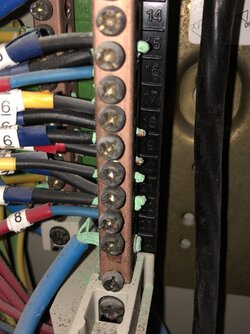
 

Attachments

  • 90B9EC59-F7A0-42B2-A2B6-B0076F946468.jpeg
    90B9EC59-F7A0-42B2-A2B6-B0076F946468.jpeg
    458.6 KB · Views: 90
Certainly corrosion but intersting that the N bar is not the same, wonder if it is lacquered.

Could be the high humidity or the pool water is slightly acidic.
 
Definitely. Be careful if working live and the conductors look wet as I got a shock from something similar where chemical contamination had made nearly everything conductive.
 
Last edited:
Agree that the corrosion of the copper conductors is caused by high humidity and chlorine levels. Some metals, including brass, can survive quite well but this entire DB is now suspect, with every MCB and RCBO and the main switch at risk of failure and terminations increasingly likely to overheat or lose earth continuity etc. A good point from @westward10 that surface contamination of insulation by salts and progressive metal tracking across creepage paths can result in significant leakage over the surface.
 
Thanks to all,I’ve given the report to my boss,he will then pass it on to others.
Recently been some circuits added to that TPN by another company...so see what happens.
 
also as the screws are a different metal to the bar and the conductors, do we have galvanic corrosion, with the atmospere being the cause? ( that's just on the N bar, other components are at risk as Lucien said).
 
Pool water is generally kept at a 7.4Ph to prevent corrosion to metal parts, its also the approximate Ph of swimmers eyes to prevent stinging, but that corrosion looks excessive, I have never seen verdigris that bad on a swimming pool installation, couple of questions, is the pool salt water, enclosed or open air?
 
Pool water is generally kept at a 7.4Ph to prevent corrosion to metal parts, its also the approximate Ph of swimmers eyes to prevent stinging, but that corrosion looks excessive, I have never seen verdigris that bad on a swimming pool installation, couple of questions, is the pool salt water, enclosed or open air?
Chlorine itself is highly corrosive, regardless of the pool ph level

Also
Distribution boards are rarely located in the pool area, more often they are in a plant room that doubles as a storage area for pool chemicals.
Storage and dilution of chemicals can lead to very high local contamination.
 
Agreed Chlorine has a Ph of about 11, it could be there is a Chlorine dispenser in the same cupboard as the CU, but then Chlorine has specific storage requirement, especially if stored in the same area as Hydrochloric Acid used to control Ph.

We have not established if this is a commercial pool with a plant room or a domestic installation, two more questions for the OP.
 
Pool water is generally kept at a 7.4Ph to prevent corrosion to metal parts, its also the approximate Ph of swimmers eyes to prevent stinging, but that corrosion looks excessive, I have never seen verdigris that bad on a swimming pool installation, couple of questions, is the pool salt water, enclosed or open air?
Enclosed pool
 
On an enclosed pool the Chlorine content in the air can get out of hand, especially if the water is dosed by liquid Chlorine and not by a regulated automatic system, its expensive to remotely measure Chlorine content and most doser's are just a quantity dose on a timer, or slow dissolving tablets on a flow dispenser, I would suggest the Electrical cupboard requires forced ventilation that draws in fresh air, not air from the pool area, to prevent this reoccurring after being addressed.
 

OFFICIAL SPONSORS

Back
Top