S

sparkinlee

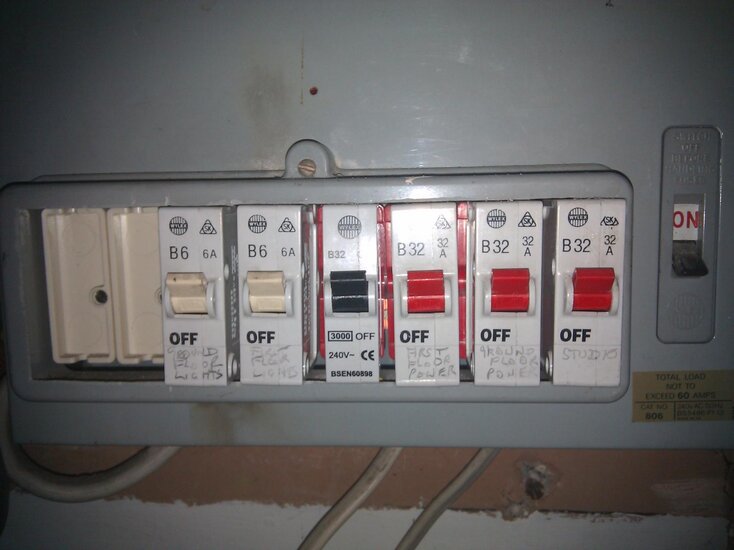
A fuse box I was working on the other day (doing such things as providing a main earth connection to the fuse box, which I can only assume was missing for years) looks like this:
2011-11-16 08.46.21.jpg

Having installed the main earth, the PSSC is 8.5kA. Must be close to the transformer...

The mcb 3rd from the left in the picture is shown to have a rated short circuit capacity of 3kA, and I assume the others are the same, and accordingly all are lower than the PSSC.

As far as I can see the simplest remedy would be to replace the push in MCBs with push in fuse carriers and BS 1361 fuses with a rated capacity of 16.5kA according to the onsite guide. Any other suggestions?

If the client requests information on upgrading to a 17th Edition board, who makes MCBs that would be suitable? - my recollection at this time of night is that they are generally 6kA, which would be too low.
 
Hager make a full range of 10kA mcb's, and even (I think) 15kA.
 
bear in mind that the MCBs have to withstand the fault current on their respective circuits. the 8.5kA would only occur downstream of the MCBs if the fault was very close to said MCBs. generally we calculate/measure the fault current applicable to the MCBs from the furthest point on each circuit.
 
would you not say upstream telectrix... and the main fuse willl be rated higher which is the one you should be concerned about... as is at the origin.... which is worse case senario
 
i=p/u, read my post. it is upstream of the MCBs that you get the 8.5kA, yes, but also downstream, close to the MCB, the pfc would be close to that figure. at the extremity of the circuit, it would be considerably lower due to the circuit impedance.
 
Annex ZA of BS EN 60439-3 gives a CU and associated devices a conditional 16kA rating assuming all devices are of the same manufacturer.
 
I've always thought that it kind of doesn't matter - the 6/10/15/whatever rating is the maximum fault current that the device will switch AND STILL OPERATE afterwards, though we all know that it'll in all likelihood be toast. So, if you're going to fry it, it's fried and therefore doesn't matter.
 
aye cause to re work the new ones are only rated at 3ka so,,, if you did fry one , what would be the effects, would they not reset or what you notice/see??? im interested
 
Last edited by a moderator:
I think the conditional rating is more to do with safe operating limits, in reality the fault rating of a device is usually not a worry as its never going to reach the 33kA of the service fuse.
 
I thought that if the main fuse was a BS1361 type II that this would have a Maximum capacity of 33Ka and would subsequently allow individual mcbs 16Ka downstream?

Sent from my GT-I9100 using Tapatalk
 
Yes...Almost, it allows for TT assemblies to assume an overall 16kA rating as part of the 60439/61439 standard
 
The 16kA rating of CUs applies to type tested CUs, which are tested with CPDs installed.
I don't know whether these old domino style CUs were ever type tested, or whether the CUs have been type tested with the plug in MCBs installed.
It's something you would have to confirm with the manufacturer.
Here's a link to a publication that gives some information: http://uk.search.yahoo.com/r/_ylt=A0geu8UC98ZOtXsAw2FLBQx.;_ylu=X3oDMTBzdTNjcXU5BHNlYwNzcgRwb3MDMTAEY29sbwNhYzIEdnRpZAM-/SIG=132o8aia5/EXP=1321691010/**http%3a//www.beama.org.uk/download.cfm/docid/1861A011-BADD-4874-9B0F246FC31F490F
 
Good News:
The Wylex MCBs are all BS EN 60898 Type B and the Wylex distribution board is BS5486 Pt13, 8way. According to the latest Wylex Catalogue the BS5486 Pt13 designed board is considered a factory built assembly to BS EN 60439-3 when fully assembled, and therefore the above combination has been fully type tested to that specification.
 
Last edited by a moderator:

OFFICIAL SPONSORS

Back
Top