M

Monkeyblaine

From the transformer as I understand it, it steps down the voltage to 230v (ish for argument sake) and then is supplied to people's homes. How do
They design the transformers. If one supplies say 5 houses is it generating enough 230v for 500A supply. I know I don't need to know this. I'm just interested. I think we're I'm overthinking things I'm getting lost on the fundamentals.
 
I'm getting confused. 230 is generated then the cables are designed big enough to continue the 230 for the 500a supply to all 5 houses.
 
I'm getting confused. 230 is generated then the cables are designed big enough to continue the 230 for the 500a supply to all 5 houses.
Supply and demand via diversity regarding KWH is how the local electricity company works out their loads, I very much doubt they allow 500 amps for 5 houses lol
 
I think you would understand the DNO supply system better if you were to think of HV, MV, LV, 3 phase TX's and 3 phase supply cables with maximum demand / diversity taken into account.
 
From the transformer as I understand it, it steps down the voltage to 230v (ish for argument sake) and then is supplied to people's homes. How do
They design the transformers. If one supplies say 5 houses is it generating enough 230v for 500A supply. I know I don't need to know this. I'm just interested. I think we're I'm overthinking things I'm getting lost on the fundamentals.

power from the transformer is on 3 phases.

between any phase and neutrel you get 230v or between any 2-3 phases 400v


usually they tap off one of the phases to go to said house then next house is on one of the other phases as it alternates down the street.

thats why some people can have power and others dont during a power cut
 
Yeah.

Appliances are designed to operate at +/-10% of the nominal voltage of a country(230) here.
The supplier is obliged to supply you with +/- 5% and your house.
At the primary side of the step down transformer I think +/- 2%VoltDrop is allowed and maintained by onload tapchangers.
Everything is designed and selected according to the calculations to allow for this to be achieved.
That's as far as I can remember its not really my ball game. I may be wrong. Let me know if so

Tin hat on
 
I'm no expert, but if you add up all the breaker ratings in a consumer unit it'll most likely ad up to more than the DNO fuse (eg 100A). If you were to use over 100A (extremely unlikely) the fuse would blow, protecting the cable supplying the house.
Likewise there's a fuse at the transformer so if the value is exceeded it will operate and protect the transformer. For argument's sake that could be a 500A fuse protecting the supplies for 10 houses, so if each house used over 50A simultaneously (again, extremely unlikely) the protective device at the transformer would operate.
 
From the transformer as I understand it, it steps down the voltage to 230v (ish for argument sake) and then is supplied to people's homes. How do
They design the transformers. If one supplies say 5 houses is it generating enough 230v for 500A supply. I know I don't need to know this. I'm just interested. I think we're I'm overthinking things I'm getting lost on the fundamentals.

Transformers transform and Generators generate...

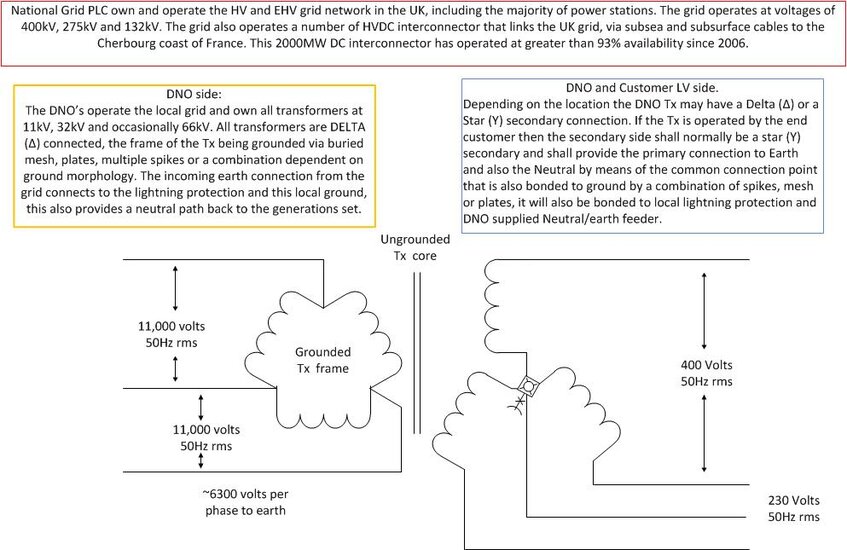
The process in the UK is 11kV 3 phase [~6300v per phase to Earth](Final HV rating) is stepped down by a 27:1 ratio winding to ~400V 3 phase that is also ~230V to earth or the neutral point of the delta connected transformer.

The transformer for a given load will be decided by calculating the design load on the transformer, then doubling it as they work on a 50% loading to ensure they do not overload the Tx
 
Thank you. I really am interested in al the design sides of the trade. DNO side and mine. Thanks again for help.
 
Blaine, this might help, knocked it up for one of our apprentices and thought it might help you with some insight too.

11kV_400V_Tx_layout.jpg
 

OFFICIAL SPONSORS

Back
Top