They made Pyro in both copper and alluminum, probably still do to some extent. I haven't seen it about for a number of years now though...

Never too long in the tooth to learn - in what must be thousands of miles of Pyro, I don't recall ever once coming across aluminium. Just lucky I guess :)

I do recall pulling out miles of aluminium T&E when I commenced many moons ago, however, and remember well the tables being split for copper or aluminium and having to do calcs for both at college too....
 
Well, now you put it like that.... I'd still far sooner work on Mummy's Insulated Milk System..... :)

Yes, it makes sense as such, I don't honestly think I've ever heard it described as such though - only as MICC or Pyro.

The aluminium is interesting - I thought we'd long done away with aluminium as a conductor for a number of reasons, and to my understanding, FP200 and similar cables which have an aluminium sheath don't qualify as MICC or MIMS...as they're not mineral insulated....

Time for me to do a little more reading up I think.

Pyro has been manufactured as an all copper cable, an all aluminium cable and a copper cored aluminium sheathed cable. The termination kits for the latter where labelled as ALCuMIC. Haven't done a lot with the aluminium stuff but it was not good to work with especially trying to repair it or modify an installation

I do like your alternative "Mummy's Insulated Milk System" is that when you make a boob

It was really with the kids in college that it came to mind lol....

I have led a sheltered life apparently, when it comes to Pyro - though I can (still) work well enough with the copper stuff we all know and love - I'm happy to confess I had little knowledge of aluminium pyro in any form. Not something on any sites at all I was on in the 80s - either for fire or power. Lucky escape, perhaps :)
 
Not heard of that for a long time now. Standard "conversion" now is a potted junction, and new cable from that to the termination. On fire anyhow, though on certain LV jobs, I've been asked to re-run the whole cable.

It's a shame BICC did away with the "shrink on" seals for Pyro made it very easy for doing repairs on imperial cable. I actually worked on a site when they were first used had the Pyro reps on site a few times sorting out the teething problems of using them on site and not in a cosy workshop
 
love Pyro, did a church in it, all bare copper, shaped around the stonework, still the job i am most proud of, its just...proper! shame that its all FP200 etc now ..

as for tools, i found that unbolting the tools off the Wrexham MICC stand in CEF's counter was a much cheaper way of getting strippers, pot crimpers etc lol.... ahhh, misguided yoof...
 
Last edited by a moderator:
It was really with the kids in college that it came to mind lol....

I have led a sheltered life apparently, when it comes to Pyro - though I can (still) work well enough with the copper stuff we all know and love - I'm happy to confess I had little knowledge of aluminium pyro in any form. Not something on any sites at all I was on in the 80s - either for fire or power. Lucky escape, perhaps :)

I started just as the Ali stuff was coming to an end in the 70's but did some repairs to installations into the 80's the all aluminium stuff was horrible as the small conductors became brittle and snapped very easily the copper cored stuff was marginally better, tightening the gland nuts had to be done carefully to avoid breaking the sheath with the olive

It's surprising how many things have come and some gone with pyro over the years there's been crimp on pot's, shrink on seals and glands that covered a number of cable sizes to name a few
 
You must be one very heavy handed electrician, is all i can say!!...lol!!

I have never broken or snapped a core off of a MICC, or the Ally stuff ever, not even the on the smallest of sizes!! Oh, and aluminium Pyro was still being used long after the 70's, i can show you miles of the stuff (all PVC sheathed) installed in mid 80's and beyond!!!

Ally Pyro, had it's own working methods and restrictictions, keep to them and there is nothing wrong with installing the cable or the cable itself.
 
Speaking of heavy handed.
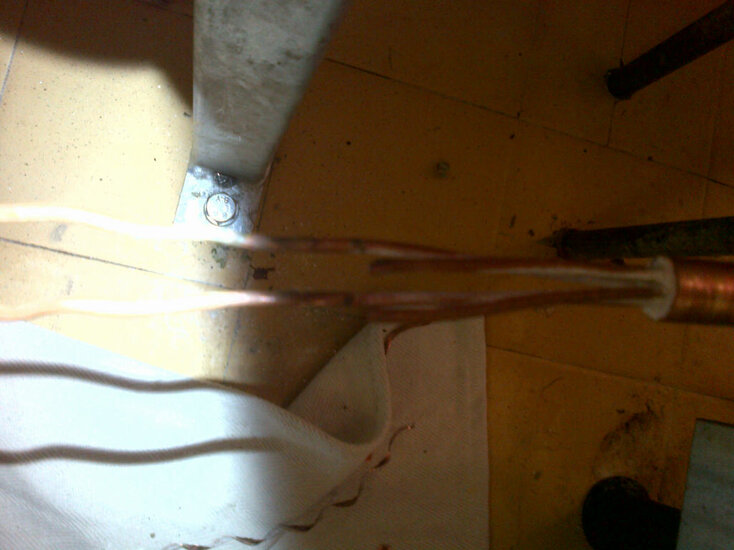
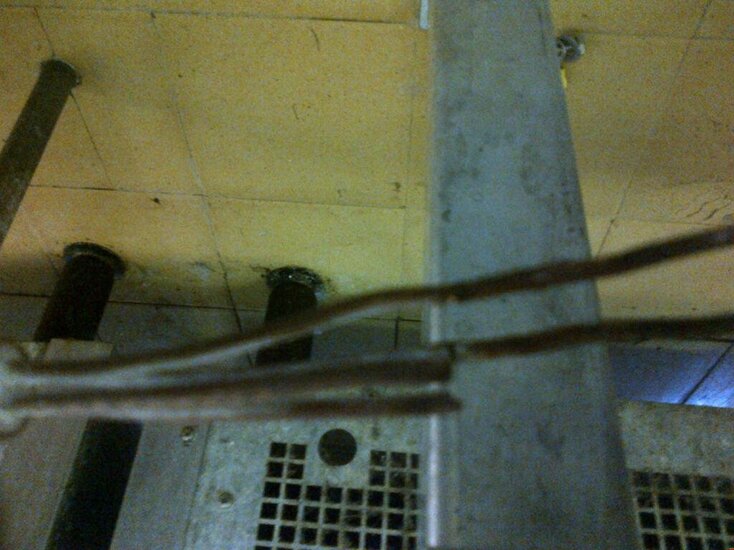
An old thread, I know, but came across a couple of photos. Old 6mm 4 core MICC 3 phase oven/cooker supply in school kitchen. Called in after industrial kitchen fitters found a phase down after unit replacement.

Made an attempt to repair but insufficient length or room available. The pyro came through the floor in a 25mm conduit. Stripped a couple of inches and found the point where all 4 cores had been nicked on initial termination, causing the broken conductor after movement of the machine isolator.
You can just about make out the damage caused initially to the 2 remaining cores. A second core snapped whilst stripping. Had to give up and rewire in
swa.
IMG-20120821-00034.jpgIMG-20120821-00038.jpg
 
I miss Pyro. I hated it initially as an apprentice, but once you knew how to terminate it properly and how to make a good job of installing it the end job was far superior to any other cable method. I remember a Job we did many moons ago that was 100% pyro and I was tasked with taking all the pyro's around the switch room on tray and terminating into the various dis boards. I decided to make it a good Job to prove I could be bothered (I was only 19). I spent the best part of two weeks running them in, taking out all kinks and straightening the cables and making sure none crossed on the tray before terminating them.

I was that sad or whatever you want to call it, but I actually used brasso to clean and polish the bare pyro and some fairy to clean the PVC coated for the E-Lights, Fire alarm and exterior lights. I have never done such a job since (costs too much money to spend the time sadly).

I do have some old picture of this job when finished somewhere, I will dig them out, scan them and put them up for people to see
 
Going back to the original question, ...i was thinking, this may have not been 6mm MICC, but an imperial sized MICC cable. If so then it would of held a higher CCC than that of it's metric cousin!! Around the equivelent to 7/044 as i remember...
 
I haven't used it since the Channel Tunnel, those where the days, ceramic seals lol

Those high temperature ceramic seals were also used on the HK MTR underground system too. Around the 250-300c mark if i remember correctly?
 
Don't know the temp rating of run of the mill terms but I remember visiting the burned out shell of a WMC in yorkshire once. Lengths of smoke blackened pyro were strung about the debris, cable and terms still intact.
 
I wonder if the Electrical Trainee sparks can fit the ceramic seals without damaging them, I know there was a lot of sparks who struggled even with the special tool supplied by, I think BICC, I spent many 12hour shifts replacing the seals.
 
I'm currently working on a decommissioning project and everything (accept a few irrelevant things like fire alarms, emergency lights...) and everything is either (heavy duty) pyro or really old (ie no outer sheath) SWA. Getting bored of ripping it out all the time, but I like seeing the over the top use of brass, huge buzz bars everywhere, cast iron controls and enamel industrial lights all over the place.

Needless to say, it would be a lot more expensive of a job to do now
 

OFFICIAL SPONSORS

Back
Top