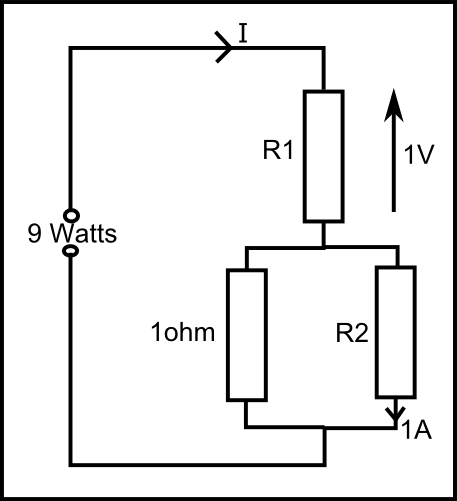
Haha...crafty!

Crafty?!? Downright dastardly, I'd say!
And if you can't see it, don't feel bad, because this is very sneaky and none of us could at first - including our tutor! The person setting this question has engineered a set of circumstances whereby a normally-unsolvable problem can be solved due to some jiggery-pokery.
I'll start you off:
The "someone else" who will help you solve this is Kirchhoff. He has a couple of "circuit laws" named after him. They are pretty much common sense:
Kirchhoff's Voltage Law: all the voltages around a circuit must add up to zero. Think of this as, "If you've got stuff in series, then all the voltages across each thing adds up to be the total voltage at the source."
Kirchhoff's Current Law: the sum of all the current flowing into a point must equal the sum of all the current flowing out of it. So if you've got current I1 flowing in a circuit and the circuit splits into two, then the currents flowing out of that point (I2, I3) must add up to be equal to I1 ("I1=I2+I3"). Makes sense - it's got to go somewhere!
How to solve this? Here's what I do (your way might be different, but this works for me):
(1) Work out exactly what you're trying to work out. If you're set an exam question, then this is just the question (here, "what's I, R1, R2?"). In real life, fault-finding, say, then you'll have to work it out yourself. "This circuit doesn't work." So: "Why doesn't it work? What are the symptoms? Where on the circuit is the problem? What sort of a problem is it?"
(2) Draw a picture. Different folk learn/are creative/solve problems in different ways. Me, if I can't picture it, I can't sort it.
(3) Write down everything you know about the problem. Start off with the simple stuff.
(4) Look for patterns. So, e.g. "Ok, so we know this, we know that... are they related in some way? What would happen if...?" See if anything jumps out at you, or looks familiar (might have seen it before).
So:
(1) What's I, R1, R2.
(2) Draw the picture. There's some bits on the circuit it might be a good idea to give names to, so we'll mark up anything we don't know:
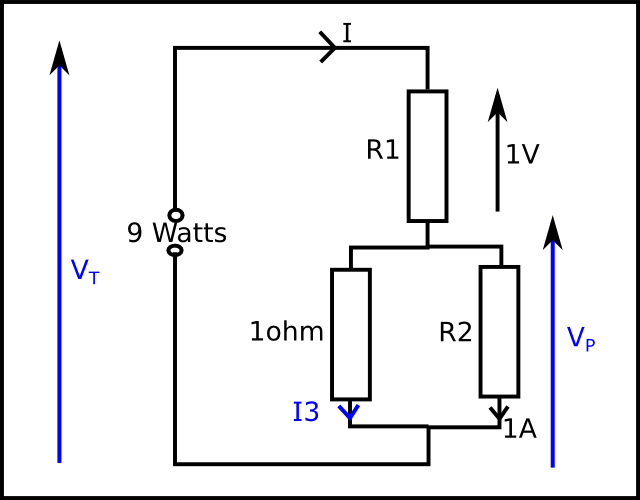
So V[SUB]P[/SUB] is the voltage across the parallel resistors, and V[SUB]T[/SUB] is the total voltage across the whole circuit, and I3 is the current through the 1 ohm resistor.
(3) Alright, what do we know. I'll start you off:
V[SUB]T[/SUB] = V[SUB]P[/SUB] + 1
(the "+1" as there is 1V across R1).
Over to anyone else who wants to have a crack at this