Short Circuit Fault Current

Hello all,

After some advise please!

TN earthing system.

DB1;
Zdb = 0.16
IPF = 0.22 / 1.00kA

Circuit Lodge 1;
100A / 100mA Time Delayed RCD
C80 MCB - Maximum Permitted Zs @ 80% 0.22 Ohms
16x2c Cu SWA

Lodge 1;
Measured Zs = 0.46
Measured Line-Neutral Loop = 0.40

Obviously the high Zs is covered by the RCD for fault protection.

What would I check against for the line-neutral loop? Could I use the generic for the C80 or will I have to find the manufactures curve.

If I am correct;
C80A - Magnetic trip between 5 > 10 x rated so between 400A - 800A
Line-Neutral loop = 0.40 which gives a fault current 575A

Would you leave this as is or potentially look at replacing the C curve or even down rating the breaker.

Do I have to look out for anything else?

Thanks all.
 
You LN loop has to be within the max Zs figure. It’s just fault current going through your device.

Look at the curve for the C80 device you have and see what figure ifs gives you for a 5 sec disconnection.
 
Okay I have done this quickly so may be incorrect.
Your fault current of 575A should interrupt the protective device in around 8 seconds according to the curve in BS7671.
Using the equation in Regulation 434.5.2 this gives times of around 10 seconds (PVC) and 15 seconds (XLPE) before thermal damage occurs albeit the value of k in Table 43.1 are based on 5 seconds.
 
You LN loop has to be within the max Zs figure. It’s just fault current going through your device.

Look at the curve for the C80 device you have and see what figure ifs gives you for a 5 sec disconnection.
Thank you.

I keep second guessing myself on this.

I have checked against the manufacture data on this for maximum permitted Zs.

For example;

Eaton C80A MCB = 0.22 Ohms.
 
Okay I have done this quickly so may be incorrect.
Your fault current of 575A should interrupt the protective device in around 8 seconds according to the curve in BS7671.
Using the equation in Regulation 434.5.2 this gives times of around 10 seconds (PVC) and 15 seconds (XLPE) before thermal damage occurs albeit the value of k in Table 43.1 are based on 5 seconds.
Would this matter if the LN loop impedance is too high anyway?

What would I check against to ensure it will operate before thermal damage occurs.
 
Generally if the line to neutral impedance is less or equal to your maximum Zs then it should be fine but your's isn't so you have to decide if the conductors are likely to suffer thermal damage under short circuit conditions.
 
Okay I have done this quickly so may be incorrect.
Your fault current of 575A should interrupt the protective device in around 8 seconds according to the curve in BS7671.
Using the equation in Regulation 434.5.2 this gives times of around 10 seconds (PVC) and 15 seconds (XLPE) before thermal damage occurs albeit the value of k in Table 43.1 are based on 5 seconds.
Just gone through it and would agree.
 
An idle fellow does some calculations.

2 core 16mm2 SWA cable has a volt drop/amp/metre figure of 2.9mV/A/m

Rated current carrying capacity circa 110A to 130A depending on installation method and temperature.

At maximum current carrying capacity (say) power dissipation (Joule heating) per metre Px of cable is:

Px= (Volt drop per metre) x current = (130 x 0.0029) x 130 = 49 W/m call it 50W/m

In short circuit conditions for 5 second mcb trip time and current of 575A power dissipation per meter Py of cable is:

Py = (575 x 0.0029) x 575 = 959W/m call it 960W/m

So for short circuit over current of 575A for 5 seconds SWA cable has Joule heating of

Py/Px = 960/50 = 19.2 call it 20 times it's rated Joule heating rating.

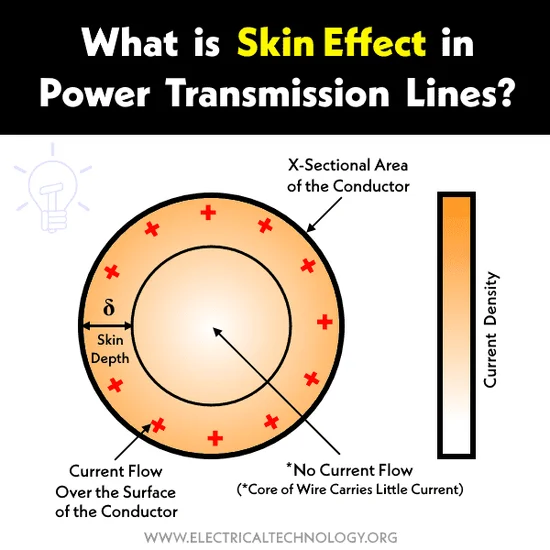
Further thought: In short circuit conditions SWA conductors experience the skin effect - tendency of current density to be much higher in a thinner annulus of the live conductors - thus effective resistance of conductors is higher per metre. Consequently Py is probably higher than 960W/m and Py/Px greater than 20.
 

Attachments

  • What-is-Skin-Effect.webp
    What-is-Skin-Effect.webp
    23.1 KB · Views: 28

OFFICIAL SPONSORS

Back
Top