Weird one - any thoughts please Guys

sythai

~
Arms
After bit of advice please if anyone has any ideas ??

Did job last week.... part of it was replacing faceplates throughout a property.

Now customer is saying on kitchen ring where her mobile used to take 40-50 mins to charge fully is now taking 2 hours.
She has tried in both 13amp and USB sockets (click ones we have put in) and same.

Then she has gone and tried same charger on different ring in house and is full charge in 50 mins (again on new click sockets we've just put in.)

Everything else working normally.

Where do I start with this guys, odd one 😵‍💫
 
I can understand the USB sockets not charging as quickly as the dedicated charger as have same problem too.
Output of USB is much lower than dedicated charger so as charger is plugged into 13A outlet (wherever) it should be the same??
 
USB chargers come in a variety of amperage’s.

The one I am using just now is a usbC built into a 13A socket marked as 3100mA.
The other socket is the normal square USBA socket, also marked 3100mA, but it it considerably slower.

The plug in type chargers could be variable between factors such as manufacturer, age, quality.


If she saying the SAME charger in the SAME phone takes different times to charge from the same low battery percentage…. Then I am thinking outside influence?
What about temperature? Is the kitchen socket heating up? Most phones cut the charging rate if they become too hot.


Also, charging is slower if the phone is being used while plugged in.
 
Also the output quoted is often shared between USB's so if a double or triple USB socket and multiple devices plugged in it will be slower.
 
Thanks Guys appreciate the feedback

f she saying the SAME charger in the SAME phone takes different times to charge from the same low battery percentage…. Then I am thinking outside influence?
What about temperature? Is the kitchen socket heating up? Most phones cut the charging rate if they become too hot.

She is implying that since we've replaced all her 30 year brass faceplates for click, that the power seems to be affected.
Only when she is charging her phone though.

Old sockets charged at 40-50 mins, new ones around 2hrs.

Going back to re-test next week.
I'm wondering if we have lose connection causing tiny volt drop maybe ?
And this is only affecting her mobile charger.
Everything else on same circuit is working fine (kitchen) 🤯
 
does she think the world is flat and aliens are real?

probably her phone took an update, and Apple or Samsung or whoever have "limited charging rates to extend the life of your battery" or some other excuse for you to need to buy a new phone
 
does she think the world is flat and aliens are real?

probably her phone took an update, and Apple or Samsung or whoever have "limited charging rates to extend the life of your battery" or some other excuse for you to need to buy a new phone
she is a right know it all as well.... probably be chat GPT'ing it all before my visit 🙈
 
Thanks Guys appreciate the feedback


She is implying that since we've replaced all her 30 year brass faceplates for click, that the power seems to be affected.
Only when she is charging her phone though.

Old sockets charged at 40-50 mins, new ones around 2hrs.

Going back to re-test next week.
I'm wondering if we have lose connection causing tiny volt drop maybe ?
And this is only affecting her mobile charger.
Everything else on same circuit is working fine (kitchen) 🤯
I'm sorry but a bit confused about exactly what was installed.
Are the click twin 13A sockets equipped with USB C PD sockets, or USB A and are 5V? What model are they?
And are the click sockets in the kitchen exactly the same model/part number as the ones in the rest of the house? i imagine they are supposed to be, but is there an odd one (or two) out?
I could understand the scenario where her plug-in charger will charge her phone quicker than a Click USB socket does, but that depends on the age of the phone and what you've installed, and it's not what I understand she's claiming.
Also:
As per Littlespark, there are many parameters affecting charging time of a phone, to do with the age and state of the phone battery, ambient temperature, whether using original or generic charger, whether the supply/phone pair is operating in PD mode properly. Also the strength of wifi and 4G signals being good or poor could affect apps running in the background, and possibly thus charging time. If phone apps were for some reason 'busier' in the kitchen, it might be the cause of longer charging time for both mains and USB charging?

The power needed for phone charging is so tiny I can't imagine the kitchen circuit has any sort of fault. Maybe there's some bizarre conducted interference on that one circuit (unlikely), or there's something about rf interference or signal strength in the kitchen that's different from the rest of the house?

Sorry I'm not trying to be a right know-it-all because I'm really not, but there are so many variables.
You could buy the monitor gadget mentioned by James in post#2 and show what's going on - I'm going to get one 🤪

PS: The PD chargers negotiate with the phone/device and select a suitable voltage from 5V, 9V, 15V, or 20V, so it's not about the maximum current from a 5V supply, it's about what range of PD is operating and the compatibility of supply with the device. The little test tool in post2 would show what volts and current have been negotiated.

I suspect the charging time experiment may not have been conducted under sufficiently controlled conditions (logging start and finish battery levels, app activity, signal strength for wifi and 4/5G etc. etc) There may not actually be such a problem 🤔
 
Last edited:
I'm sorry but a bit confused about exactly what was installed.
Are the click twin 13A sockets equipped with USB C PD sockets, or USB A and are 5V? What model are they?
And are the click sockets in the kitchen exactly the same model/part number as the ones in the rest of the house? i imagine they are supposed to be, but is there an odd one (or two) out?
I could understand the scenario where her plug-in charger will charge her phone quicker than a Click USB socket does, but that depends on the age of the phone and what you've installed, and it's not what I understand she's claiming.
Also:
As per Littlespark, there are many parameters affecting charging time of a phone, to do with the age and state of the phone battery, ambient temperature, whether using original or generic charger, whether the supply/phone pair is operating in PD mode properly. Also the strength of wifi and 4G signals being good or poor could affect apps running in the background, and possibly thus charging time. If phone apps were for some reason 'busier' in the kitchen, it might be the cause of longer charging time for both mains and USB charging?

The power needed for phone charging is so tiny I can't imagine the kitchen circuit has any sort of fault. Maybe there's some bizarre conducted interference on that one circuit (unlikely), or there's something about rf interference or signal strength in the kitchen that's different from the rest of the house?

Sorry I'm not trying to be a right know-it-all because I'm really not, but there are so many variables.
You could buy the monitor gadget mentioned by James in post#2 and show what's going on - I'm going to get one 🤪

PS: The PD chargers negotiate with the phone/device and select a suitable voltage from 5V, 9V, 15V, or 20V, so it's not about the maximum current from a 5V supply, it's about what range of PD is operating and the compatibility of supply with the device. The little test tool in post2 would show what volts and current have been negotiated.

I suspect the charging time experiment may not have been conducted under sufficiently controlled conditions (logging start and finish battery levels, app activity, signal strength for wifi and 4/5G etc. etc) There may not actually be such a problem 🤔
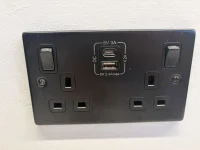
Fitted couple of these click usb on the kitchen ring and rest were standard plug sockets.

She has been plugging into the click USB and also standard plug socket (using USB to 13amp adaptor.)
Both taking around 2 hours.

We did test once completed and all ok, didn't note the voltage though !
I suspect the charging time experiment may not have been conducted under sufficiently controlled conditions (logging start and finish battery levels, app activity, signal strength for wifi and 4/5G etc. etc) There may not actually be such a problem 🤔

Agree, don't really want to be going back there and pulling all the plug sockets off if can help it.
 
Fitted couple of these click usb on the kitchen ring and rest were standard plug sockets.
That's useful to know. That Click USB charger delivers a fixed 5V. Helpful to be able to plug in USB C, but it doesn't do Power Delivery charging, ie have the ability to increase the voltage to reduce charging time.
So the question is - what phone charger is she using? If that is PD capable it is quite likely that her charger, plugged into the 13A socket, could charge her phone quicker than plugging the phone lead directly into the USB C.

Is it possible the message has got confused, and that "It's slower in the kitchen" just means she's found it's 2 hours with the phone cable plugged into USB C, and sort of assumed that's the case for the adapter as well?

I might be completely wrong with my suggestion, but if I'm not, this Click model (which is supposed to do fast charging) might help if the situation escalates.
 
I have used similar, it sits between charger and device being charged.
 
@James don't suppose you've used one of these have you ?

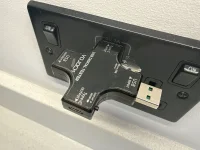
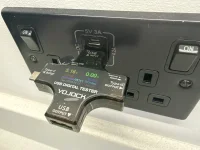
Got mine today not sure faulty !
Bad luck! I bought one and it seems to work fine. Indicates PD voltage, current and power. Confirms my Ipad moves within a few seconds from 5V to charging @9V 2A from our spare generic but dubious PD charger 👍
 
Bad luck! I bought one and it seems to work fine. Indicates PD voltage, current and power. Confirms my Ipad moves within a few seconds from 5V to charging @9V 2A from our spare generic but dubious PD charger 👍
maybe it's just me !

Still sussing it out.

So if plug directly in to A port of usb plug socket - display lights up showing volts
whereas if plug into the C port nothing comes up. Only way to get reading is plug a load in on other side 🧐
IMG_3201.webp
IMG_3200.webp
IMG_3199.webp
IMG_3201.webpIMG_3200.webpIMG_3199.webp
 

OFFICIAL SPONSORS

Back
Top