HappyHippyDad

~
Arms
Supporter
I have just been to a chaps house to find out why some of his 12v downlights are not working. 4 in total were not working, 2 turned out to be just bulbs but he didn't feel too silly as the other 2 were due to the damaged terminal blocks between the transformer and light (see pic)

I checked all other terminals on the other downlights and all are fine.

What would cause this?

It was difficult to tell if the screw was tightened firmly against the conductor but I believe it was, also they are 5A terminal blocks so should be able to take the current easily?
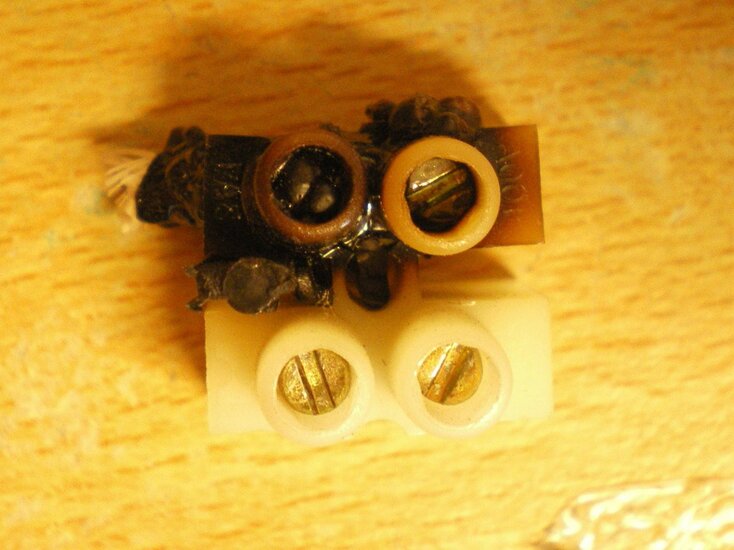
terminal.jpg
 
common fault. heat from the halogens causes expansion so even if the terminals were tight to start with, they slacken over time. also, cheap choc blocks, running at close to 5A. gthis is why screw terminal JBs are no longer allowed where they are inaccessilble.
 
By the look of what is left of the connecting cable its seems to be fine wire thus is required to be crimped or an appropriate connector designed for fine wire.... this is what happens when you don't crimp as the delicate strands breaks when tightened on or strands ride up the side of the screw rather than been clamped.... i hope your replacement repairs where crimped or you are using designed pressure clamp terminals for fine wire.

Agree with Tel also regarding the current demand over long periods is close to the connectors rating hence any shortfall in the terminations usually results in your burnt out connector.
 
Thanks for all the replies guys...

By the look of what is left of the connecting cable its seems to be fine wire thus is required to be crimped or an appropriate connector designed for fine wire.... this is what happens when you don't crimp as the delicate strands breaks when tightened on or strands ride up the side of the screw rather than been clamped.... i hope your replacement repairs where crimped or you are using designed pressure clamp terminals for fine wire.

Agree with Tel also regarding the current demand over long periods is close to the connectors rating hence any shortfall in the terminations usually results in your burnt out connector.

Thanks Darkwood. Even though I wasn't sure why this had happened I thought it silly to just put it back in similar terminals as the same thing may happen again so I used the wago (lever clamp - rated at 32A - for stranded 0.08mm-4mm) and then into some choc blocks.

ps..It was in the loft
 
As Dark says, ferrules and clamping terminal block are the way to go. Most of the rubbish supplied with the majority of fittings need binning in my opinion.
If you don't have a selection of decent bootlace ferrules and crimping pliers, then your toolkit's not complete as far as I'm concerned!
 
Thanks for all the replies guys...


Thanks Darkwood. Even though I wasn't sure why this had happened I thought it silly to just put it back in similar terminals as the same thing may happen again so I used the wago (lever clamp - rated at 32A - for stranded 0.08mm-4mm) and then into some choc blocks.

ps..It was in the loft

so make sure that the itchy-poo is pulled away from the fittings. that's usually half the problem.
 
By the look of what is left of the connecting cable its seems to be fine wire thus is required to be crimped or an appropriate connector designed for fine wire.... this is what happens when you don't crimp as the delicate strands breaks when tightened on or strands ride up the side of the screw rather than been clamped.... i hope your replacement repairs where crimped or you are using designed pressure clamp terminals for fine wire.

Agree with Tel also regarding the current demand over long periods is close to the connectors rating hence any shortfall in the terminations usually results in your burnt out connector.

Is this a particular problem with 12V lighting then? if it had been 230V the current running through that terminal block would only have been around 0.2A, but as it was 12V the current was around 4.2A? (light was 50W)
 
Yep, good old Ohms law. Voltage goes up and current comes down. Assuming same power, temperature, height above sea level, etc. And higher current obviously causes more problems whenever it tries to pass through poorer connections. Daz
 
as we used to say in scouseland... eggsakkly.
 
Yep, good old Ohms law. Voltage goes up and current comes down. Assuming same power, temperature, height above sea level, etc. And higher current obviously causes more problems whenever it tries to pass through poorer connections. Daz

Well I dont think much of the safety of 12V lighting then! I guess you wont die from an electric shock just a fire instead!!Thats a bit tongue in cheek.. I suppose the answer is as guitarist said, you use good quality materials terminated correctly.
 
Well I dont think much of the safety of 12V lighting then! I guess you wont die from an electric shock just a fire instead!!Thats a bit tongue in cheek.. I suppose the answer is as guitarist said, you use good quality materials terminated correctly.

It's not just 12V lighting to be fair. Any high current device is susceptible to this - showers, immersions, cookers, etc. Daz
 

OFFICIAL SPONSORS

Back
Top