Greetings.

I was working in next doors garage and decided to remove the lamps from one of his twin 70 Watt fluorescent garage lights.
I left the lights on as there are a pair of identical lights so I could see what I was doing.
IE the light from the other lamp at the other side of the garage would help me see what I was doing.

I removed one of the long six foot tubes and bang.
The circuit breaker tripped and the ballast was ruined.

I didn't realise these electronic ballasts were so delicate, I mean all I did was to remove a tube while the power was still on.
What do you think happened?
The ballast is designed to run two six foot tubes and the thing blew when I removed one of these six foot tubes.

I have ordered another ballast from Ebay, made in Austria, so I should be able to cover my tracks. :lipsrsealed2:
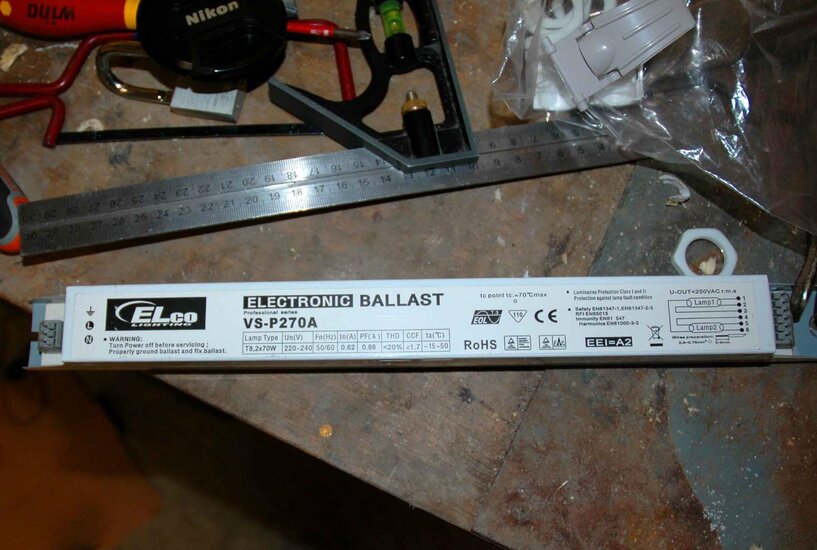
 
I dont think i would be happy to fit any part not bought in this country,you should be able to pick up a like for like ballast at any wholesalers.
 
I don't know why removing a tube would blow the ballast. What type is it, is it HO or VHO?
 
Greetings.

I was working in next doors garage and decided to remove the lamps from one of his twin 70 Watt fluorescent garage lights.
I left the lights on as there are a pair of identical lights so I could see what I was doing.
IE the light from the other lamp at the other side of the garage would help me see what I was doing.

I removed one of the long six foot tubes and bang.
The circuit breaker tripped and the ballast was ruined.

I didn't realise these electronic ballasts were so delicate, I mean all I did was to remove a tube while the power was still on.
What do you think happened?
The ballast is designed to run two six foot tubes and the thing blew when I removed one of these six foot tubes.

I have ordered another ballast from Ebay, made in Austria, so I should be able to cover my tracks. :lipsrsealed2:

why did you decide to remove the lamps
 
Because I needed to drill a small hole in the plastic housing as an entry point for some 20mm flexible plastic conduit.

I know I'm going to get flamed here for not isolating the lamp but I needed the other lamp to see what I was doing.

Basically you can remove the body of the lamp that contains all the electronics with two clips, hold this body in one hand, drill your hole then snap it all back into place again without switching the power off.

The lamps are temporarily wired as I am constructing a rather elaborate conduit system.
Once the conduit system is finished all the lights will be wired in singles within the conduit but right now they are temporarily surface wired from the fuse board.

I know it's not text book but it seemed the easiest way.

working live eh!! weve all done it,:ninja: was just wondering why you removed the lamps as it wasnt clear,seemed you just fancied removing some lamps for something to do..:p
 
theres a man called alan lynch part p doctor talks about sparks like you... weve all dont it... probably cheaper and handier buying new fitting.. about 8 quid
 
Hi La Poste, Most electronic ballasts do not like being driven without a load i.e. tube(s) disconnected. The better quality units, Osram for instance, have protection circuitry built in which prevents catastrophic failure of the electronics in such conditions. Disconnecting one or more tubes with the ballast powered causes the stored energy within the ballast to seek an alternative discharge path "punching through" the driver transistor semiconductor junctions and in the process destroying ballast output circuitry.
 
An old 4 or 5 foot floury on a 10 metre flex and plug top be a vital tool for you in the future La Poste, trust me.
 
This just gets better, check this out.

I fitted a movement sensor to a part of the garage so that when the owner drives in the lights will come on automatically, it has a manual over ride.

I also fitted a small 5 foot dual bulb fluoro above his work bench inside.

Now I switched on the light above the work bench and I heard this clicking sound so I went outside to investigate.

I went outside and noticed the Fluoro attached to the movement sensor going mental, it was switching on and off at a really fast speed and I thought OH NO what have I done.

I tried all different switch combinations and checked the wiring and nothing, the problem still persisted. Then I had a brain wave.

I have a spare Tridonic ballast so I fitted this to the light above the bench and took out the manufacturers ballast, problem solved.
It seems the manufacturers ballast was emitting some sort of radio frequency that was being picked up by the PIR and making it dance a merry tune.

I breathed a sigh of relief and am now drinking a beer, I have never seen anything like this before.
 
Last edited:

OFFICIAL SPONSORS

Back
Top