M

mike915

Hi, I'm mike, I was reading this forum and others, but i get confused because someone say that more resistance means more heat, others say that less resistance means more heat and others say that it depends on the amps. So i get confused.
I know only a very few things about electricity, so i wanted to clear my doubt.
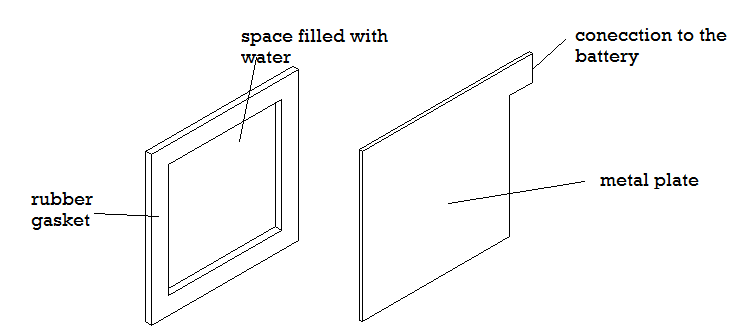
The reason of this question is that I'm working on a personal project related with electrolysis. the device are two metal plates separated with a gasket in which between is some water, each plate has a connection to a battery, one to positive, the other to the negative, so what i wanted to know is the thickness of the plates and of the gap between them (in which is the water). It is going to be running at a constant amperage and voltage.
Here is a drawing I hope you could help me. Thanks a lot!!
ejemplo.png
 
if you studied physics at school you will know the answer not complicated just ohms law
 
There's a lot of variables that will effect the resistance of your circuit. Pure distilled water is a very poor conductor so there will need to be an impurity such as salt to act as an electrolyte. The concentration of the electrolyte will determine the resistance far more than a small variation in the distance between the plates. This concentration will also be difficult to control and keep constant so your current in the circuit is likely to vary wildly unless you use some kind of voltage control to limit it. Be careful that the water doesn't boil if you just connect a battery to the plates directly, the closed cell with the gasket around it could explode if the temperature gets too high.
 
There's a lot of variables that will effect the resistance of your circuit. Pure distilled water is a very poor conductor so there will need to be an impurity such as salt to act as an electrolyte. The concentration of the electrolyte will determine the resistance far more than a small variation in the distance between the plates. This concentration will also be difficult to control and keep constant so your current in the circuit is likely to vary wildly unless you use some kind of voltage control to limit it. Be careful that the water doesn't boil if you just connect a battery to the plates directly, the closed cell with the gasket around it could explode if the temperature gets too high.

Well, this is a very simple example, the real device is far more complex, I only posted the simplest form of it to explain it to you, the water is a mix of distilled water and KOH (potassium hydroxide), also the plates are drilled to let the water flow and the gas scape to a reservoir, and it is made a structure of many plates, the voltage is controlled by an electronic device.
So you think that the distance between the plates wont make much difference??, what about the thickness of the plates??. What I'm trying to realize is only the aspect of heat for now, taking into account the thickness and separation of the plates.
Thanks for all your help!
 
I take it that you are intending to plate potassium onto one of the plates?
Or are you making some kind of fuel cell?
 
Last edited by a moderator:
if you studied physics at school you will know the answer not complicated just ohms law

Another waste of time/ignorant/superior than thou answer to the OP. Same old clever clog replies, and by too many.
 
Well, this is a very simple example, the real device is far more complex, I only posted the simplest form of it to explain it to you, the water is a mix of distilled water and KOH (potassium hydroxide), also the plates are drilled to let the water flow and the gas scape to a reservoir, and it is made a structure of many plates, the voltage is controlled by an electronic device.
So you think that the distance between the plates wont make much difference??, what about the thickness of the plates??. What I'm trying to realize is only the aspect of heat for now, taking into account the thickness and separation of the plates.
Thanks for all your help!

The distance between the plates will effect the current in the circuit, just possibly not as much as other factors such as electrolyte concentrations in the solution and maybe deposits build-up on the plates etc. I doubt the thickness of the plates will make much difference but obviously the surface area of the plates would.

Heat produced will be both electrical and chemical so it won't be straight forward to predict. Actual temperatures within the cell will also be relative to the rate of heatloss from the system which makes for even more complex calculations. I doubt you'll get the info on this forum either, it would be as much a chemistry and thermodynamics answer as an electrical one. I would research the enthalpy of bond association and dissociation with regard to KOH. If this is just a home experiment I'd suggest some controlled experiments would give you the best indication, if it's a commercial/professional venture then you'd be better off seeking professional assistance with these types of calcs. You haven't given us much in the way of background info so it's difficult to assist further.
 
Well Thank you Marvo for your help. I think, as you said, it is a problem more focused to chemistry or thermodynamics, I will ask in a chemistry forum. Thanks. :smile5:
 
Lol, if it is a homework question I actually feel sorry for him. I had a 2 year brush with enthalpy in my university days and it was something I never fully got to grips with.
 

OFFICIAL SPONSORS

Back
Top