Currently: a detached garage used occasionally as a woodshop with a range of machinery. Only one user. Garage is 25m from CU. Currently supplied with one double socket which is a spur from the ring final. Lighting (3A max) comes off this too. Draw from this source <18A.
CU has a old unused cooker radial with a 32A Type B MCB. 4m of 6mm in plaster from CU, terminating in an accessible junction box.

Requirement: Two new bits of kit brought in from 'proper' workshop have upped power requirements. Do not want a permanent (i.e. expensive) solution, as this shop is only used temporarily. New equipment needs a 16A supply (bandsaw with high startup current but only 1.8kW running) and another item drawing 10A running together. Possibly another item used at the same time, but total new supply required is about 25A.

Possible solution: Change to a 32A type C MCB. Install a 32A 2P+E surface outlet at junction box in house and in garage. From 32A outlet in garage, connect a 16A outlet for saw and a 13A double socket using 4mm T&E in conduit and metal-clad 13A outlet. When power is needed, use a dedicated 32A 25m extension cable (not from Screwfix: a proper waterproof industrial one) to connect the 32A outlet from the cooker radial to the 32A outlet (used as, essentially, an 'inlet') in the garage.

Would this work, and is it fully safe? I do not want to install a permanent new supply, but equally I'd like something a bit more robust than trailing extension leads all over the place, and cutting the 16A plug off the bandsaw and replacing it with a 13A one (which is quite common, it seems, and no tripping occurs).

Would be grateful for your not answering if your answer is going to be 'get an electrician'. Thanks.
 
TL;DR
Non-permanent supply to garage repurposing cooker radial using 32/16A outlets and extension lead.
Sorry but, what you are proposing sounds like a dangerous bodge.

You can buy or hire electrical distribution equipment for temporary installations, commonly used for festivals, markets, concerts etc.
It is well built and designed to be used and packed away many times a year. It will have the right protection devices and suitable plugs and sockets etc.

The old cooker supply may not be suitable as it is unlikely to have rcd protection.

I have no doubt that you have the knowledge and skills required to make it work, however only you know if you can make it safe.
Thank you for trying to help - appreciated. The temporary distribution equipment idea is a good one - thanks. I'll look into that for price. Regarding the current arrangement, the cooker supply is RCD protected, and the whole installation was checked not that long ago.

Basically, you're right to say it's a bodge, and being frank I'm looking for a bodge: what I want is a safe bodge, which I don't think is necessarily a contradiction in terms.

These two items could just be plugged into the existing double 13A outlet, or alternatively plugged into 'normal' 1.5mm extension leads from other outlets in the house. I doubt anyone would say 'get an electrician' for that (actually, having read this forum for a bit, someone probably would...) and, in general terms, plugging it in this way would be 'safe'. However, I'm aiming to take some of the load of the ring final, particularly given the spur into the garage is already at the furthest point from the CU. It seemed to me that using essential a 25m glorified extension lead from a repurposed RCD-protected 32A radial was safer than loading the ring final further. The analogy I could think of was a caravan/motorhome hookup, albeit 32A rather than 16A. I was also thinking of adding an inline 10mA RCD between the saw and outlet and having the Zs tested from this outlet.

I know no-one would want to definitely say 'yes this is safe', or 'no, this is not safe', but what I'm asking really is whether there is something really obvious which I've overlooked? The expected maximum load, voltage drop, circuit protection arrangements and terminations all seem appropriate - but I'm not an expert.

Thanks.
 
Last edited by a moderator:
Possible solution: Change to a 32A type C MCB. Install a 32A 2P+E surface outlet at junction box in house and in garage. From 32A outlet in garage, connect a 16A outlet for saw and a 13A double socket using 4mm T&E in conduit and metal-clad 13A outlet. When power is needed, use a dedicated 32A 25m extension cable (not from Screwfix: a proper waterproof industrial one) to connect the 32A outlet from the cooker radial to the 32A outlet (used as, essentially, an 'inlet') in the garage.
The fact you are asking in the way you have does kinda point to suggesting an electrician as you have lost me a bit in you idea, however you are suggesting steel conduit which sways one the other way.
In essence adding a 32A ceeform socket (outlet) many will say not permitted in a domestic situation as they are not shuttered. Some will say an interlocked socket is ok, such as screwfix 6423F.
Using a type C MCB is only possible if the testing allows it
I don't follow why you mention another 32A outlet in the garage which is then connected to a 16A outlet, somewhere in there should be suitable over current protection. I assume you are not suggesting a cable with 2 plugs to feed a socket? There is a reason we call them 'widowmakers'. If this is your suggestion, why not use a proper inlet such as screwfix 825JR
Or you could get a small CU such as 599XF another MCB (22963) and connect your 4 or 6mm flexible cable directly into there instead of using an inlet.

How long are you anticipating the 'temporary botch' to be in place for?
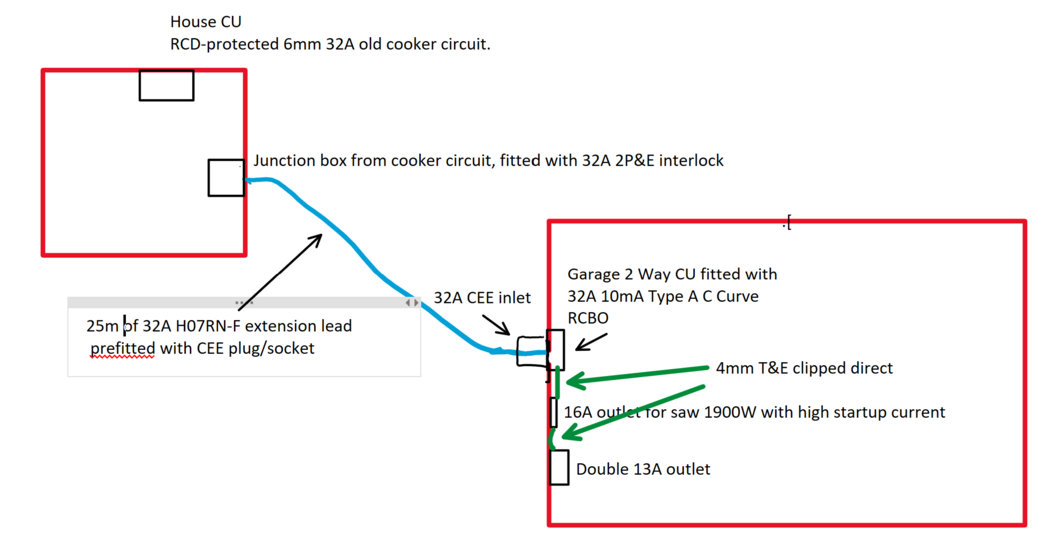
Thanks for replying. Yes, this was what I was thinking of doing, but I obviously didn't explain it very well in the text. Please see diagram attached for what I'm proposing to do. It is, essentially, a caravan/motorhom hookup, with the garage acting as the van and the house acting as the EHU point.

It's long-term temporary, if that makes sense. Used very infrequently, but in place for a long time so it's available when required - hence the desire to make it as safe as possible. A permanent installation is not possible.
 

Attachments

  • Screenshot 2025-12-15 121840.png
    Screenshot 2025-12-15 121840.png
    146.2 KB · Views: 11
Any temporary installation needs to be fully compliant, we know from experience that so called temporary installations turn out to be more permanent, by classing it as temporary it would need very frequent inspections
 
Any temporary installation needs to be fully compliant, we know from experience that so called temporary installations turn out to be more permanent, by classing it as temporary it would need very frequent inspections
Indeed, I helped a friend move house and the only place their fridge/freezer would fit was in the shed, I left an extension lead, a very long orange ribbed 2.5mm lead, rather lovely to handle like the old TRS cables. Thoughts of the kitchen remodelling faded when a growing tummy changed their plans to adapting the 2 bedrooms to 3. Eventually the shed was demolished and replaced with a rather lovely log cabin to become the office when he worked from home. The bump went to university, retirement kicked in and downsizing I was offered my extension lead. 20 years of laying in a flower border had turned it light grey but the first 10-15m was still in remarkable condition so shortened it and then to my shame I used the grey bit for temporary ELV garden bollards for a BBQ. The bump is 32, and the cable is still delivering ELV to the bollards with parts buried under paving slabs and turf.
 
Thanks for replying. Yes, this was what I was thinking of doing, but I obviously didn't explain it very well in the text. Please see diagram attached for what I'm proposing to do. It is, essentially, a caravan/motorhom hookup, with the garage acting as the van and the house acting as the EHU point.

It's long-term temporary, if that makes sense. Used very infrequently, but in place for a long time so it's available when required - hence the desire to make it as safe as possible. A permanent installation is not possible.
It will need a 16A over current protection device for the 16A socket but I'll leave the details to those better qualified to answer.
 
It will need a 16A over current protection device for the 16A socket but I'll leave the details to those better qualified to answer.
Thanks - I thought that might the case. I plan to put a 16A 10mA type A DP C curve RCBO on the saw and a 20A 30mA type A B curve DP RCBO on the double 13A outlet.
 
Last edited:

OFFICIAL SPONSORS

Back
Top