newfutile

~
Arms
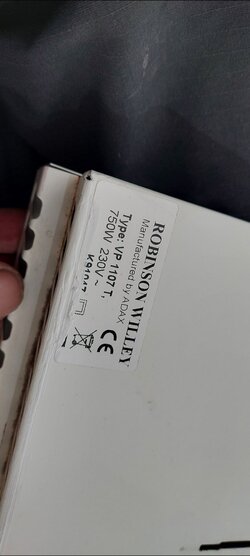
During an EICR the heater cases were found not connected to earth and only had 2 core cable, they do have a double insulated label on them, is this acceptable, they are fed by mcb with no rcd.
 

Attachments

  • Screenshot_20220827-095934_Gallery.jpg
    Screenshot_20220827-095934_Gallery.jpg
    146.9 KB · Views: 74
I remember several years ago getting involved in a dispute over some De'Longhi convector heaters failing a PATest on earth bond. Like yours they were deemed to be Class II and it was argued the powder coating acted as insulation which I proved to be insufficient. Can't remember the outcome but the chances of something like this being Class II to me is somewhat optimistic.
 
Only a flash test can absolutely confirm double insulation or not in the absence of any other information
Agreed. But this will have been confirmed at the point of manufacturing, and included in the declaration of conformity.
Flash testing by an individual carrying out ISITEE is not required or recommended:

"common in PAT testing up until the IEE Code of Practice 2nd edition was published in 2001. On page 27, paragraph 10.4 it said “Dielectric strength testing is not normally carried out during in-service testing. This is normally carried out by the manufacturer on a complete appliance after assembly”. Page 48 paragraph 10.5 of the new Code of Practice 3rd edition also re-states this; thus flash testing is not normally done now."
 
No dielectric testing can be destructive and is carried out randomly at quality control by the manufacturer. A sample is taken and if it passes then all those between that and the last test are deemed okay, if it fails then all those between that and the last test are removed and further inspected.
 
Agreed. But this will have been confirmed at the point of manufacturing, and included in the declaration of conformity.
Flash testing by an individual carrying out ISITEE is not required or recommended:

"common in PAT testing up until the IEE Code of Practice 2nd edition was published in 2001. On page 27, paragraph 10.4 it said “Dielectric strength testing is not normally carried out during in-service testing. This is normally carried out by the manufacturer on a complete appliance after assembly”. Page 48 paragraph 10.5 of the new Code of Practice 3rd edition also re-states this; thus flash testing is not normally done now."
I never agreed with the flash testing when doing ISITEE when it first came in and saw it as a way of prematurely degrading equipment, the HAE advocated at one point that all hired equipment should be flash tested after every hire, I always remember the argument I had with the HAE rep / assessor at a hire shop were a couple of mates worked he was adamant it needed to be done and I was arguing the opposite and that the only time it needed to be done was after a machine was stripped down, repaired and reassembled shortly after that the HAE lost a member
The problem / challenge these days is identifying the copy / fake equipment and / or labelling and whether you should take the label as a true and accurate confirmation of it's safety
 
We used to work for a hire company and everything was flash tested. Anything the manufacturer flash tests is not sold but kept or recycled.
 

OFFICIAL SPONSORS

Back
Top

