So that's where the 1.414 comes from! I never realised it's the square root of 2!
The inverse being 0.707
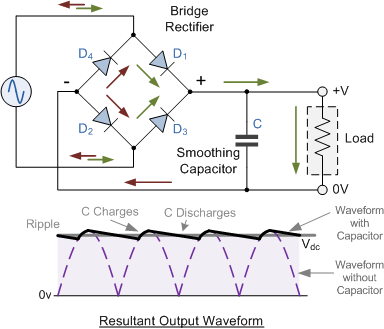
Still a bit confused though, is the RMS from the output of the bridge rectifier still 230v? Or does RMS not apply to DC? Meaning it could be called 325v rippled?
For full wave rectification the mean value is the RMS value, you will start to get near peak value if you start to introduce capacitors.
Somewhere I've got some drawings that may help. Somewhere being the operative word!
For three phase chuck RMS out of the window! It gets nearer to peak voltage.
ok read post again, found pic on google have a better one somewhere makes a bit more easier for lamen. done btec electronics before realising wasn't for me so took electrical a long long time ago more electronic questions for a change but not too difficult please.
for information RMS (root mean squared) is used in AC because it relates to an amp per volt that will acheive the same heating effect as 1 amp per volt in a DC system.
Im trying to find a link for this, as its something i covered in college years ago.
I've just completed a spreadsheet to calculate it.
It can be used for waveforms other than sine, also ripple and superimposed waveforms such as rectified 3ph.