D

DaveS

Hi all

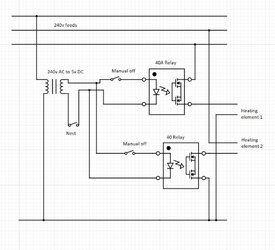
Have had a request from customer that would like their immersion heater controlled via a Nest. It has standard 2 elements and is not on Economy 7. My initial suggestion was to just put in on a Horstmann timer but he is adamant would like it on Nest, has bought the bits already including relays. My thoughts we're that this would require 2 nests to control both elements individually and would become convoluted and impractical. In all honesty he seems to have quite a bit of electrical knowledge......maybe a bit more than me in regards relays and nests. He has previously set up a standard electrical heater in similar fashion with a relay. He sent me the attached drawing of how he proposes the Nest to be wired, my question is, is this feasible and are there any glaring errors that would make this impractical to be used with a Nest and immersion with 2 elements?

Many thanks for any clarification on this
 

Attachments

  • IMG-20220327-WA0007.jpg
    IMG-20220327-WA0007.jpg
    97 KB · Views: 312
Heating element 2 appears to have a switched neutral which is a no no, and I would use contactors rather than relays. Definitely ditch the 5v supply... the Nest should be capable of switching 230v (3A max which should be ample for a coil or two).
 
It would be more conventional to switch the live to both elements rather than live to one and neutral to the other. If they are fed from separate circuits the neutrals should also be separate and not commoved as they are in the drawing.
 
Heating element 2 appears to have a switched neutral which is a no no, and I would use contactors rather than relays. Definitely ditch the 5v supply... the Nest should be capable of switching 230v (3A max which should be ample for a coil or two).
They are 40A solid state relays which will be more than capable for this task (and silent!). I agree it would have been simpler to use solid state relays with 240V input to save on the need for a transformer.
 
Where are the thermostats for the elements? Nest in this application is simply acting as one big remote switch
 
They are 40A solid state relays which will be more than capable for this task (and silent!). I agree it would have been simpler to use solid state relays with 240V input to save on the need for a transformer.

I know and I agree with the reasoning in general (their silence), just personal preference (mainly due to double pole switching and less chance of an explosive finish if a contactor fails).
 

OFFICIAL SPONSORS

Back
Top