B

Buzz1980

Hi All

Wondering if anyone can point me in the right direction regarding uk double sockets. Is there a reg or a British standard that manufactures have to stick with. As if my memory serves me right most double sockets will handle 20amps of load for long periods without causing any issue but is this for all sockets as standard. As currently have 1 of 2kw heater and 1 of 2kw sand blast machine plugged into a double socket. So pulling 17amps through the double socket just need to know if all sockets are rates for 13amp in total or is it 20amp s in total ?
 
The standard is BS1363.
You're correct in saying that a double socket is generally rated at 20 amps, though this may vary between manufacturers.
 
My immediate response was to say "20A", as I believe type testing of the product involves taking 14A from one socket and 6A from the other (simultaneously) for 6? hours, which is probably where the 20A comes from.
But many basic twin 13A sockets now seem to be 'rated' (ie in their spec and stamped on the back) at 13A total.

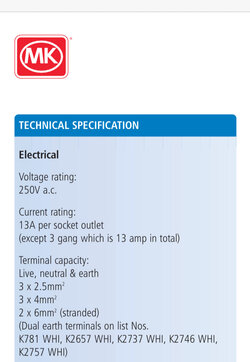
However the spec for MK metalclad twin sockets says 13A per socket outlet, so the answer would be to fit one of those!
 
Thanks for the responses guys much appreciated. So if I had a load of 8 amps through each side of socket will be all good then as standard 13amp doubles should handle 20amps ?
 
Are 13amp double sockets good for 17amps between the two outlets ?
If made by MK, yes!
FB89F9E2-1E9D-4460-BEA2-A144DDAC63FF.jpeg
 
Last edited:
Ok no probs. Surely a standard double socket should be able to handle 17amps continuous load only 4amps above a 1gang socket which is rated for 13amp?
 
Ok no probs. Surely a standard double socket should be able to handle 17amps continuous load only 4amps above a 1gang socket which is rated for 13amp?
Not all 13A sockets are the same. They are all designed to meet the standard, but differences in design approach and the materials used mean some have better contacts (ie more robust connections) between the mating parts, the switch contacts, and the terminations for the cables. And some age better over time than others (as in don't develop poorer contact).
So I wouldn't venture to guess whether your brand new or 20 year old socket of unknown manufacture is up for the job or not.
If you're there all the time to keep an eye on it, just plug in your loads and see what happens - check regularly that it's not getting hot, especially after an hour or two. I don't mean a few degrees above ambient, but distinctly warm to the touch.
Quite useful to pull the plug out after a while and feel the pins! (NB if there's a suppressor in the equipment, this is a good way of sometimes getting a shock - maybe short L&N pins first!)

If you are in the workshop all the time it's on, that's perhaps less of an issue than leaving it on unattended!

Personally I'd be putting the heater on a different socket from the sand blasting machine, even if that meant wiring another (single?) socket into the ring somewhere.
 
Last edited:
IME the biggest problem with overheating sockets comes from one high load appliance approaching 13A, rather than two medium loads. The part most likely to overheat due to high combined load is the busbar serving the two switches, as this must take the dissipation of the two switch contacts. But it is much more common to see a burnt out socket contact where a dryer or similar high-load appliance has been used, than one with all female contacts intact but a burnt switch or busbar assembly (except where the wiring terminal has been left loose).

That said, @brianmoooore has the right approach for anything marginal on a double.
 

OFFICIAL SPONSORS

Back
Top