Hmm...British Leyland
Yep...good old British Leyland
My statement was meant to be tongue in cheek. To be fair, the other British made cars of the same period were equally comparable.

Recall my Morris Marina, became a top spec item, when I added a silver foil stick on heated rear window element, think it made it go faster. My brothers first car was a Hillman Imp, rear engine.

Down fall of BL came with the rise of 'Red Robbo', Michael Edwards and the collaboration with Honda and the Triumph Acclaim.

All those good marks MINI, Jaguar Land Rover remain with foreign ownership. Wonder if those other marks of Wolsey, Austin, Morris etc would be here now in some form if it hadn't been BLMC
 
I look after a few pieces of plant from the 1930s still serving their original purposes in their original location. The oldest wiring still in service on any sites that we maintain, other than DNO-owned PILC service cables, is from c. 1928.

We did have an interesting project on the go until early last year, restoring probably the oldest complete electric-action pipe organ in the UK. 'Electric action' means that the keys, stops and other controls on the console operate contacts rather than pneumatic valves or mechanical linkages. These control electromagnets in the organ windchests and apparatus, including relays, binary logic and even electromechanical memory devices. Most of the 700 electromagnets and much of the switchgear in this beast were made in 1901, while the remainder and much of the wiring were fitted in 1923 which was the last time it was expanded. Because of its historic interest and the generally good condition of the 115 year old silk-covered coil windings and 103 year old cotton-covered wiring, we intended to retain all the original material, replacing only a few parts too badly damaged to repair after eight decades of use and three decades of disuse.

We ran a pilot project, restoring a small section to prove it would work reliably, which it did without a single snag, and gave a successful demonstration of just how well the repaired parts worked (and even much of the unrestored part worked fairly well). But sadly, less than two weeks after the main project began, the building was destroyed by fire. The pipes and windchests were already offsite so they survived, but most of the original wiring and switchgear was lost, along with the claim to be the oldest original electric action in full working order.

BAC_281108_consoleobliquefront.jpg

BAC_281108_relay2octavesfront.jpg

BAC_281108_relaywiring.jpg
BAC_281108_consolerhtestbd.jpg
 
But sadly, less than two weeks after the main project began, the building was destroyed by fire. The pipes and windchests were already offsite so they survived, but most of the original wiring and switchgear was lost, along with the claim to be the oldest original electric action in full working order.
Hope the cause of the fire wasn't an electrical fault :eek:
 
Hope the cause of the fire wasn't an electrical fault :eek:

No, none of it was energised at the time and we weren't in the building, a fire started in the roof and spread thoughout this wing of the building. Some had recently been rewired and the remainder was about to get done - Sintra was running the E+M side of the job so his project took a bit of a change of direction too.
 
No, none of it was energised at the time and we weren't in the building, a fire started in the roof and spread thoughout this wing of the building. Some had recently been rewired and the remainder was about to get done - Sintra was running the E+M side of the job so his project took a bit of a change of direction too.
I was only joking, but I can understand you making things clear. :-)
 
No, none of it was energised at the time and we weren't in the building, a fire started in the roof and spread thoughout this wing of the building. Some had recently been rewired and the remainder was about to get done - Sintra was running the E+M side of the job so his project took a bit of a change of direction too.

It's a great pity lucien when stuff like that is lost
 
No, none of it was energised at the time and we weren't in the building, a fire started in the roof and spread thoughout this wing of the building. Some had recently been rewired and the remainder was about to get done - Sintra was running the E+M side of the job so his project took a bit of a change of direction too.

Still on that job. It'll be 2 years next month but we've managed to complete most of our works on the undamaged section of the building. It's been a grind but it's nearly done, hopefully in another 4 or 5 weeks we'll be complete. The only burning question pardon the pun is if we will get the works to redo the damaged grand hall.
 
Worked in plenty of churches but the oldest wiring I have seen still in was in a factory in Bath about ten years ago. Throughout the basement store rooms pairs of VRI conductors were strung across the ceilings on ceramic cleats. Thought nothing of it until I tested the lighting circuits down there and realised they were still live!
 
20151202_105656.jpg
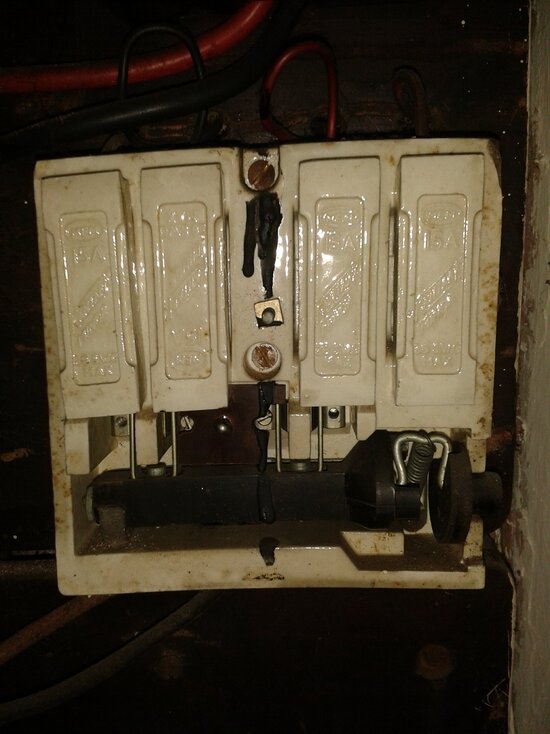
20151202_105656.jpg Switch fuse with fused neutrals supplying lighting in a shop, as you can see it can be opened whilst energized because the switch doesn't function.
 
A mere 60 years old but also nearly 100% original and still in full time use, I think I posted about part of this on one of my puzzle threads a few years back. It's a 7hp Ward-Leonard variable speed drive on a Swiss-made horizontal borer. The MG-set is a long thin unit comprising an induction motor, DC generator, exciter and cross-field amplifier machine all on one shaft running at 2900 rpm. The output to the spindle motor is something like 0-270V DC at 0-65A, controlled using voltage feedback via a magnetic amplifier driving the Metadyne, which in turn drives the main generator field. Allied with two mechanical gears, the spindle speed range is around 60-3000 rpm in either direction with full torque at all speeds

Inverter drives might be smaller, quieter and more energy efficient in the midrange but at low speeds these old DC drives massively outperform them as they maintain full torque all the way to zero. Without any mechanical brake, the spindle locks rigid when stopped because the servo generates an opposite torque to resist any attempt to alter the speed (from zero). With great effort I can just about get the chuck to budge a little at a time, and the same applies to any variation in target speed when running.

Plus there's a sense of ceremonial importance that you don't get with a VFD - you press the converter start button, that spins up, you hear it switch to delta, the DC contactors switch to standby and the big red light comes on meaning control system ready for you to start the spindle motor...
Control cabinet.jpg
DC drive motor.jpg
MG set labelled.jpg
Controls.jpg
Part of speed control.jpg
 

OFFICIAL SPONSORS

Back
Top