D

Dan_swx

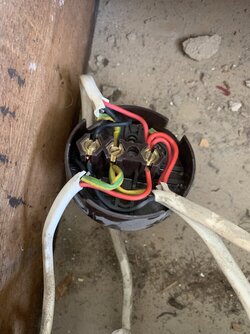
I have recently moved into a house and am giving it a full refurb. The wiring in one of the rooms has me stumped! I found a junction box under the floorboards and found that the only plug socket in the room was spured off this too (now removed).

The two wires on the right go one direction into the room (one through a wall into another room and not sure on the other) and the two on the left come from outside the room (they do no enter the room together and come from different directions).

Can anyone help me find the wiring loop so I can extend it and add a few plug sockets to it safely.5F1917CE-229D-4B75-9D86-E52DA69814EA.jpeg
 
Last edited by a moderator:
without being able to test the cables to find out which are the ring and whether or not you have 2 spurs or even if the ring is compromised in some way, it's impossible to advise, apart from call in a competent electician.
 
What type of circuit is this supposed to be? Ring or radial?

What do you mean exactly when you say 'wiring loop'?

It would be best to wait for the competent electrician who is doing the electrical work for the refurb to sort it out.
 
Could also be a spider ring (search on here) where every socket is spurred from a junction box under the floor. Common in some older houses.
 
Could also be a spider ring (search on here) where every socket is spurred from a junction box under the floor. Common in some older houses.

Thanks everyone for the rely, I think this is exactly what I have. There was another socket on here attached to this too.

I’m now down to three cables going into the Junction Box, I know one is the ring but not sure on the other two as yet.

Is there a simple way to tell?
 
Last edited by a moderator:
What are you actually trying to achieve by keep disconnection the cables ?

is this part of a future rewire job or as you say just to add a new socket ?
 
What are you actually trying to achieve by keep disconnection the cables ?

is this part of a future rewire job or as you say just to add a new socket ?
I’m trying to add more plug sockets into the room and relaocate them at the same time. I have done this in other rooms with ease but this setup has me stumped!
 
Sometimes is it easier to just put in a new circuit, rather than extending and relocating the bits of the circuit you have. Then you can have any joints at accessible sockets etc.
 
As above, a competent electrician is needed here. Bear in mind also that any non accessible junction boxes need to be of the MF variety.
 
Just to expand on DPG's comment: Here MF = maintenance free, a type of connection (and matching box) that is designed not to loosen with time/vibration/thermal cycling. If you search on various sales sites you will find ones meeting this. Usually this is a spring-loaded type that maintains pressure, where as screws run the risk of loosening over time and are more likely to be too tight or too loose if you don't have experience or a torque screwdriver (and actually use it, not just leave it in the cupboard!).

Wago are generally the favourite here, but be aware that you need to get the correct combination of box and terminal to meet the MF designation. Also take care as usually the push-on Wago (and similar brands) are only suited to solid (i.e. single core) wires, whereas the clamp-type of terminal will work with both solid and stranded wire.

But as already said, it is always better to avoid junctions if you possibly can (and doubly so if concealed) and run new cable from socket to socket for your ring.
Sorry pc, but I feel you're attempting to help to someone who is sadly lacking in both knowledge and experience regarding the matter in question. If the DIY OP can give some sort of indication that he can install and test his alterations to the correct level, fair enough.

Remember, just because something is operating (correctly), doesn't mean it is safe.
I know it's the 'same old', but get someone qualified to do the work....or at least to oversee.
 
Last edited:
Sorry pc, but I feel you're attempting to help to someone who is sadly lacking in both knowledge and experience regarding the matter in question. If the DIY OP can give some sort of indication that he can install and test his alterations to the correct level, fair enough.
Yes, you are probably right there.

Remember, just because something is operating (correctly), doesn't mean it is safe.
I know it's the 'same old' but get someone qualified to do the work....or at least to oversee.
Very true!

It is relatively easy to make something work, but to make it work in a safe and reliable manner is why the IET wiring regulations run to over 500 pages and sparky training is usually a few years.
 
Thanks everyone for the rely, I think this is exactly what I have. There was another socket on here attached to this too.

I’m now down to three cables going into the Junction Box, I know one is the ring but not sure on the other two as yet.

Is there a simple way to tell?

This can be sorted it with some very basic testing, if you aren't aware of how to do this are you sure you are competent to be working on an electrical installation?
 
I would hazard a guess that if the circuit started out as a bona-fida ring it wont be anymore.
Thanks everyone for your support! I have actually sorted this matter now. There was another wire that wasn’t connected to anything and terminated under the floorboards with insulation tape around it.

The wiring is actually safer than when I started ??
 

OFFICIAL SPONSORS

Back
Top