Two Way Light Switch

J

Jaseyb2

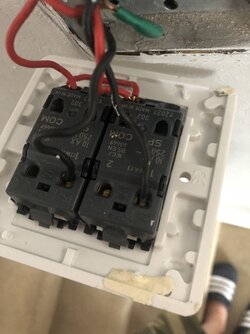
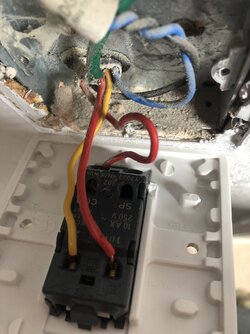
Hi folks, looking for help with a two way light switch…the downstairs switch (circled) puts light on and off, however, if the light is on, the single switch upstairs (photo 3)cannot switch the light off, it just remains on unless turned off downstairs. I think it is a tiny wiring fault but cannot get my head around it! Any advice would be great! I tried to take photos best I could…
 

Attachments

  • 6D1A74AE-1CED-4A68-BA51-0BF6CB49BC65.jpeg
    6D1A74AE-1CED-4A68-BA51-0BF6CB49BC65.jpeg
    372.8 KB · Views: 584
  • 413AD14F-B435-442A-AF99-3BB5764C7503.jpeg
    413AD14F-B435-442A-AF99-3BB5764C7503.jpeg
    335.9 KB · Views: 147
  • 7BF38B19-C718-4E27-8E35-BF7373E9D10A.jpeg
    7BF38B19-C718-4E27-8E35-BF7373E9D10A.jpeg
    376.2 KB · Views: 186
That's fairly unusual wiring there. However I would expect the red wire that is in the cable should be in the terminal marked 2. Leave the red link wire in COM.
 
Hi folks, looking for help with a two way light switch…the downstairs switch (circled) puts light on and off, however, if the light is on, the single switch upstairs (photo 3)cannot switch the light off, it just remains on unless turned off downstairs. I think it is a tiny wiring fault but cannot get my head around it! Any advice would be great! I tried to take photos best I could…
That's fairly unusual wiring there. However I would expect the red wire that is in the cable should be in the terminal marked 2. Leave the red link wire in COM.
Thanks, I’ve moved the red wire to ‘2’…that solved the problem, but now the single switch upstairs doesn’t put the light on if the switch downstairs is off….it does turn the light off if the downstairs switch is on now…hope that makes sense…
 
The problem is that we don't know how the red/yellow/blue of the triple & earth (at the single switch) relate to the two pairs of twin & earth at the 2-gang. The hidden joint between them is a little bit non-standard because normally one of the twin & earths, carrying strappers L1 & L2, would simply reappear at the single switch.

Does the second switch of the 2-gang operate a hall light? Does that work now, independently of the 2-way?
Do you have a multimeter and the knowledge to use it to make resistance tests with the circuit isolated?

BTW anyone notice the vintage 'Scruit Midget' porcelain thimble connector jointing the blue in the 1g box?
 
The problem is that we don't know how the red/yellow/blue of the triple & earth (at the single switch) relate to the two pairs of twin & earth at the 2-gang. The hidden joint between them is a little bit non-standard because normally one of the twin & earths, carrying strappers L1 & L2, would simply reappear at the single switch.

Does the second switch of the 2-gang operate a hall light? Does that work now, independently of the 2-way?

BTW anyone notice the vintage 'Scruit Midget' porcelain thimble connector jointing the blue in the 1g box?
The second switch on the two gang is for the downstairs hall light, it still works totally fine.
 
Then it's reasonable to expect that the black in the switch controlling the hall light is its switched line and the red of the same cable is the feed that should be connected to both commons. Then the red and black of the other cable would be the two strappers and connected to L1 & L2 of the 2-way. I expect that this is what you have now?

If now both switches have to be in a particular position for the light to come on, and either switch can turn it off, this implies one strapper is broken or one switch is not making contact in one position. I.e. there is a circuit L1-L1 but not L2-L2, or vice versa. However, there was a time at which the 1g could not turn the light off. so if the connections there have not been changed, both strappers are probably continuous. Are you sure red and black of the same cable at the 2g are securely connected to L1 and L2 of the 2-way?

My next test would nonetheless be to isolate the circuit and test in turn the continuity of the two strappers, red and yellow at the single switch to red and black at the 2g. There are tests one could do live but good practice suggests working dead if possible.
 
3C802ACD-FA21-4801-AEB2-C9A1117B02A4.jpeg
Then it's reasonable to expect that the black in the switch controlling the hall light is its switched line and the red of the same cable is the feed that should be connected to both commons. Then the red and black of the other cable would be the two strappers and connected to L1 & L2 of the 2-way. I expect that this is what you have now?

If now both switches have to be in a particular position for the light to come on, and either switch can turn it off, this implies one strapper is broken or one switch is not making contact in one position. I.e. there is a circuit L1-L1 but not L2-L2, or vice versa. However, there was a time at which the 1g could not turn the light off. so if the connections there have not been changed, both strappers are probably continuous. Are you sure red and black of the same cable at the 2g are securely connected to L1 and L2 of the 2-way?

My next test would nonetheless be to isolate the circuit and test in turn the continuity of the two strappers, red and yellow at the single switch to red and black at the 2g. There are tests one could do live but good practice suggests working dead if possible.
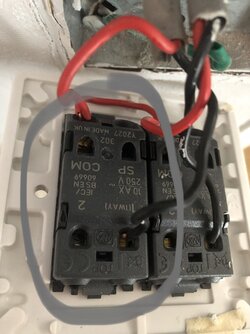
Your assumption of what I have now is correct…I’m not an electrician but it sounds right…here’s a photo of the current set up…this was a ‘simple’ switch swap that a neighbour did a few months back but he clearly hasn’t done it quite right, I don’t believe anything is broken between the two switches.
 
As that is about the only logical arrangement, at this point we have to stop assuming anything and start from scratch. I would definitely now work with the power isolated, testing continuity of the two strappers and the switches themselves in case one is faulty.
 

OFFICIAL SPONSORS

OFFICIAL SPONSORS

Thread statistics

Created
Jaseyb2,
Last reply from
Lucien Nunes,
Replies
7
Views
5,296
Back
Top