What sort of lamp is fitted. To make fault finding simpler, fit an ordinary (resistive) GLS rather than CFL or LED. With an ordinary GLS, does it glow or are these phantom voltages which show up because of the nature of the lamp?
 
It may be the neutral with a loose connection, as I presume your testing at each light switch to earth and the light from live to neutral. Try to earth see what voltage you get then. I presume the light dosnt work?
 
Well, problem solved - finally. The answer was so annoyingly obvious it's embarrassing.

I'd asked the customer three times if anything had changed or been done in the room. Because of this, I had ASSUMED that the curtain pole had been there for ever, when in fact it now turns out it had only been installed a couple of months ago - err, around the time the problem with light started. I only finally found this out when asking the direct question: when was put up?

So the lesson learned the hard way is the customer doesn't always understand the question "have you had anything done in this room?"

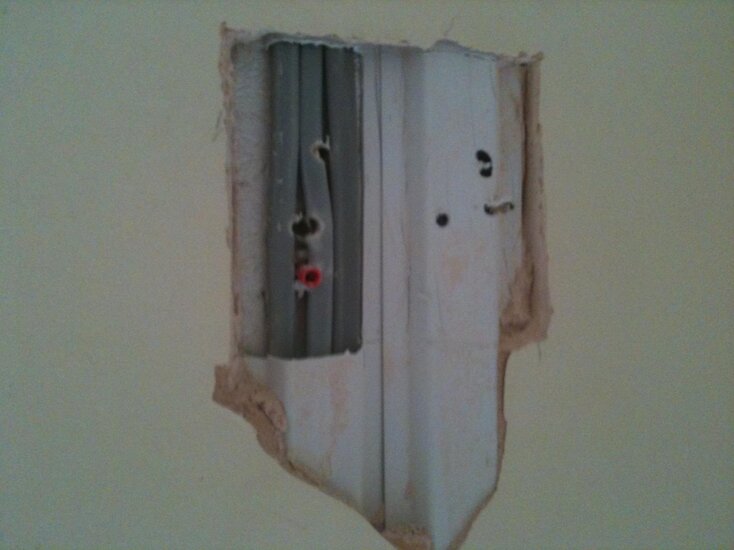
The interior decorator responsible had made a good effort to get the cables - missing them a couple of times, then finally on target. It was clear from evidence that he knew he was near cables, as the capping had become exposed by the drill!
 

Attachments

  • photo5.jpg
    photo5.jpg
    152.8 KB · Views: 101
Cheers for getting back to us. Its funny how often a client neglects to tell you about things when fault finding. They dont comprehend how any visible item kike a curtain pole or picture frame could have any effect on the 'invisible' electricity
 
Cheers for getting back to us. Its funny how often a client neglects to tell you about things when fault finding. They dont comprehend how any visible item kike a curtain pole or picture frame could have any effect on the 'invisible' electricity

Which is true, and all the more reason we should make no assumptions. I'll be beating myself up over this for a few weeks yet ...
 
It's normally the case, wires generally don't just go faulty normally has a helping hand.
 
strip all the sw,s and lamps out . use connectors and test lead. then put it back together one piece at a time.
 
.....and out of interest, how did you effect the repair?????????:grin:

The capping was a few molecules of plaster short of the surface, so no room to play with. And, the badly damaged cable was the middle of three. The customer would have done her nut if I'd suggested stripping the plaster from the switch to the ceiling, so I did it in a 'letterbox', scooping out the breeze block behind to create a cavity, then fixing in little section of new cable using Ideal SpliceLine connectors, which are brilliant (I use these when I need to extend cables in new consumer units, etc). Frankly, I didn't do a lot about replacing all the sheathing, but the insulated new conductors and connectors are protected by the other cables. I bonded the capping back in place, ready for the plasterer to come and do a re-skim.
 
Cheers for getting back to us. Its funny how often a client neglects to tell you about things when fault finding. They dont comprehend how any visible item kike a curtain pole or picture frame could have any effect on the 'invisible' electricity

I had a tennant once that complained her light stopped working, when I got there there was a nasty B&Q fan light on the ceiling which had been there for years, took it down all the reds in one connector, all the blacks in another, all the earths pushed into ceiling, apparently it was working fine yestererday and had been there for years! She accused me of being a liar etc. and complained how long it took for them to send someone, and was generally rude, especially when I pointed out that it could never possibly have worked! Funniest thing was, on the way out I noticed the little bit of red sleeving in the waste paper bin!
 

OFFICIAL SPONSORS

OFFICIAL SPONSORS

Thread statistics

Created
paulbeardwood,
Last reply from
somersetsparks,
Replies
24
Views
3,262
Back
Top