G

Guitarist

Guys, I'd value your opinion on this oil-fired boiler scenario.
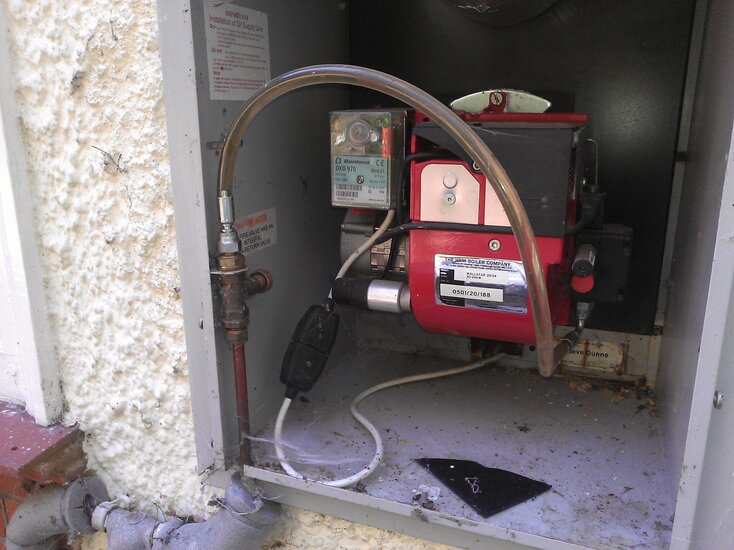
Oil pipe comes into the boiler from below the ground and as such is an extraneous conductive part. Thing is, it's not "touchable" from within the building, only from outside, and where it does enter the boiler, it's connected to the boiler frame via a fixing bracket. As such, I'm getting a reading of 0.00 ohms with a 500v test to the main earth (with all cables disconnected) due to it connecting to earth via the copper mains coming into the property, which then connects via the pipework to the boiler frame.
To bond or not to bond the oil pipe itself, as the boiler is both outside and inside at the same time?

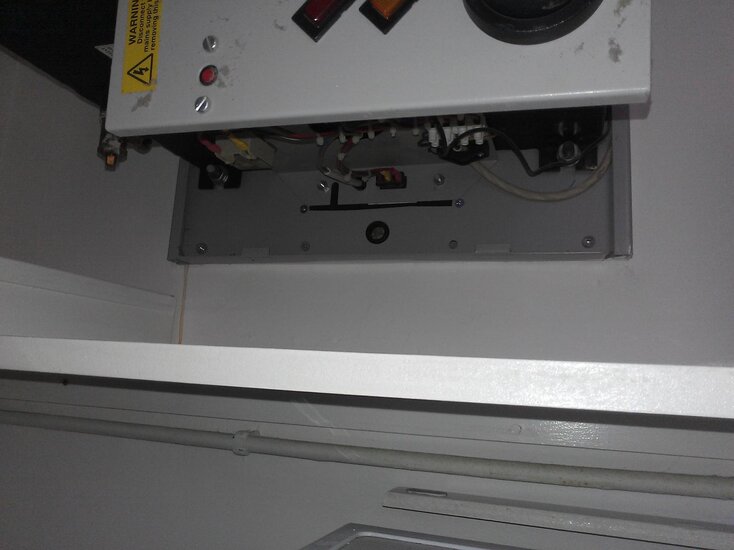
I've attached a couple of pictures.

WP_000071.jpg WP_000068.jpg
 
Assume the internal pipework is plastic ?

The framework of the boiler inside the house appears to meet the definition of extraneous conductive part

If the only thing making it defined as such is the fixing bracket,then if that fixing bracket was to be replaced with a non conductive fix,your dilemma perhaps would not exist
icon12.png

Not able to change the bracket, so I have to agree that the best assumption is that "were" the pipework to be changed for plastic at some point in the future, then there would be no effective bond.
To this end, it's now been bonded back to the MET.
Thanks for your input guys. :)
 
It's only the extraneous pipework that enters the equipotential zone, that needs bonding back to the MET. If the pipework coming off this external boiler into the house are bonded, then you have complied with BS7671 requiements...
 
My concern was that "if" the water pipework was disconnected for any reason, then the boiler would sit there as one massive ECP (half in the house, half outside), just as any other boiler can if attached to a copper oil pipe. Although the pipe itself is presently accessible from the outside only, the metal fixing bracket essentially makes that pipe into one big lump of metal.
After umming and ahhing over this one, I've now bonded the whole thing back to the MET so that whatever happens, it's still bonded.

Quite Agree.

The thing is you can't second guess what's going to happen to an installation in the future, you have to take any installation as it's presented to you. If you can bond this unit/system as a whole that's fine, and what you have done,
 
I don't know if I'm missing something but shouldn't you have been doing an r2to confirm continuity seeing as you're looking for a reading of 0.05 ohms or thereabouts?
 
I don't know if I'm missing something but shouldn't you have been doing an r2to confirm continuity seeing as you're looking for a reading of 0.05 ohms or thereabouts?

No, there was no bonding present to the oil. I carried out the 23k test at 500v, but due to the copper water pipework, there was no way of isolating the boiler itself, short of disconnecting the 22mm pipes. That said, the 10mm copper oil feed pipe came up out of the soil so there was no doubt that the unit was an ECP.
 

OFFICIAL SPONSORS

Back
Top