E

ed-ectrician

Hello there,

You lot have always been helpful in the past and generally not too condescending so I'm going to ask what I feel could be seen as a dumb question (the dumbest being not asking it!)

I went to do an inspection on a kitchen the other day and the spark that had done the work had a kitchen ring on a 32 amp breaker. All good, then he put the cooker on a 32a ring circuit of its own, now my guess on this is that it is not OK becasue the idea of a ring is that the load is distributed on the first and second halves of the ring. With one appliance on the ring this isn't the case so doing a cooker on a 32a ring circuit of it's own with 2.5mm twin and earth cable is not right because the cooker will draw all its current from the "half" of the ring that is the least resistance right? So it's like basically putting a cooker on a 2.5mm 32a radial which is not ok.

The bloke I spoke to said the electrician who did it didnt have 4 or 6mm cable so did it this way. Often the case!!

Am I right here? Missing something?!

Ed
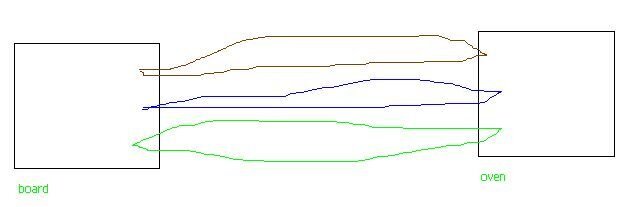
 
What you saying here, that he took the 2 cables in two different directions to get to the cooker?? lol!! If the cables were run in parallel, that's a whole different matter, and as far as i can see will comply...
 
Sounds like conductors in parallel rather than a ring.

Are both the cables the same length? run together?
 
I have seen this a few times also for cookers where someone has run 2 x 2.5s together to make 5mm CSA.
 
picture.jpg

See (awesome!) picture. Doesn't what I'm saying about the load just going down one of the cables (one is obv going to be less resistance than the other!) make any sense!?

- - - Updated - - -

I have seen this a few times also for cookers where someone has run 2 x 2.5s together to make 5mm CSA.

Sky would you say this is ok?!
 
View attachment 14759

See (awesome!) picture. Doesn't what I'm saying about the load just going down one of the cables (one is obv going to be less resistance than the other!) make any sense!?

- - - Updated - - -


Sky would you say this is ok?!

If they are the same length they should be the same resistance and so have been installed as conductors in parallel and as such complies.

Cables in parallel are very common although not so much in the domestic and commercial world....
 
Alright but even if they are exactly the same length the current will only pass down the path of least resistance and one of them has to be slightly different resistance - 0.00000001 of an ohm even would mean the current ignores the other one and just goes down the one of least resistance, is this wrong?!
 
Alright but even if they are exactly the same length the current will only pass down the path of least resistance and one of them has to be slightly different resistance - 0.00000001 of an ohm even would mean the current ignores the other one and just goes down the one of least resistance, is this wrong?!

I'd be really interested as to where you learnt that little gem??
 
Alright but even if they are exactly the same length the current will only pass down the path of least resistance and one of them has to be slightly different resistance - 0.00000001 of an ohm even would mean the current ignores the other one and just goes down the one of least resistance, is this wrong?!

No, current flow will be proportional, the one with the lower resistance will see slightly higher current.

The National Grid would be in trouble and overload if current took the cable of least resistance an ignored the others
.
 
I would say its OK - would never do it myself like that I hasten to add, I would get the right size cable for the job.
The spark who did it I imagine he only had 2.5mm and could not be bothered to get the right gear.
 
It is a common misconception that current only takes the path of least resistance.
Current takes any paths available.
That is the principle of how a RFC works.
If you have a socket half way round the ring with a load of say 4A, then you would have 2A down each leg of the ring.
If the socket was a quarter of the way round the ring, then you would have 3A down the short leg, and 1A down the long leg.
This is because the resistance on the long leg is 3X as much as the resistance on the short leg.
When you have conductors in parallel, the resistance of each conductor should be the same.
Small differences in resistance won't be a problem, unless the difference is enough to cause a current greater than the CCC of the cable.
 
Thanks everyone. I've got it now. Going on my previous logic a ring circuit wouldnt be useful at all for reducing cable size!! Doh!

Engineer 54 I learnt that little gem from always assuming that (GCSE science "electricity always takes the lowest path of resistance"!) and not asking the question. From asking on here and correcting my assumption I have learnt something new today! Thanks everyone! So the current would be split and it's ok for the spark to have done this.
 
Hello there,

You lot have always been helpful in the past and generally not too condescending so I'm going to ask what I feel could be seen as a dumb question (the dumbest being not asking it!)

I went to do an inspection on a kitchen the other day and the spark that had done the work had a kitchen ring on a 32 amp breaker. All good, then he put the cooker on a 32a ring circuit of its own, now my guess on this is that it is not OK becasue the idea of a ring is that the load is distributed on the first and second halves of the ring. With one appliance on the ring this isn't the case so doing a cooker on a 32a ring circuit of it's own with 2.5mm twin and earth cable is not right because the cooker will draw all its current from the "half" of the ring that is the least resistance right? So it's like basically putting a cooker on a 2.5mm 32a radial which is not ok.

The bloke I spoke to said the electrician who did it didnt have 4 or 6mm cable so did it this way. Often the case!!

Am I right here? Missing something?!

Ed

Hi Ed,
try to catch up wiht Ohm's Law, circuits in paralel. will clear things up, not dificult, you will fly through...
 
Don't see a problem if they are run in parallel!!
Cables will always take twice the current in parallel.
 

OFFICIAL SPONSORS

Back
Top