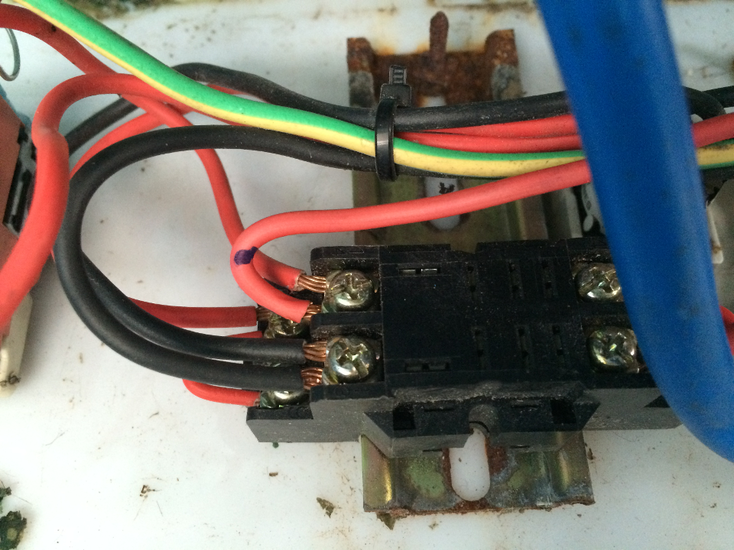
]I am assuming It's probably a relay with no base ,spade terminals only,
can be replaced with a standard relay 8 pin or 11 pin With base
probably best way to understand the concept is like a two way switch ,common in one side , 2 switch wires out the other side
One contact will be normally closed and then when the coil of the relay is switched the ,relay will change state and make the other contact live ,just haven't figured out from your post, what the control strategy for switching the relay, to change between heating elements would be?
That's pretty well how I see it, except visually the device looks more like a base without a coil attached, which is what was puzzling me. The heating strategy I think is to separately heat up a large tank (150L) of water overnight, and also have a means of topping up a smaller amount directly in the bath when required, which would heat up faster.
 
Haven't got a problem with that.. It was the intimation that I didn't know what I was doing, just because I hadn't come across this device before. And that because a trailer is deemed to be commercial and outside then suddenly it much more dangerous. That's Micky mouse logic to me.. What's more complicated and dangerous, rewiring a multi floor, multi circuit domestic installation supplied with 100A, or a car trailer supplied from a 13A plug? I'm qualified to do the former but you're saying not the latter?

Your profile states that you are a domestic electrician, which must have been put there by you, so the logical assumption for anyone reading it is that you are only qualified and insured to carry out work in domestic premises.
It is not a question of what is more dangerous or complicated, I don't think anyone has suggested it is more dangerous.
However this does likely fall under a special location, may be subject to appliance design and construction regulations, puwer, and depending on where it is used may come up against 7909.

Plus saying that you are unaware of what a relay is doing and where to get a replacement suggests you are out of your depth.

But anyway, do you have more information to share so that we can actually help you with this?
 
Well I have now got a photo but it's in a funny format but will try and paste it.. I was hoping to go back and have another closet look but the client hasn't responded..
 
To the OP,although Dave may have ruffled your feathers...he is correct.

If the unit is indeed foreign,and no details exist for design,or the missing items,you will have to reverse engineer,to ensure it functions safely and as intended.

This requires that you understand,fully,both what it is,and what it should be.

Just reading the first page of the posts,it put me in mind of other similar arrangements,on mobile units,where folk have used vehicle type relays and equipment,to enable operation of mains equipment. Even to the degree of using vehicle 5 pin relays,with the 12v coil feed being derived via permanently connected battery chargers.

This,is obviously not within the design criteria of these components. Simply replacing one of these components,would not improve this.

There are plenty of dudes on here,who can assist,but generally they will want to improve situations,and not keep/make them worse! :smartass:
 
I've pasted the photo..The red input wire and neutrals are on the left and I've temp connected one heater output to the input. It can be controlled via stat knob and off switch..
j00004671411_ctyvjsgp.png
 
Taking one look at that picture, I would say walk away unless you wish to become liable for a non-conforming control set-up. The fact the din-rail is subject to heavy corrosion means this kit isn't IP rated for its environment plus it looks rough, unless you are going to address these issues I would consider your position here.
 
Last edited by a moderator:
That's fantastic! Thank you so much. I shall be sure to include a pic in future :behead:

Pay very careful attention to what darkwood has said though, he really knows his stuff in this area, and if he advises walking away then I'd do exactly that.
Even without his knowledge it's obvious that there are some serious issues to be addressed in that picture,
 
Taking one look at that picture, I would say walk away unless you wish to become liable for a non-conforming control set-up. The fact the din-rail is subject to heavy corrosion means this kit isn't IP rated for its environment plus it looks rough, unless you are going to address these issues I would consider your position here.
You know, I fully agree with you. I initially thought it was OK but the more I think about it, the fishier it gets. I shall write my opinion for the client so she has it in writing..
 
That relay set-up,is not a means of achieving the control of your two heating elements. The DPDT gives you the possible facility of alternate or paired control,but without a fail-safe position. If,indeed your heating loads require to be interlocked,so as to prevent both loads being energised simultaneously,and,a fail-safe position,this relay will not achieve that.
 
That relay set-up,is not a means of achieving the control of your two heating elements. The DPDT gives you the possible facility of alternate or paired control,but without a fail-safe position. If,indeed your heating loads require to be interlocked,so as to prevent both loads being energised simultaneously,and,a fail-safe position,this relay will not achieve that.
OK but if it provides alternate heating then that's its purpose, yes? To prevent both heaters being on simultaneously. There is a control knob on the bath stat which is accessible, and a heater switch which energises both heaters but via the relay..
 

OFFICIAL SPONSORS

Back
Top