Issue installing electric downdraft cooktop

Need advice from a professional electrician.

I just had my counters replaced and I had to install the new downdraft cooktop myself.

Details:
House predates 4-wire code requirement for ranges/cooktops. So, my house wiring to the island consists of 1 solid black wire (hot 1), one black with red stripe wire (hot two) and one multi-strand bundle of bare wire (neutral/ground). All connections verified in panel.

Cooktop consists of one black wire (hot 1), one red wire (hot 2), one white wire (neutral), and one green wire (ground). Parenthesis based on installation manual.

Connection wire consist of 1 black wire, 1 red wire, 1 white wire, and 1 bare wire.

Manual states to connect the ground and neutral wires together in a 3-wire setup (like I have)

I installed a junction box in the island and ran the house wire and connection wire into the junction box. I connected the black wire of the connection wire to the black wire of the house wire, the red wire to the black w/ red stripe, and both the bare wire and the white wire to the mass of bare wires using large wirenuts and double wrapped them with electrical tape to be safe.
At the cooktop I connected black to black, red to red, white to wire, and green to bare. When I flipped on the breaker I heard a loud pop, saw a flash of light (breaker panel is within feet of the kitchen island) and it tripped the breaker - all immediately upon my flipping the breaker on. So, I disconnected the cooktop and double-checked the wires for the correct voltage - 243 between black and red, 121.5 between black to white and black to bare, 121.5 between red and white and red and bare. I also verified there was no continuity between the hot legs or between either hot leg to the neutral or ground. So there doesn't seem to be a short. Also, when turning on the breaker with the cooktop disconnected (and ensure none of the bare ends of the wires are touching anything of course) the breaker does not trip, and all the voltage readings are as above.

So, now I am at a loss as to what the heck happened. Any help will be greatly appreciated.
 
Whatever the fault was it may have blown clear. Have you tested the insulation resistance of the cable?
 
Whatever the fault was it may have blown clear. Have you tested the insulation resistance of the cable?
How would I do that?

Also forgot to mention that I did turn on the breaker after hooking up the connection wire to the house wire in the junction box but had forgotten that I didn't start on the cooktop end yet, so there wasn't a short then either (to have blown apart, if that is what you mean, when I threw the breaker with the cooktop connected).
 
Does not sound right to me?
How so? If the house wiring is only 3 wires, all the grounds and neutrals terminate at the same bus bar in the panel, and you still want the housing of the appliance grounded in case of an internal short in the appliance. This accomplishes it. It's just grounding, and 120v return, on the same wire. It's not ideal, but it does work. While not CURRENT code, it does meet code from pre-1996 houses. My house was built in 1993.
 
Does not sound right to me?

What is the voltage of the downdraft unit?
Downdraft is 120v, as are all the indicator lights. US code was updated in 1996 for all new construction to have 4-conductor wiring for ranges/cooktops/ovens/dryers, but pre-1996 the 120v return and the appliance ground are the same wire (unless the house has been rewired - mine hasn't, not cost effective at the moment).
 
Doesn't current work have to be to current code?

Are we talking about a hot plate with a separate down draft unit?
 
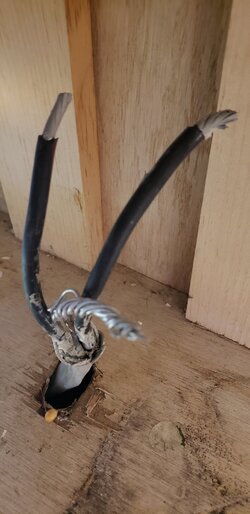
Branch Circuit in the house


20220804_211614.jpg

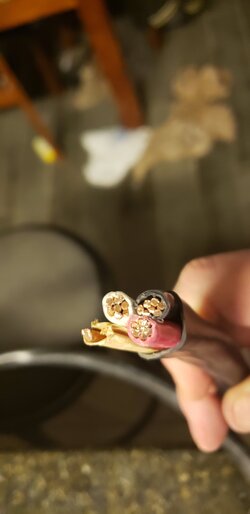
New connection wire referenced as "power supply leads" in the installation manual.
20220804_214214.jpg

So for the above: White and Base were connected to the bundle of bare wires on the branch circuit. Black was connected to the solid black, and red was connected to the black with red stripe.

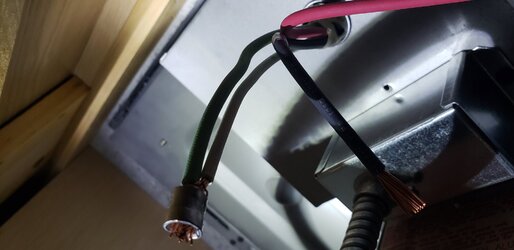
Cooktop wires
20220804_211655.jpg

The colors aren't real clear due to lighting, but you can see the cooktop came with the green and white wires connected be a ferrule. I removed the ferrule because I can't put a wire nut on that anyway, and connected red to red, black to black, white to white, and green to bare. Ultimately green and white come together in the junction box.
 
Doesn't current work have to be to current code?

Are we talking about a hot plate with a separate down draft unit?
We are talking about an actual cooktop. I have an island cooktop and a wall oven. I do not have a "range" or stand alone "stove". And yes, the Cooktop has a downdraft vent in the center where a blower mounts as there is not a hood/blower above it.

And another note on the code question. US law isn't so draconian that it would require one to rerun the wires in their house just because they bought a new stove... That's asinine.
 
I'm a UK electrician so have minimal knowledge of US electrical installations but some things are pretty universal. There was a loud bang and a bright flash as soon as power was applied, this suggests a solid shirt circuit which is likely to have made quite the blackened mess when it happened.
If you haven't found any evidence of this in the connections you have made it suggests that the fault is in the appliance itself.

I'd hazard a guess that there's a manufacturing fault in the appliance such as a cable being cut/trapped by grounded metal parts. I'd look at returning the appliance under warranty and getting a replacement.

And another note on the code question. US law isn't so draconian that it would require one to rerun the wires in their house just because they bought a new stove... That's asinine.
UK law doesn't have such draconian requirements either. But it has been illegal to use a combined neutral and earth conductor in an installation for many many years and it seems very odd to us that the US only moved away from this in the mid-90's
 
I'm a UK electrician so have minimal knowledge of US electrical installations but some things are pretty universal. There was a loud bang and a bright flash as soon as power was applied, this suggests a solid shirt circuit which is likely to have made quite the blackened mess when it happened.
If you haven't found any evidence of this in the connections you have made it suggests that the fault is in the appliance itself.

I'd hazard a guess that there's a manufacturing fault in the appliance such as a cable being cut/trapped by grounded metal parts. I'd look at returning the appliance under warranty and getting a replacement.


UK law doesn't have such draconian requirements either. But it has been illegal to use a combined neutral and earth conductor in an installation for many many years and it seems very odd to us that the US only moved away from this in the mid-90's
Please don't think I was implying they were that ridiculous there (or elsewhere), just stating they aren't here. I don't know about the when's or why's of the US Electrical code, and only know the 1996 date specifically from that installation document, which was written for US installations of course since it's a US market appliance. What I do know, however, is that all pre-code change houses were grandfathered in, and did not have to be rewired. If you DO rewire, however, then yea, you gotta meet current code. I would love to have my entire house rewired because I'd like to make some adjustments to the circuits (you can tell some circuits were added after the fact, causing some circuits to make little to no logical sense). I've just heard numbers ranging from 10k to 20k to have such a job done, and that's a lot of coin for fixing something that isn't really broken.

I searched for blackness in an attempt to discover where this occurred and found nothing. I even took the service panel off on the cooktop and saw no burnt wires or any blackness anywhere. I am truly at a loss here.

I guess my next step is going to be what I REALLY didn't want to do, which is to remove the cooktop, flip it over, look over a wiring schematic, and trace everything down to ensure it was all assembled correctly at the factory.
There is no warranty due to my having owned it, in a box, for a couple years. It took that long to get around to dropping the coin to have the counters done.
 
What you really need to do is get an electrician in to check over what you have done and find the fault, they will be able to test the cables for any short circuit and narrow it down to the cables or appliance.
 

OFFICIAL SPONSORS

Back
Top