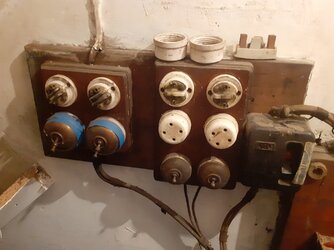
It doesn't seem real

I got some pictures, I still don't believe it. Who needs crummy old rcb's.
 

Attachments

  • 20210331_161151.jpg
    20210331_161151.jpg
    342.6 KB · Views: 149
  • 20210331_161159.jpg
    20210331_161159.jpg
    413.2 KB · Views: 138
  • 20210331_161202.jpg
    20210331_161202.jpg
    336.5 KB · Views: 133
I've seen a couple of the light switches before when I've found them under the floorboards on older properties, but never a full install in all its glory.

Is that still live? Wonder how many LAP light switches/sockets will still be in this condition in 50 years time...?
 
Its still live in a very old building with a very old owner. The update I got was that her "partner" who passed on 20 odd years ago did it all from when they moved in (don't know when). I'm negotiating to buy them when she's gone and a rewire takes place.
 
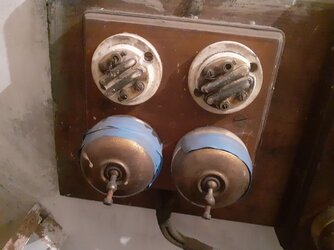
Those pairs of switches look like they should have bars across them so they switch together as a double pole switch as they appear to be one switch for live the other neutral, feeding the live and neutral fuses above. Though of course it could have had modifications over the last 90 odd years...

The installation is a long way past its design life!
 
A linked pair of tumbler switches (to make a DP switch) and a pair of pepperpot fuses, mounted on a square pattress like this, was typical of small domestic lighting installations up to the late 1920s. It was a cheap, basic way of making a DP switchfuse for up to 15A service. It would be quite common to find the cables leading to a small 2- or 3-way channel fuse board mounted adjacent or near ceiling level in the hall. Two pairs of pepperpots on a pattress, making a splitter to feed two circuits, was less common.

However, in this case I am not sure this is fully original. One or both pattress assemblies might have been re-purposed and re-installed because they were to hand. The left one with one circuit has the proper switches with the screws for the linking handle, although that is missing. The TRS cable leading from the top (if it is TRS) is probably later.

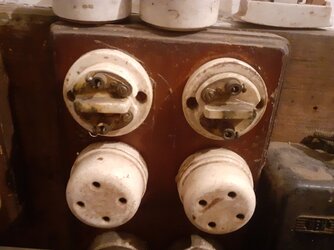
The ones on the right, I cannot see the flat surface normally present on the dolly where the screwholes are, so might actually be normal light switches in which case they are definitely not original. Presumably the outgoing circuits are in buried conduit, it will be interesting to discover more about the actual wire as that will help date things.

For comparison, there is a 3-way glass-fronted channel fuse board live in an installation in my sight. It is served by the same linked-switch and pepperpot arrangement and it was original to the building's first electrical installation. But it was removed and later reinstalled on the end of a submain by the owner, so it is not an original installation as such.

As is very common in these installations, a switchfuse has been added later to supply a ring. Until that was fitted there might not have been any socket-outlets at all or perhaps one 5A.

Keep us posted and assume all material constutes evidence and might be of interest. Some of us like to document the history of these things, as well as polish the brass.
 
I've seen a couple of the light switches before when I've found them under the floorboards on older properties, but never a full install in all its glory.

Is that still live? Wonder how many LAP light switches/sockets will still be in this condition in 50 years time...?
haha LAP switches are normally good for the bin after 50 minutes forget 50 years !
 
Absolutely, we all act in shock when we see this sort of stuff, but it's probably been live and working perfectly for 90+ years.

Can't even get a luminarie to last a couple of years now!! Things have improved so much.....

Same with cu's, we find loads of wylex fuseboards all still up and running 40/60 years on, but are replacing defunct rcd/mcb/rcbo boards less than 10 years on because they are no longer working properly
 
Same with cu's, we find loads of wylex fuseboards all still up and running 40/60 years on, but are replacing defunct rcd/mcb/rcbo boards less than 10 years on because they are no longer working properly
Or because spare parts are no longer officially available!
 
Those pairs of switches look like they should have bars across them so they switch together as a double pole switch as they appear to be one switch for live the other neutral, feeding the live and neutral fuses above. Though of course it could have had modifications over the last 90 odd years...

The installation is a long way past its design life!
Thanks for the hint, I wondered why the bigger switches had a screw on the end but it makes sense if there's supposed to be a link bar.
 
Was there a concept of 'design life' back then ? What about 'planned obsolescence' too ?
Probably not, the only reference I have seen is some cable information where the manufacturers have listed the expected life of the cable. Making products out of cast iron and ceramic materials suggests the manufacturers expected a very long life.

Currently rewiring my grandmothers 65+ year old house, all the original mk accessories, wylex fuseboxes, light fittings, dimplex wall heater and towel rail are all still in good working order.
 
Watched this video about planned obsolescence last night. Interesting and also covers the origin of such engineering.


OFFICIAL SPONSORS

Back
Top