A

Adalia

I have run a cable plugged into my bedroom socket outlet into my garden and put an outdoor weather proof outlet in the garden, my landlord has told me I need a electricians certificate but I thought it was just like an extension lead. Any help would be fantastic.
 
I have run a cable plugged into my bedroom socket outlet into my garden and put an outdoor weather proof outlet in the garden, my landlord has told me I need a electricians certificate but I thought it was just like an extension lead. Any help would be fantastic.

Ask your landlord what "electricians certificate" is required. As above, I can only think of a Pat test.
 
He said he wants some form of certificate to prove it was installed and checked by an electrician otherwise I will have to remove it.
 
He said he wants some form of certificate to prove it was installed and checked by an electrician otherwise I will have to remove it.

It's an extension lead. It's not part of the 'fixed installation'. If you plug in a new kettle does he also want an electrician to test that as well?
Just get it Pat tested.
 
He said he wants some form of certificate to prove it was installed and checked by an electrician otherwise I will have to remove it.

Out of interest, have you had the Electrical Installation Condition Report for the property?

The only safety issue with having an external socket would be to ensure that it is RCD protected - and any socket that might supply outside equipment should already be protected. I assume you aren't running it out of a 3rd floor flat into a garden?

It's not part of the fixed installation as already mentioned. Was it a pre-bought setup, or was it made up by yourself from a lead, plug and external socket? If the former, then proof of purchase or manufacturer's instructions might count as proof of safety.

If not, then a PAT test would be the way to prove it was safe - though not clear on whether it would be a requirement for you to do so...
 
Anything on a plug top is not part of the electrical installation, it is deemed a portable appliance and you won’t be able to get an electrical installation certificate for it.
you could get the extension lead PAT (portable appliance test) tested, which would get you a little green sticker on your lead...
 
I suppose the LL is just trying to cover his own rear end if something happens, but as others had said, it’s not part of his installation.

Would be interesting to know if LL is up to date with his own responsibilities.
RCD protection, fire detection etc etc.
 
The landlord has a point in that he/she would be the one facing the heat in the event of anything going wrong, even if ultimately they could show it was not their doing (i.e. they did not supply the extension lead). If I were in that position I would want to know the whole place was adequately safe as I would rather never be at a fatal accident inquiry even if ultimately exonerated.

Also it is possible (though less likely) to have a flat that has a satisfactory EICR without RCD protection of the sockets if they are not seen as likely to supply a special area or outdoors. Adding a monster extension lead might not be considered.

To satisfy your landlord the easiest option would be to get someone in to check it out. Most of what they would do you can do yourself, except probably the more specialised electrical testing. If you want a quick check list, it would be:
  • The socket supplying your lead is on a working RCD (or RCBO that combined RCD & MCB). If you look at your CU (consumer unit = fuse box) there should be something that has a small test button, on pressing that it should trip and all your sockets go off. Possibly lights as well, so test in day time!
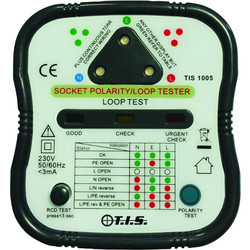
  • The socket supplying the lead should be correctly wired and with an acceptably low earth impedance. The better (£50-ish) plug-in socket tested can verify this.
  • Your lead should be mechanically sound: cable outer sheath clamped by the plug, no damage visible to the cable, cable glanded for mechanical support and water sealing at the outdoor socket.
  • Your lead should be electrically sound, so all 3 conductors properly connected at both ends. Again, a good socket tester will show this at the outdoor end (as for indoor socket).
  • The fuse in the lead's plug should be appropriate for the cable size. (e.g. 13A for 1.25mm or more cable, 5A for 0.75mm cable, etc)
  • The route your lead takes should not present a hazard for tripping or a cable dropping on firefighters (in the worst scenario).
  • While not so important for "temporary" arrangements, if long-term the cable should be UV resistant or otherwise shielded from direct sunlight that will degrade PVC and similar insulation.
An example of one of the better socket testers is this:

For most outdoor flexible leads the use of H07RN-F grade cable is recommended, for example:
 

OFFICIAL SPONSORS

Back
Top