No, I was thinking more about this bit:
Although one may question the necessity, ELV circuits are not excluded from the clause 522.6 requirements. In order to ensure complete compliance with BS7671, the same consideration needs to be given to all fire alarm cabling including the ELV circuits.

Which says nothing about whether FP200 complies or not so is no use I supporting your incorrect statements above
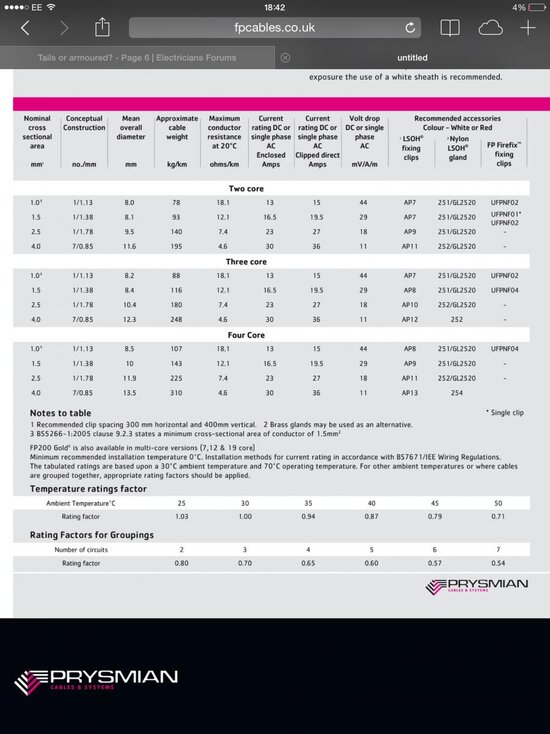
 
Does FP200 have the same limitations as other BS8436 cables ? if it does (which I suspect it does) then that is still quite a limitation for general circuits, especially in commercial, so it is not as simple as to say yes it would comply, it may comply only with limitations.

The point being it was designed for fire alarms and EM lighting and such which are fairly low load, and which circuits you really don't want an RCD on if you can help it.
 
One of the problems with BS8346 cable, is it's ability to withstand the higher fault currents.
As such while FP200 may well be acceptable for ELV circuits, it is not acceptable for LV circuits.
Because of this Prysmian manufacture a BS8346 compliant cable called Afumex.
It is available in CSA sizes 1.5mm, 2.5mm and 4mm.
If FP200 is BS8346 compliant, why is it not listed as being a standard which it complies with, and why do Prysmian manufacture another cable which is BS8346 compliant?

It can be used for single phase.
 

Attachments

  • image.jpg
    image.jpg
    112.3 KB · Views: 105
Not aware that anyone is stating that FP200 cannot be used for single phase.
For all I know, it can also be used for 3phase.
What I am questioning: is whether it can be considered an acceptable method for providing additional protection for LV cables concealed in walls.
As far as I'm concerned, it does not satisfy the requirements of BS8346 and as such unless buried at a depth greater than 50mm, RCD protection will be required if the cable is concealed in a wall.

Dave, while lead sheath cable may appear to meet the requirements of BS8346, unless it has been tested, it doesn't and is not considered as being an acceptable method of providing additional protection for cables concealed in walls.
Yes, I forgot about MICC cables, sorry.
 
Hi guys,
I have job on to install a consumer unit, the problem is I'm unsure weather to supply the consumer unit with meter tails or an armoured.
the setup is the meters are outside on the garage wall and the consumer unit is on the other side of the garage fed in 10mm tails currently. The distance from the meter to the CU is abou 5 metres max.
Im going to put a 80amp switch fuse in the garage back to back with the meter, but I'm unsure on what would be best to supply the CU in.
i was either thinking maybe using trunking across garage joists enclosing 25mm tails or would armoured be more suited. The customer is using there own CU which ain't metalclad and the gap to fit the board wouldn't allow an adapt box to be fitted aswell.
so all I'm asking is would the meter tails in trunking be the best method or should I look for an alternative.
any suggestions from experience appreciated.
How will you terminate the armoured in the DB? unless it is metal clad of course.
 
I am aware but things move on. I have read some threads on here where people are using buried FP200 to get away with not installing RCD protection. I almost fell off my chair when I read that. Turns out the cable can NOW be used for that (I personally would not though). FP200 certainly was not designed for this purpose either. Things change. I personally only use SY for connecting external equipment instead of standard flex cable.

Hmmm, So you use SY cable for external work do you. I don't suppose you realise that SY cable is probably one of the worst cables you could use externally. In fact if you read the data on SY cable it is specifically stated as Not For External Use!!

That's apart from the fact that the cable is manufactured as a machine control cable and that more than one manufacturer specifically states, NOT recommended for use as mains supply cable!!!
 
if we go back to the original question with regards to running a cable in the space of a cavity wall the 50mm/RCD is not going to be a factor, as the cavity is a good deal deeper than 50mm...
 

OFFICIAL SPONSORS

Back
Top