J

James1985

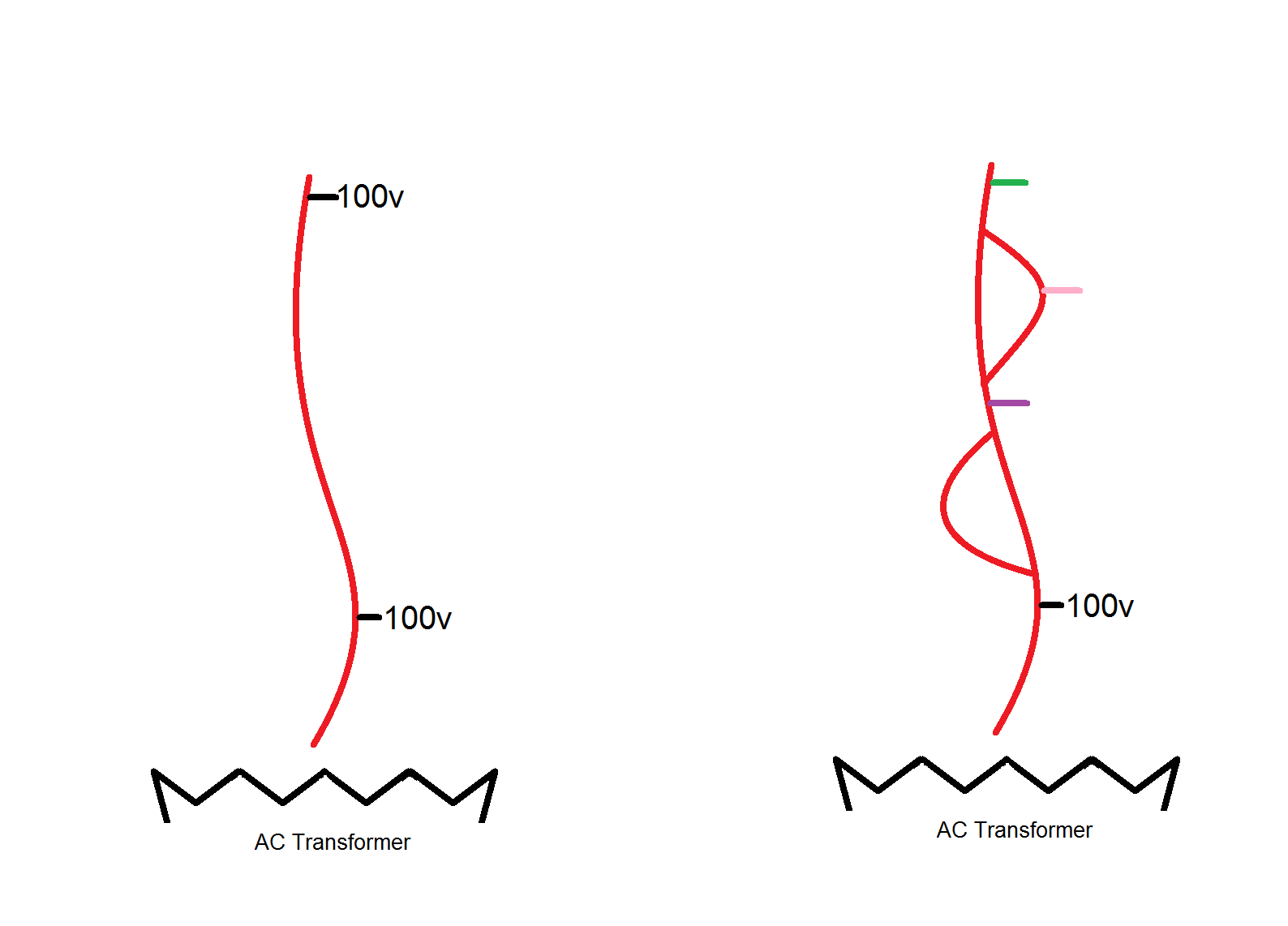
If we have a single 100V Live coming in from the AC Transformer, at any point we measure its 100V

If however we introduce loops, does this have any effect on voltage?

q.png


What would be the voltage reading at the following points on the image
  • Purple
  • Pink
  • Green
Im wondering does it have any effect at all?
 
Absolutely none.

Think of a house, where every wire is branched of to somewhere else… and a domestic socket circuit which is a loop starting and finishing at the same point…..
Every point in the house will be generally the same voltage, as long as you are measuring to an earth point.

The only thing that affects the voltage would be the length of the wire…. And we are talking millivolts every meter
 
At normal AC power frequencies e.g. 50 - 60 Hz, and normal current densities, the physical route a typical length of wire takes through space has no significance. The only things that really matter are the length and cross-sectional area; if your added loops increase the length, then there will be proportionally more voltage drop when a current is flowing (although obviously no drop when there's no current).

However, at radio frequencies, the physical layout of the cable starts to have some impact, and at the frequencies your phone uses, even small loops and bends can create all sorts of complex effects as they behave as inductors, capacitors and transmission lines. This is out of the realm of anything an electrician would normally have to deal with, but an important part of electronic circuit design. If you look at the motherboard in your computer, you will find PCB tracks laid out in specific routes to create the right electronic properties. E.g. tracks with meanders to delay the arrival of signals so that they are in sync with others. At high clock speeds, the wavelength of the signals is so short that different voltages are present at different points along the same wire at the same time. A digital '1' voltage level might be entering a track at one end while a '0' is still travelling along it towards its destination.
 
Just as @Lucien Nunes points out, this only becomes a factor once the cable length / loop length becomes a noticeable fraction of a wavelength. For 50Hz mains and assuming typical plastic velocity factor of about 0.67 then your wavelength is 3.0e8*0.67/50 = 4002km and so you really are not likely to see even 1% of a wavelength other than major route HV transmissions lines.

The simpler L & C behaviour is noticeable before you get to that point, but really you are still very unlikely to see much of that sort of effect outside of a DNO system.

As a historical note, they way the verified the frequency of the first magnetron used in WW2 radar by the UK was an open line where they slid a detector along it and the gap between successive max (or min) was a half wavelength. As it was air-filled so velocity factor practically identical to a vacuum so they could convert distance to frequency with tolerable accuracy based on the velocity of light as more or less 3.0e8 m/s (they probably using imperial units then).
 

OFFICIAL SPONSORS

Back
Top