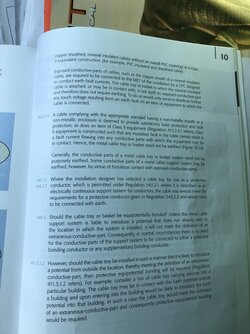
And the IET agree that they don’t need earthing , if you read GN8 tray, basket and the like containing / supporting cables which are insulated and sheathed and fulfill the requirements of double insulation do not require earthing.
You certainly wouldn’t provide protective bonding to them as they are unlikely to be extraneous conductive parts either.
The bottom line is that in most cases they do not form part of the electrical installation
 
I would totally disagree - with respect you think exposed conductive part is metal part being used as CPC - Exposed conductive part is metal part that is part of the electrical installation but Not the circuit that could become live under fault, just like short circuit I.e from brake down of insulation.
 
I would totally disagree - with respect you think exposed conductive part is metal part being used as CPC - Exposed conductive part is metal part that is part of the electrical installation but Not the circuit that could become live under fault, just like short circuit I.e from brake down of insulation.
So an insulated and sheathed cable requires break down of both inner insulation and the outer sheath, how does that happen then?
They should be installed for the location , so away from things like impact and the like.
Also the regulations do not list tray as requiring bonding at all, steel conduit and trunking contain single insulated cables so require earthing, metallic enclosures contain single insulated conductors and terminations so require earthing.
Tray with swa cables fixed are unlikely to cause the tray to become live as they have an earthed metallic screen around the conductors.
Tray and basket do not contain cables and in most cases are not exposed conductive parts by definition.
E773AFEA-A2F0-431B-9F65-C139447ABA9A.jpeg
 
Last edited by a moderator:
ageing? doesn't matter does it

BS7671 page 30 Fault.....
but that's just one example
Ageing is a poor excuse unless it’s VIR cables I have never seen Modern pvc cables break down because of ageing.
Besides Swa has an earthed screen so any degradation of the live conductors and then the inner bedding will make contact with the earthed armour of the cable and disconnect the ocpd and remove any danger, long before the outer pvc insulation can break down.
 
Last edited by a moderator:
listing a thousand examples of how a conductors insulation might become damaged or how it might come into contact with a Exposed conductive part isn't going to change the definition of a Exposed conductive part unless it's class 2 or plastic etc it's exposed con part by Definition BS7671 Exposed-conductive-parts’ as: Conductive part of equipment which can be touched and which is not normally live,but which can become live under fault

take care bye
It’s not equipment, it’s support management For cables. Cables which by definition meet the definition of class 2 equipment.
Cables which have an earthed screen like swa.
You can Earth it if you want but it’s not required by bs7671 is all I’m saying.
 
Basically
It's Metal
It's part of the electrical installation
It has the potential to become live under fault - how the fault happened is not relevant here
Yes it should be bonded but that's just my opinion following all sources of official information available to me .

crazy that stuff that didn't need bonding got bonded but real exposed conductive parts didn't.

just read your reply yes it probably would no longer be required to be bonded under most instances I.e RCD protection.
 
Basically
It's Metal
It's part of the electrical installation
It has the potential to become live under fault - how the fault happened is not relevant here
Yes it should be bonded but that's just my opinion following all sources of official information available to me .

crazy that stuff that didn't need bonding got bonded but real exposed conductive parts didn't.

just read your reply yes it would no longer be required to be bonded under most instances I.e RCD protection.
Bonded or earthed? 2 completely different things, certainly it doesn’t need bonding it’s not extraneous.
Did you look at the image I posted from the IET guide earthing and bonding?
Clearly states that it needs neither earthing ( if not a cpc) or bonding (unless extraneous).
Anyway I leave it there.
 
although it could get a bit confusing because it could actually be in contact with the Cable tray and you can visually see - some say cable tray doesn't need bonding but I'm sure I've seen in either Regs or OSG tray is a Exposed conductive part and then... you could meet the requirements where no supplementary bonding is needed anyway, please tell if I'm wrong.

My understanding of the guidance is that:
Tray is not an exposed conductive part if all of the cables on it form a complete wiring system in themselves, that is to say they are insulated and sheathed cables.
Metal trunking is, technically, only an exposed conductive part if it contains single insulated cables, if it was to contain only insulated and sheathed cables it wouldn't be.
 
Bonded or earthed? 2 completely different things, certainly it doesn’t need bonding it’s not extraneous.
Did you look at the image I posted from the IET guide earthing and bonding?
Clearly states that it needs neither earthing ( if not a cpc) or bonding (unless extraneous).
Anyway I leave it there.
Wrong earthing/CPC can form part of an equipotenial zone I.e a bathroom connecting a a class 1 fitting cpc to the supplementary equipotential bonding.

and bonding normally carrys away fault current, always makes me laugh when people try and be clever saying there not the same "They do two different things" not knowing how they work in the first place - Earthing and Creating equipotential are different but bonding is an act of joining two items.
[automerge]1593188058[/automerge]
the only time you could really say there Totally different is if you used Supplementry Equippotential bonding Totally Local I.e not linking it back to the MET/means of earthing its only use then would be keeping Metal parts at the same potential to avoid shock and that alone.
 
Last edited:
Wrong earthing can form part of an equipotenial zone I.e a bathroom connecting a a class 1 fitting cpc to the supplementary equipotential bonding.

and bonding also carrys away fault current, always makes me laugh when people try and be clever saying there not the same "They do two different things" not knowing how they work in the first place - Earthing and Creating equipotential are different but bonding is an act of joining two items.
[automerge]1593188058[/automerge]
the only time you could really say there Totally different is if you used Supplementry Equippotential bonding Totally Local I.e not linking it back to the MET/means of earthing its only use then would be keeping Metal parts at the same potential to avoid shock and that alone.
Not being clever but they are NOT the same thing at all.
Hence they are both sized and installed using completely different regulations for the purpose of completely different tasks, they are interlinked but are not the same
 
yep creating Equipotential and earthing are different.

you said something is only Exposed conductive part if it is used as CPC lol - BS7671 a metal part not forming part of a circuit but part of electrical installation- so requiring a CPC LOL.
 
yep creating Equipotential and earthing are different.

you said something is only Exposed conductive part if it is used as CPC lol - BS7671 a metal part not forming part of a circuit lol.
The function of Protective bonding Is minimising the magnitude of touch voltages within the building/installation when an earth fault occurs between exposed conductive parts and extraneous conductive parts , for pme arrangements it will also be required to carry diverted neutral currents in the event of an open PEN fault.
Now earthing is the connection of all exposed conductive parts of the installation to the main earthing terminal for the purpose of operating the protective devices due to a fault to earth for protection against electric shock.
Seem like completely different things to me?
 
wrong CPC can be Equipotential what do you think happends to that Class 1 light fitting in the bathroom - where do you think that CPC connects? so what other job do you think that bonding is doing? carrying away the fault current and bringing metal part to same potential the same as a earth.
 

OFFICIAL SPONSORS

Back
Top