Hi guys

Recently I've had a wall paper steamer plugged into my upstairs ring main and noticed after several minutes a fishy smell which was the result of a burnt out live pin in the socket. To add add main breaker did not trip at this point or even the plugs 13amp fuse (could you advise as to why?)

Assuming it was either a faulty plug or socket I replaced both. (Socket connections where fine)

I've since tried the steamer again for a few minutes, removed the plug and the pin was warm/hot

Unsure if it was the upstairs ring main issue I tried it on the downstairs ring main and same problem.

I assume now this issue lies with the appliance but I'm unsure as to what is causing it and wonder if you guys could give me some knowledge. I assumed something to do with current draw.

Thanks
 
Hi guys

Recently I've had a wall paper steamer plugged into my upstairs ring main and noticed after several minutes a fishy smell which was the result of a burnt out live pin in the socket. To add add main breaker did not trip at this point or even the plugs 13amp fuse (could you advise as to why?)

Assuming it was either a faulty plug or socket I replaced both. (Socket connections where fine)

I've since tried the steamer again for a few minutes, removed the plug and the pin was warm/hot

Unsure if it was the upstairs ring main issue I tried it on the downstairs ring main and same problem.

I assume now this issue lies with the appliance but I'm unsure as to what is causing it and wonder if you guys could give me some knowledge.
 
Last edited:
A good 13A plug and socket should be fine for any correct load. But one or more of those three points might be wrong!

Check it is designed for 13A supply, not EU 16A.

What brand of socket and plug did you use?

Was it a new fuse with clean / shiny terminals?
 
A good 13A plug and socket should be fine for any correct load. But one or more of those three points might be wrong!

Check it is designed for 13A supply, not EU 16A.

What brand of socket and plug did you use?

Was it a new fuse with clean / shiny terminals?
Well the origional plug was on an EU style plug but fitted into a UK type plug. All which came as part of the packaging. It is a Werner professional steamer.
I've used an mk socket and a brand new durable uk socket all with new terminals and new fuse with clean connections.
To be honest I'm more concerned is there an issue with my ring mains
The issue here is only down to the plug/socket or (unlikely) the appliance drawing too much power. Not the ring as such.

It is common for 13A pins to get warm at full load, but they should not get too hot to touch.

Usually it is down to tarnishing on old / rarely used plugs or sockets, less common on new ones.
 
2750w is the steamer rating so I guess pulling a fair current
Does is state the voltage? The original plug indicates that it was probably designed for 16A circuits, so I'm wondering if some imported stuff still quotes the wattage at 220V, just like instant showers in the UK still quote their power at 240V.
If it's 2750W at 220V, and your supply is around 240V, then it will be drawing not far short of 14A
 
If the sockets themselves are old, and well-used… the parts that grip the plug pins may be loose. This could cause the overheating.

You mention an eu plug. Has this been cut off and changed to a uk plug, or are you using an adaptor? I doubt any adaptor is rated that high.

There could be a number of things, but in the meantime, I would advise against using it for now
 
As above, a hot pin problem is 99% certainly specific to the plug and/or socket. Because the destructive heating is caused by resistance in series with the element, there is no reason for a fuse to blow or an MCB to trip. If anything, the current is fractionally reduced by the extra resistance, not increased.

The electrical installation / circuit wiring cannot be the cause (except in extreme cases in 3-phase systems). The only way for the appliance to cause a modest overload that will heat the contacts and fuse without blowing the latter is for part of the element resistance to be shorted out, which is very unlikely in a water-heating element. Such a fault will tend either to trip the RCD immediately if the short is to earth, or self destruct and render the element inoperative.

The original burnout was probably caused by a damaged socket contact or fuse clip (either one will heat the pin) and now that you have replaced both items, you are rightly still suspicious of any heat generation although what you have now might be normal. A 13A plug line pin will tend to run warm at nearly 3kW as there is up to a watt of legitimate heat dissipation from within the fuse that is transferred to the pin and terminal, adding to the heat produced by any excess resistance at the contacts. Because the heat dissipated is proportional to the square of the load, given the same plug and socket the temperature rise powering the steamer will be nearly twice that powering a 2kW fan-heater.

Quality and performance of socket contacts varies between brands. Unfortunately many are rather marginal for 13A and a pale imitation of the best of yesteryear e.g. the original MK2747 many of which are giving good service after 50 years of use. The same is true of fuse contacts; compare the bent piece of metal found in many generic plugs with the engineered design with pressed stiffener ribs and 6-point contact structure in a 1960s MK plug and it is clear which will have the more consistently low contact resistance.
 
Last edited by a moderator:
As an aside - is the Schuko 16A plug and socket capable of 16A current flow for 100% average loading = (average current)/(rated current) during a period of 10 hours at 25C ambient say or even at 13A? Do the makes matter with this combo too?

Nota bene how I included details on ambient temperature, duration of use and average loading during the duration of use.
 
Last edited:
With apologies to the OP for drifting a bit far from the subject of his wallpaper stripper...

IME yes, good quality Schuko-Steckdosen are fine at 16A continuously. They share with many of the world's plugs the advantage over BS1363 of not having a heating element attached to one of the pins. Cheap imported trailing sockets etc. run the usual gamut of constructional quality from OK to rubbish. Many parameters are of course shared with other 19mm-centre standards such as CEE7/5 and my hobby horse IEC 60906.

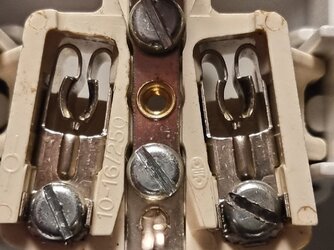
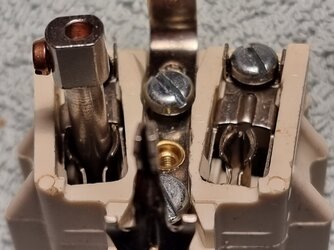
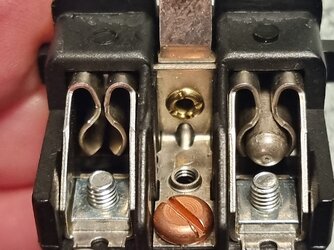
One design feature common to most good Schuko socket contacts is the significant length of live spring between anchorage and interface surface, of relatively high spring constant. It is impossible to bend any part beyond its elastic limit even with a grossly oversize pin clumsily inserted. Due to its double-curvature, the interface area remains rigid while the springiness comes from further along the contact where it is thermally decoupled by the large dissipative surface area and less prone to losing spring temper through heating.

Pics below show a good quality wall socket and trailing socket from the late 1980s that clearly illustrate the contact design with and without pin in situ.

Returning to BS1363, doing some ISITEE at the boat club on Sunday I found signs of excessive heating of a neutral pin of a short extension lead that was plugged into a multi-way block adaptor. It had been used to feed a 3kW fanheater and, although nothing was outright broken, the 13A load was too much for the shoddy contacts in the adaptor. It was no surprise that the adaptor's fuse carrier was seized into position too, although the conducted heat had not yet started the self-accelerating failure of the line socket contact.

20220524_213750.jpg20220524_213925.jpg20220524_214012.jpg
 

OFFICIAL SPONSORS

Back
Top