Hi again
I've successfully done the first 2 with the help of you lovely lot :-) I'm on question 3 at the min and the thing that's thrown me is the resistivity has changed from having e.g.
17.5×10>-9 ohms m

17.6u ohms mm

How does this change my formula do have to convert this to a scientific notations in meters square to calculate ? Don't know if I've explained my self very well but if you look at the difference from question 2 to question 3 you will see what I mean ..

The thing that's getting me is understanding how to convert mm squared into meters squared and understanding

And changing the decimals into x10 to the power of

If anyone can explain to me the formulae behind doing this it would be much appreciated ..

Thanks for your time everyone..

20180305_213207.jpg
 
I attach a picture showing some standard means of comparison of areas and working out powers and exponents.
Basic maths area and powers.jpg

For your example you have
28.5 x 10^-9 Ωm
and 17.6 µΩmm
The first one is in the units needed for the calculation Ωm, this can be thought of as ohm X meter (in comparison to Ω/m as ohms per meter or ohm over meter).
The second one is in µΩmm so, µ is micro, is 10^-6 and mm is thousandth of a meter, is milli (as in millimeter), is 10^-3.
therefore you have 17.6 x 10^-6 Ω 10^-3 m = 17.6 x 10^-9 Ωm
(add the exponents when multiplying powers, -6 + -3 = -9)
 
Hi Sam has your tutor gave you this as homework?
Hi mate kind of the course was called off the weekend due to the snow so I think he's give it us as a bit of a test just to see how much we can figure out on our own as we've not done any maths on our course yet so we've gone in completely blind .. I think it's just him seeing where we are and what we can do on our own
 
I attach a picture showing some standard means of comparison of areas and working out powers and exponents.
View attachment 41193
For your example you have
28.5 x 10^-9 Ωm
and 17.6 µΩmm
The first one is in the units needed for the calculation Ωm, this can be thought of as ohm X meter (in comparison to Ω/m as ohms per meter or ohm over meter).
The second one is in µΩmm so, µ is micro, is 10^-6 and mm is thousandth of a meter, is milli (as in millimeter), is 10^-3.
therefore you have 17.6 x 10^-6 Ω 10^-3 m = 17.6 x 10^-9 Ωm
(add the exponents when multiplying powers, -6 + -3 = -9)

Thank you Richard that's a big help
 
Hi again
I've successfully done the first 2 with the help of you lovely lot :) I'm on question 3 at the min and the thing that's thrown me is the resistivity has changed from having e.g.
17.5×10>-9 ohms m

17.6u ohms mm

How does this change my formula do have to convert this to a scientific notations in meters square to calculate ? Don't know if I've explained my self very well but if you look at the difference from question 2 to question 3 you will see what I mean ..

The thing that's getting me is understanding how to convert mm squared into meters squared and understanding

And changing the decimals into x10 to the power of

If anyone can explain to me the formulae behind doing this it would be much appreciated ..

Thanks for your time everyone..
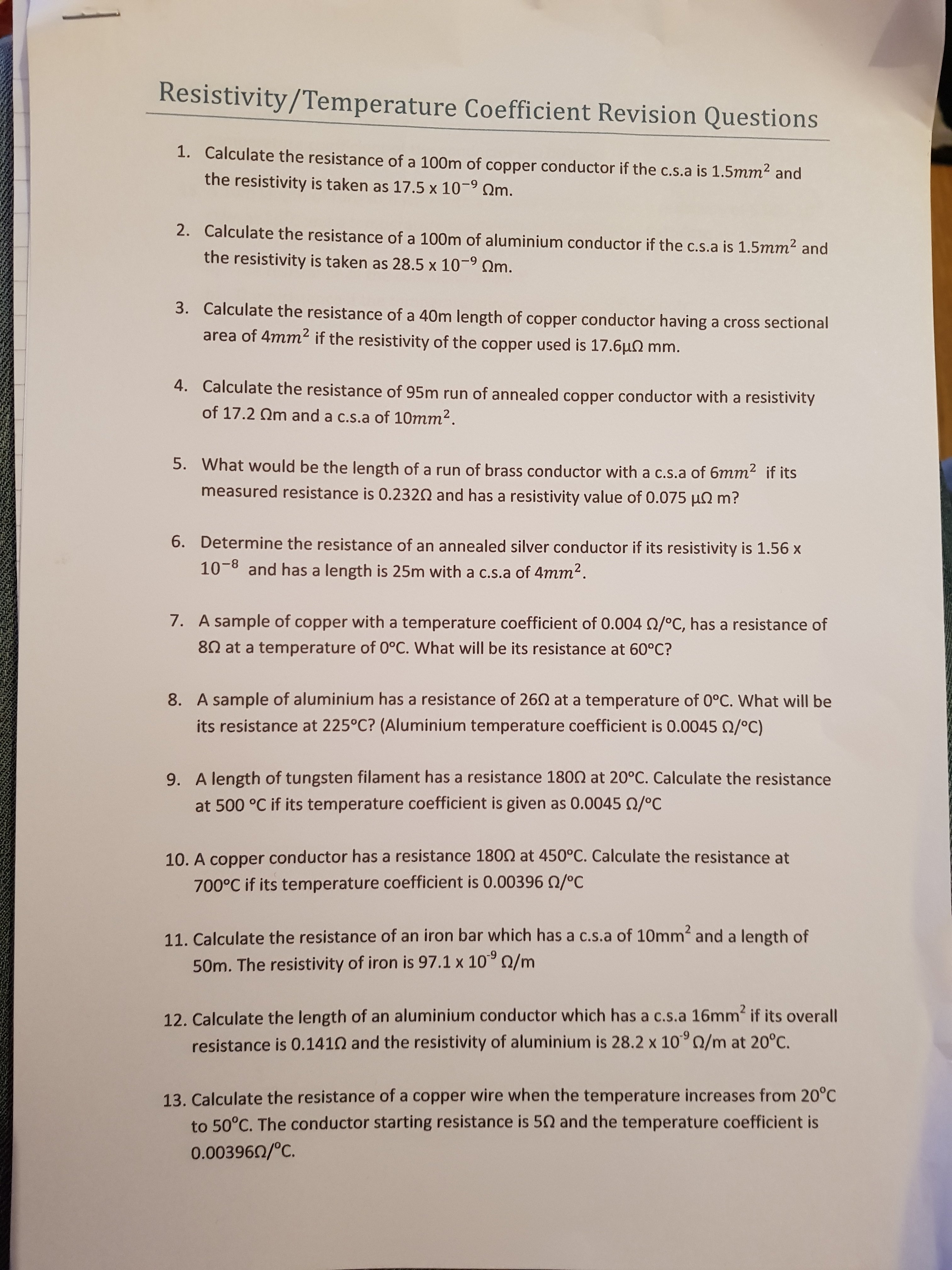
View attachment 41187
Hi sam, I will be coming to a section in my course book very similar to this, have you found any good methods for understanding this a bit better? maths is not my strong suit.
 
Yes mate been back to collage since it's all about transposing read pages 73 to 78 and 85 to 94 in the level 2 diploma book this should help
 

OFFICIAL SPONSORS

Back
Top

