HI, as my profile says I'm not a sparky and know my limitations. I'm trying to learn (for the sake of it only as I'll never do it) what tests for "Ring Final Circuits" are. I understand how the Tests 1, 2 and 3 are done but in one of the videos I watched the presenter (John Ward) mentions a "crossover" see image and says that this "could lead the current being shared in an undesirable fashion. I don't understand that.
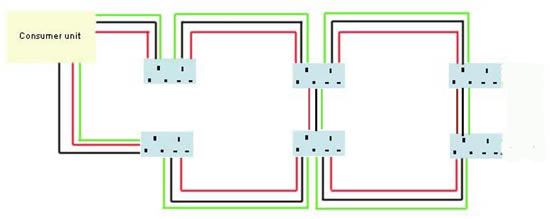
ring_main_crossover.jpg
 
That single piece of cable in the ring cannot carry the full current on its own as much as the "doubled up cable" effect of the ring.
 
The ring is a bit of an historic artefact, but a good one in my view. With the middle cross over it is no longer possible to perform a single test end to end. It doesn't improve the current capacity but it does make it much harder to test. My quick thought is it won't ruin the current handling capacity of the ring, but it's not the construction method shown in Appendix 14 of BS7671.
 
It's not done strictly in accordance with the good book, but there are worse arrangements!

The major issue is that, when you do testing on a ring final, you crodd connect the conductors in a sort of figure of 8 arrangement. Then you test at each socket and check the R1+R2 resistance. In a properly installed ring final, the R1+R2 at each socket should be more or less identical.

The circuit would fail this test because of the the 'lollypop' arrangement in your post.

Learn more about this test HERE

Or, if you love John Ward
 
It’s really too complicated to explain.
Also your diagram is not ideal.
Having a bridge reduces the resistance, so that more current can flow along one leg of the ring.
Current that should be in one leg gets diverted to the other leg which could result in the other leg being overloaded.
 
TBH I cant really recall any damage to cables on any of the hundreds of incorrectly wired rings I've come across over the years. In fact in the domestic sector it's pretty rare to find a correctly wired ring unless the house is fairly recent. The one I'm rewiring at the moment has spurs off spurs off spurs in the kitchen (now ripped out), no sign of thermal damage at all.
 
I think in reality it's highly unlikely that an incorrectly wired ring in a domestic setting would ever see high enough loading of sufficient duration to actually cause any cable damage. Seen a fair few 2.5mm^2 and even a few 1.5mm^2 radials on 30A/32A OCPDs and don't recall seeing any evidence of overload damage. Obviously, it's not good though!
 
I wouldn’t worry about it. Check out the profile of who gave you the rating!...
Only one post since 2012, and two dumb ratings:rolleyes:
I’ve reset the balance for you:)
 
I wouldn’t worry about it. Check out the profile of who gave you the rating!...
Only one post since 2012, and two dumb ratings:rolleyes:
I’ve reset the balance for you:)
It's amazing in some respects, you answer a post get, say 3 likes and a couple of agrees and 1 Dumb, that's like saying all the likes and agrees are dumb as well, yes I always check the profile, some are genuine,most are as you say TTC
 

OFFICIAL SPONSORS

Back
Top