UKMeterman

~
Arms
I think it was a rough bit of work.

The Risk Assessment should have checked out cables in the vicinity of the falling towers.


In one video you can see the towers hitting the cables, they were saying about and touching each other.
 
I think it was a rough bit of work.

The Risk Assessment should have checked out cables in the vicinity of the falling towers.


In one video you can see the towers hitting the cables, they were saying about and touching each other.
sounds like drunk students on a saturday night also
 
I read elsewhere on Twitter that a number of drones were filming the demolition and one was seen to strike overhead cables
 
No,
A metal mat was blown off the coolingtower and landed in the 33KV substation compound. I do wonder if it caused a an over voltage on the 33KV network, I wonder if there was a 132KV 33KV power cross
 
Didcot power station cooling towers were demolished today,
in the process there was damage to a 33KV substation. The strange thing is that there was signifcant flashover on the 33KV network causing alleged damage and injury to the public. Some videos here


What do people think was the sequence of events?
Do y’all think that dust from the cooling towers was conductive with carbon possibly shorted out the 33k power lines
 
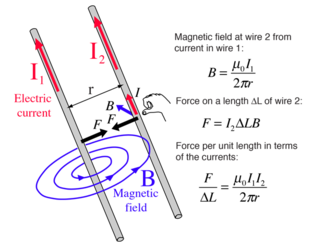
The swaying HV lines in one clip is caused by the electromagnetic forces between them due to the fault currents flowing in them - see Ampere's Law and Lorentz forces. Perhaps the amplitude of these sways was such the lines touched causing the shower of sparks over any nearby onlookers.

1566192130204.png
 
So, for a pair of parallel conductors, if the fault current was 10kA = I1 = I2 = then force per metre of line when the lines are a metre apart is:

1.25 x 10exp-6 x 10 x 1000 x 10 x 1000/(2pi x 1) =

approximately

1.25/6 x 10exp-6 x 10exp8 = 0.2 x 10exp2 = 0.20 x 100 = 20N/m

mu is the permeability of free space or magnetic constant and is - 1.25663706 × 10⁻⁶ m kg s-2 A-2

So for a 50m span total force is 50 x 20 = 1000Newtons.

As the force pulls the conductors together it increases - F is inversely related to r - so towards mid span where the conductors are freer to sway more, the forces will be much higher. On top of this, the impulse nature of this force will set up transverse vibrations of the conductors.
 
Last edited:
Radio 2 are discussing this right now
 
1000Newtons.

Or 225 lbs force for the physics luddites on here and those who refuse to use metric at any cost. Either way it's a fair old pull. The operating voltage is immaterial here, the same force per unit length would be experienced by a pair of meter tails for example.
 
The swaying HV lines in one clip is caused by the electromagnetic forces between them due to the fault currents flowing in them - see Ampere's Law and Lorentz forces. Perhaps the amplitude of these sways was such the lines touched causing the shower of sparks over any nearby onlookers.

View attachment 51446

So, for a pair of parallel conductors, if the fault current was 10kA = I1 = I2 = then force per metre of line when the lines are a metre apart is:

1.25 x 10exp-6 x 10 x 1000 x 10 x 1000/(2pi x 1) =

approximately

1.25/6 x 10exp-6 x 10exp8 = 0.2 x 10exp2 = 0.20 x 100 = 20N/m

mu is the permeability of free space or magnetic constant and is - 1.25663706 × 10⁻⁶ m kg s-2 A-2

So for a 50m span total force is 50 x 20 = 1000Newtons.

As the force pulls the conductors together it increases - F is inversely related to r - so towards mid span where the conductors are freer to sway more, the forces will be much higher. On top of this, the impulse nature of this force will set up transverse vibrations of the conductors.
Is it me or am I looking at the wrong picture but those three cables./wires, that are swaying, look suspiciously like stay wires, judging by the protective sleeves on the last few meters, mind you I do wear Specs so I could be hopelessly up the wrong tree without a branch, what do you think,? good explanation by the way nice post.
 
I looked at Rachel Barbaresi's clip in #1 - with a bit of close observation one can see the conductors stationary and then vibrating. Click on enlarge bottom right before play.
 
I looked at Rachel Barbaresi's clip in #1 - with a bit of close observation one can see the conductors stationary and then vibrating. Click on enlarge bottom right before play.
Will do 5 blinking words
 

OFFICIAL SPONSORS

Back
Top