D

DIYsparky

211EDA32-F0A0-453C-8AC5-33FCA45BC512.jpeg
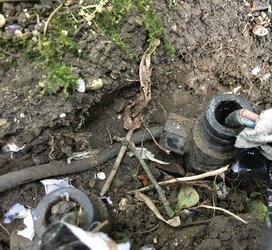
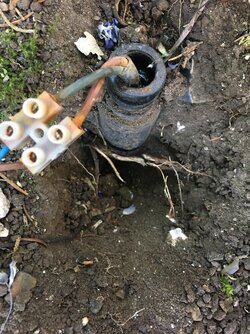
Pulled up old garden spike light to reveal what you see in the picture (the light was made in Italy - ERAL was printed on the inside).

Originally I thought the part remaining in the ground was the bottom of the spike, but now think it might be a conduit for the wire inside.

My plan is to fit a proper outdoor junction box (not much wire to work with) and then attach a new spike light (knightsbridge par38). Any thoughts on this approach or should I be doing something else?

I’ve tested voltage when switched on and covered in the meantime.

Many thanks
 
I think there is a junction box near to there, that looks like 2 core rubber flex, probably jointed within a meter of the cable end.

Also, I don’t think the cable will be reusable within the short length available, water has gone in and the strands will have oxidised for at least 400mm down the cable I expect
Thanks. I did test the electricity and it registered the correct voltage (although the contact was rusty and it jumped around a bit). Seems you’re suggesting I dig out the conduit and locate the junction box and then use fresh cable.
 
I can't picture what that 'conduit' is sticking out the ground. I don't recognise the shape at all!
I can dig down a little further. I expect the norm/best practice is to bury the cable a certain depth.
 
Thanks. I did test the electricity and it registered the correct voltage (although the contact was rusty and it jumped around a bit). Seems you’re suggesting I dig out the conduit and locate the junction box and then use fresh cable.

The whole point of conduit is to be able to pull a new cable in to replace the old one if needed without having to dig anything up.

You need to establish whether or not the existing cable is suitable to feed the new lights, I would be looking at the condition of it and whether or not the new lights require an earth.

When you say you tested the electricity and it registered the correct voltage what exactly do you mean?
To an electrician if you say you have tested it they tend to think you mean continuity, insulation resistance, loop impedance etc.
What volatge did you measure? Just saying it is correct doesn't mean much as this could be 13V,24V,48V,230V or some other non-standard value.
[automerge]1591137307[/automerge]
I can't picture what that 'conduit' is sticking out the ground. I don't recognise the shape at all!

It could be a corrugated flexible conduit, it's hard to tell from the angle and shirt section.
That stuff occasionally has a lumpy bit in it which I assume has something to do with the manufacturing process.
 
The whole point of conduit is to be able to pull a new cable in to replace the old one if needed without having to dig anything up.

You need to establish whether or not the existing cable is suitable to feed the new lights, I would be looking at the condition of it and whether or not the new lights require an earth.

When you say you tested the electricity and it registered the correct voltage what exactly do you mean?
To an electrician if you say you have tested it they tend to think you mean continuity, insulation resistance, loop impedance etc.
What volatge did you measure? Just saying it is correct doesn't mean much as this could be 13V,24V,48V,230V or some other non-standard value.
[automerge]1591137307[/automerge]


It could be a corrugated flexible conduit, it's hard to tell from the angle and shirt section.
That stuff occasionally has a lumpy bit in it which I assume has something to do with the manufacturing process.
0E021DC5-DD57-405B-9E3E-BC9720945E41.jpeg

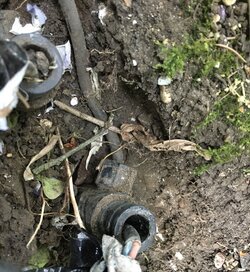
I dig a little further to find the above pic. Looks like it’s not a conduit, but part of the light spike. The cable then disappears down into the ground, I suspect to a junction box. If the wire tests ok, I may not need to dog to the junction box?
 

Attachments

  • 13A939AB-2DEF-4BD0-8F89-4FBF85AF04BA.jpeg
    13A939AB-2DEF-4BD0-8F89-4FBF85AF04BA.jpeg
    274.9 KB · Views: 58
certainlylooks like all that is part of the spike light. try pullung it out now that you've exposed the flex.
 
certainlylooks like all that is part of the spike light. try pullung it out now that you've exposed the flex.
I'll try pulling it out, especially after the rain has softened things up! I've also read that p.v.c. insulated concentric type cable can be buried, but the exposed flex doesn't seem to be that type.
 
replace any rusty looking connectors, visual check over, shake the connections with the lights on, if they don't flicker their good.
 
I'll try pulling it out, especially after the rain has softened things up! I've also read that p.v.c. insulated concentric type cable can be buried, but the exposed flex doesn't seem to be that type.

No, it won't be concentric cable.
 

OFFICIAL SPONSORS

Back
Top