lighting circuit

I

Industrial spark

Hi all. New to the forum so please go easy.
I am just about to start wiring a new kitchen under a building notice. Being an industrial electrician by trade I am not overly familiar with domestic lighting circuits and the normal setup when using twin/3 core cables. Could somebody please take a look at the attached diagram and let me know if this is how a domestic installer would set up a typical kitchen/dining room lighting circuit. Or is there an easier way to do things. 1 light in kitchen area and 2 way switches. 1 light in dining room on 2 way switches and 1 outdoor light. Plus heat/smoke detectors
Many thanks
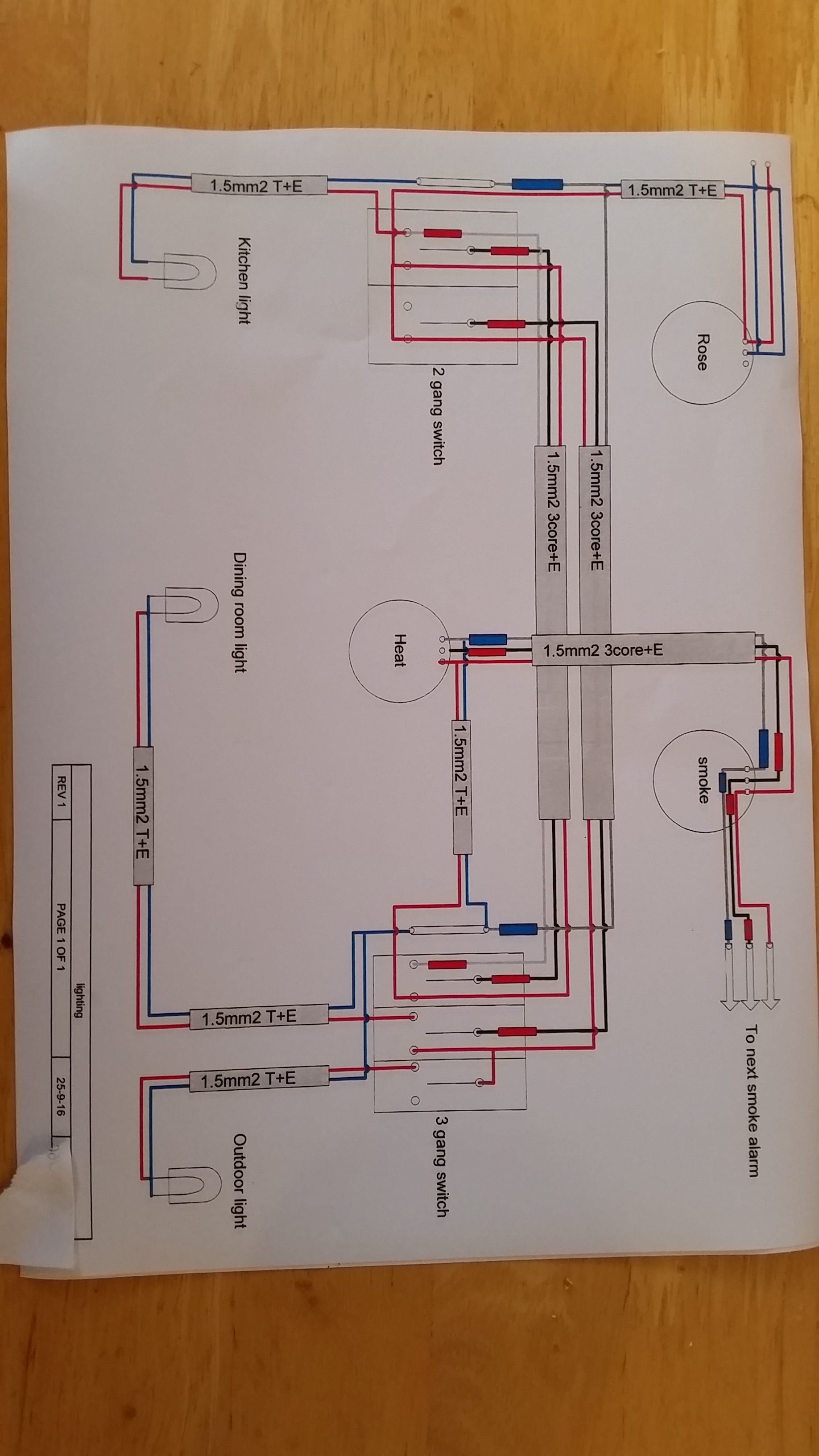
20160925_101809.jpg
 
Nothing wrong in theory. Why not take heat and smoke from the ceiling rose? it'd mean one less wire chased in and in the switch. I have a rule of thumb where i use 35mm boxes when theres more than 4 or more cables. I also sometimes sink a deeper box if i expect a dimmer to be added.
 
Why are you using 1.5mm^2 cable? Assuming the circuit isn't going to be overly long in terms of Zs and volt drop, 1mm^2 would suffice and be easier to terminate.
 
it will work but you have made life difficult for yourself. It amazes me that industrial sparks think their on cloud 9 but cant seem to understanding a basic lighting circuit. Not having a go but just seems a bit silly.
 
Nothing wrong in theory. Why not take heat and smoke from the ceiling rose? it'd mean one less wire chased in and in the switch. I have a rule of thumb where i use 35mm boxes when theres more than 4 or more cables. I also sometimes sink a deeper box if i expect a dimmer to be added.
Hi thanks for your reply.
Not shown on the picture there is also a switch wire in the rose for that light which is in another room so would be a tight squeeze to get the feed for the smoke and heats from their. Loop in, loop out,switch, pendant and smoke?
I was thinking 35mm back box but could go draper. Chasing is not a problem as dot and dabbing thermal board into wall.
 
it will work but you have made life difficult for yourself. It amazes me that industrial sparks think their on cloud 9 but cant seem to understanding a basic lighting circuit. Not having a go but just seems a bit silly.
Lol. I do understand it but as I said my day in day out job involves large 3 phase machinery and PLC programming. If I could put some conduit in and a bunch of singles I'd be laughing. Not sure the wife would be though.
 
Why are you using 1.5mm^2 cable? Assuming the circuit isn't going to be overly long in terms of Zs and volt drop, 1mm^2 would suffice and be easier to terminate.

I do agree and i would use 1mm but just happen to have a drum of 1.5mm handy and it seems a waste to buy new.
 
It amazes me that industrial sparks think their on cloud 9 but cant seem to understanding a basic lighting circuit. Not having a go but just seems a bit silly.

Wait until he needs to add some intermediate switches! :D:D:D

If I could put some conduit in and a bunch of singles I'd be laughing. Not sure the wife would be though.

I'm sure she'd prefer some nice conduit as opposed to some wonky grey T&E pinned to the walls.


(Arch, Inst Tech :))
 
I was installing AV kit in an office refurb job but were not allowed in the rooms until the corridor lighting was working.
One circuit, about 12 intermediates operating a contactor with 3 10a (single phase) runs to the lights.
The sparky had run 2off 3c&e between the switches (lucky, one grey & one white so very easy to identify).
He spent 2 days doing the switch wiring and it was not finished, during that time I spoke to the main contractor several times and was advised he had put 'the best man was on the job as it was so complicated'. When I informed him we would be passing our penalty clause claim on to him he allowed me to 'finish it off' for a days rate.
I expected to find the same two colours of cores wired into each intermediate and a single connector.
I was wrong, the colours switched back and forth allong the row and there were differing numbers of joins in each switch and differing numbers of spares in the cables.
I didn't bother trying to work out he what had done, instead I just rewired each switch, leaving a completely spare 3c&e.
The main contractor was amazed that I'd stripped and rewired well over half of them in the time it took him to get the keys to unlock the power cupboard.
We took on some of the leccy work after that as well as the AV.
 

OFFICIAL SPONSORS

Back
Top

