The bottom right quarter of a meter box is reserved for customers equipment. The DNO do not own the meter box, the customer does.
Source URL: Supply to garage. - https://www.electriciansforums.net/threads/supply-to-garage.188535/#post-1643781

Correct. But the supply agreement normally stipulates that the meter box is for the exclusive use of the DNO and meter operative, just the same as they always have a separate board from the consumer unit if the point of supply is inside the house.
Ownership of the meter box basically means that the customer is responsible for maintaining it.

In theory
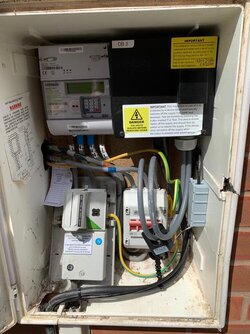
I see an awful lot of consumer units in meter boxes. They never complain
 
I have been to many meter boxes , and they are jammed pack with PV equipment , isolators, switchfuse, and even seen CU's in them.(thats without the cutout)

Smart meters with comms hub and T2 Aerial if needed take up a lot of room, it would not fit with the mentioned equipment above.
It is the space for DNO and metering equipment.
 
This picture from UKPNs guide for customers may help.

Screenshot_20200717_101944_com.android.gallery3d.jpg


I believe the word contractor in the top right quarter is incorrect and should say contactor.
 
For car charger I would go for a zappi or pod point. Neither requires an earth rod but importantly both have ct clamp functions to monitor the load in the property and garage to protect the fuses. It will throttle the charger up or down according to capacity in the property. When there is little demand the charger can pull the full 32 Amps. If other things are in use it will charge at a lower rate.
 
For car charger I would go for a zappi or pod point. Neither requires an earth rod but importantly both have ct clamp functions to monitor the load in the property and garage to protect the fuses. It will throttle the charger up or down according to capacity in the property. When there is little demand the charger can pull the full 32 Amps. If other things are in use it will charge at a lower rate.
Thx for advice. Sorry for slow reply.
 
OP, Sizing cables is down to factors other than ability to teminate!! Seriously, confirm exactly what he is having and how he will use it, then work out a realistic design current. It may save a few quid too.
 
Hi thanks for reply.
I don't fully understand your isolator point. The current tails are 15 hence they are on the isolator seen in the picture. They do not require fused switch? So why would my swa require one.

I see your point but not entirely sure I agree otherwise all meter tails would need one wouldn't they?

Hope you respond with your thoughts.

Thankyou.

I just read this. I genuinely think you should decline this job.
 
This all seems a bit crazily thought out, do you always choose your cable sizes based on how easily it will be to terminate them?!
No not at all. But when your only option is the meter cupboard space you start to have issues. My concern was for future car charging capacity when he has two cars but since having looked at the xlpe cable I will go for 16mm. 10mm would most probably be ok but why ---- about for 20 pound considering the 12 meters of digging.
[automerge]1595106869[/automerge]
Nonsense, having a concrete floor does not require you to install a TT system.

Everyone is happy to criticise so I will respond. This is direct from stroma please read Dave sparks.


If the remote building has a concrete earth floor, or conductive floor, or the building is of metal construction or metal outside skin, the shock risk is increased. It’s therefore recommended that the remote building has a TT earthing system.

That is why I will TT it.
 
Last edited by a moderator:
No not at all. But when your only option is the meter cupboard space you start to have issues. My concern was for future car charging capacity when he has two cars but since having looked at the xlpe cable I will go for 16mm. 10mm would most probably be ok but why ---- about for 20 pound considering the 12 meters of digging.
[automerge]1595106869[/automerge]


Everyone is happy to criticise so I will respond. This is direct from stroma please read Dave sparks.


If the remote building has a concrete earth floor, or conductive floor, or the building is of metal construction or metal outside skin, the shock risk is increased. It’s therefore recommended that the remote building has a TT earthing system.

That is why I will TT it.

You only need to prove if it is extraneous. If it is not then you have nothing to bond.
 
I just read this. I genuinely think you should decline this job.
TJ Anderson thanks for response. My response you highlighted doesn't read well. I will try to explain better for discussion. That's what it is discussion not criticism.
When meter tails are over 3m an isolator is normally needed to satisfy the dno.
If the tails were split with say swa cable and a neat way was found to terminate the swa without the need of a fused switch then what is the difference between the new swa tails and the existing house tails? If they the same rating?
The difference the swa is actually better protected than the original tails that run for 15 meters through the house.
The discussion was if the new tails absolutely have to have a fused switch then why is just an isolator acceptable for every other property in the uk with meter tails over 3m.
I will be using a fused switch, I will be changing cable size to xlpe because of its increased rating I will be TTing the system.
The reason for the TT is its safer.

I can speck the install 100 percent because he doesnt know how many chargers he wants in the future. Most probably 2 but not ruled out more.
I hold my hands up to not knowing the true capabilities of xlpe cable over standard swa but I have now been educated

Discussion forum not criticism forum. People come on for help and advice in improving installs not to be picked apart otherwise what's the point.
 
The discussion was if the new tails absolutely have to have a fused switch then why is just an isolator acceptable for every other property in the uk with meter tails over 3m.
The way I have always seen the regulations interpreted is you (i.e. the designer) has to provide the switching & OCPD for cables longer than 3m.

Obviously if your cable is rated below the DNO fuse (e.g. sub-main to a garage CU in 6mm or whatever) then it is essential that you include the appropriate fuse/breaker.

Now from a simple engineering point of view there is no reason why you should add a 2nd 100A fuse immediately after the DNO fuse as you will have no selectivity. But from an ownership and legislation point of view the DNO side is separate and distinct from the installation you are designing. Theoretically they can change the ratings and/or the OCPD to suit whatever is needed for protecting their network.

So some might feel that only an isolator is needed if the long tails are adequately protected from overload by the DNO's biggest fuse option, but I have always seen it interpreted as the installation should be designed to have OCPD under your control.
 
The way I have always seen the regulations interpreted is you (i.e. the designer) has to provide the switching & OCPD for cables longer than 3m.

Obviously if your cable is rated below the DNO fuse then it is essential that you include the appropriate fuse/breaker.

Now from a simple engineering point of view there is no reason why you should add a 2nd 100A fuse immediately after the DNO fuse as you will have no selectivity. But from an ownership and legislation point of view the DNO side is separate and distinct from the installation you are designing. Theoretically they can change the ratings and/or the OCPD to suit whatever is needed for protecting their network.

So some might feel that only an isolator is needed if the cables are adequately protected from overload by the DNO's biggest fuse option, but I have always seen it interpreted as the installation should be designed to have OCPD under your control.
Thankyou now that is what I call a well constructured reply. Explains the point very clearly and explains my question.
 

OFFICIAL SPONSORS

Back
Top