J

jackinthehood

Hi,

I have an outside light that I would like to add a PIR to while keeping the ability to continue to use the switch as normal, do I simply add the PIR in parallel to the switch as shown in my excellent high quality attached drawing? :)
Or will this damage the PIR when the light is turned on using the switch?

Just to be clear I am a DIY'er with a background in electronics, and will be getting it checked over by my sparky mate but he's crazy busy at the mo so don't want to waste his time if I can work it out myself as I have plenty of time on my hands from being covid-unemployed at the moment.

Thanks
 

Attachments
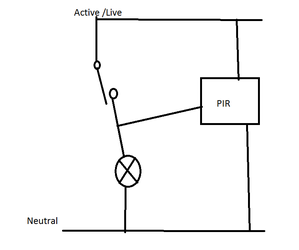
  • PIR.png
    PIR.png
    7.1 KB · Views: 31
Last edited by a moderator:
Love the drawing mate.
I'm presuming it would depend on what type of PIR you get and how it switches.
There are many great people on here who have done this, so I will let them instruct you better.
 
Great drawing! Lowry would have been proud...Rolph Harris, less so...can you guess what it is yet?
No offence meant, mate...just having a bit o' fun!
 
I do not know if you can still get the pir's that latched by flicking the switch off and on within 2 seconds (if it is in the permanent on position). If not you will have to wire an override , this usually involves an extra core. You may be lucky , it may be three core and earth , but I doubt it.
 
Last edited by a moderator:
I do not know if you can still get the pir's that latched by flicking the switch on and off within 2 seconds. If not you will have to wire an override , this usually involves an extra core. You may be lucky , it may be three core and earth , but I doubt it.
Yeah, used to install loads but not seen any for a while. Switch twice for override.

Hi Rus, How's things pal?
 
I'm ok thank's . Thank's for asking. I hope you are well too.
I'm not allowed out, but it is not too bad . I'm finding old worn out stuff to repair, glad I didn't bin it now. :)
 
Cant beat a bit of drawing with good ol' Paint!! :)

I do not know if you can still get the pir's that latched by flicking the switch off and on within 2 seconds (if it is in the permanent on position). If not you will have to wire an override , this usually involves an extra core. You may be lucky , it may be three core and earth , but I doubt it.

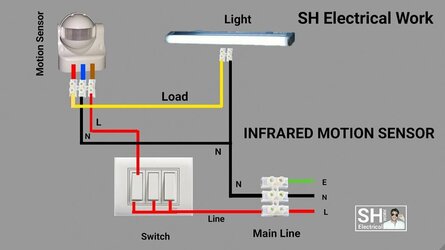
So to get the PIR to latch on, I would need to wire it in series with the switch not parallel? like this
maxresdefault.jpg


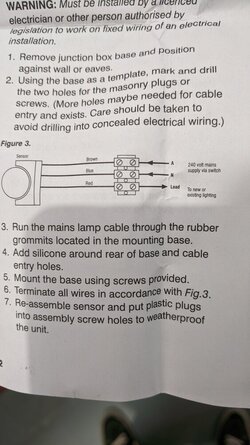
one of the PIR's I looked at had this as the wiring diagram.
Cheers

IMG_20200517_140422.jpg
 
Last edited by a moderator:
The override is built into the sensor ; if they are still available.
If they are all that is required is your existing supply connected to the PIR sensor .
Your control switch will be permanently on when operation is required, switching the sensor of and on within two seconds will bring the lamp on permanently.
Go to your local electrical wholesaler and see if this type of PIR is still available.
If your supply is two core and earth and you require override with a sensor that does not have an override facility to do as you wish, you will need a three core and earth , the extra core needed to bypass the sensor direct to the lamp. This will entail a separate switch at the control point.
Amazon for one has the manual override detectors.
 
Last edited by a moderator:

OFFICIAL SPONSORS

Back
Top