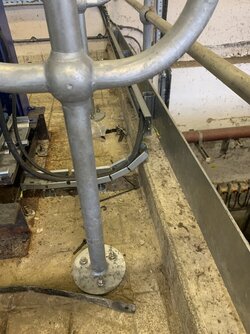
Would this barrier require supplementary bonding to the cable tray?
 

Attachments

  • AF363B8F-2ADF-46E8-A99B-7C5853DF6B93.jpeg
    AF363B8F-2ADF-46E8-A99B-7C5853DF6B93.jpeg
    158.6 KB · Views: 199
Is the barrier at risk of contact with any other cable or extraneous parts? I guess it is tricky to know if rebar in the concrete is externally earthed, etc.

It is probably not required, but at Mike puts it, if in doubt bond it! Worked fine for the 15th edition after all...

I think the more scientific approach is the check its impedance to the system Earth, if it is below 0.05 ohms or above 22k (I think, need to check) then it is not needed as in the first case can be considered already well-bonded, and in the 2nd case can be considered as not having enough of a potential extraneous path to allow more than a 10mA fault current.
Where do we measure to if on a mcc can I measure from the chassis stud to the extraneous part?
 
As already said, the correct place is the MET (especially for the low bond impedance check), but for the 22k test then anything you know is on the CPC circuit.
[automerge]1593069936[/automerge]
If far from the MET then you should allow a reasonable increase in the 0.05 ohms test. For example, what might be expected of X meters of 10mm cable as a good indication of a solid bond.
What do we class at the MET of An MCC. I know there’s a resistance between exposed conductive part and extraneous part ( current causing the breaker to trip in 5s divided by the resistance measured should be less than 50v. Just struggling with determining if it’s extraneous or not.
 
What do we class at the MET of An MCC. I know there’s a resistance between exposed conductive part and extraneous part ( current causing the breaker to trip in 5s divided by the resistance measured should be less than 50v. Just struggling with determining if it’s extraneous or not.

What figure do you get when you test to see if it an extraneous part?
 
Testing to establish the requirement for supplementary bonding doesn't need to be from the MET and should be done with all other bonding connected, which is somewhat opposite to testing to establish whether main bonding is required.
 
Testing to establish the requirement for supplementary bonding doesn't need to be from the MET and should be done with all other bonding connected, which is somewhat opposite to testing to establish whether main bonding is required.
So testing if supplementary bonding I could just test from a bonded part of the circuit to the parts of question and then from the values determine if it’s extraneous or not? But main bonding is always measured from the MET is that what you’re saying. Thanks for your help!
 
I say don't just bond something and introduce a possible fault current when not needed - you can do a test to see if it's a extraneous conductive part and path to earth.
 
although it could get a bit confusing because it could actually be in contact with the Cable tray and you can visually see - some say cable tray doesn't need bonding but I'm sure I've seen in either Regs or OSG tray is a Exposed conductive part and then... you could meet the requirements where no supplementary bonding is needed anyway, please tell if I'm wrong.
 
Normally tray is neither an extraneous conductive part as it doesn’t introduce an earth potential into the installation and not exposed as it doesn’t form part of the electrical installation as it’s only a cable management system, unless it’s being used as a cpc which is allowed then it is earthed for use as a cpc.
Supplementary bonding maybe required if the earth fault loop impedance cannot be Met for a circuit and the tray is in the location so is supplementary bonded to keep touch voltages bellow 50 v
 
Well NICEIC would agree

but in my mind it's not less an exposed conductive part in my mind than SWA or trunking.

City and Guilds official source - handout

"Equipotential bonding
BS 7671:2018 (page 29) defines ‘equipotential bonding’ as:
Electrical connection maintaining various exposed-conductive-parts and
extraneous-conductive-parts at substantially the same potential.

When used (as it usually is) for the purpose of safety, it is referred to as ‘Protective equipotential bonding’, which is defined as ‘equipotential bonding for the purpose of safety’ (page 35).

BS 7671:2018 (page 29) further defines ‘Exposed-conductive-parts’ as: Conductive part of equipment which can be touched and which is not normally live,but which can become live under fault conditions.
This includes:
 steel conduit
 steel trunking
steel tray
 steel enclosures of wiring systems"
[automerge]1593183415[/automerge]
it doesn't have to be something used as a CPC - this includes metal face plates and backing boxes

Back to OP

old OSG
"Metal handrails and metal windows not connected to metal parts of the building structure, are not required to be supplementary bonded"
 
Last edited:

OFFICIAL SPONSORS

Back
Top