
Hello all,
I'm a commercial electrician who was asked to install some lights by a family member, so domestic/lofts etc isn't really my area of expertise. Just wanted to clarify something about the regs in lofts and my cable calculations that came from it.
I've altered an existing lighting circuit to add another ceiling rose in a bedroom. The existing installation was in 1.0mm and I've ran additional cables in 1.5mm, but will for the purposes of the calcs treat the circuit as if all is wired in 1.0mm.
I interrupted the permanent feed in the loft space with a Wagobox, which now feeds each light using 3 plate wiring. This JB is uncovered by any insulation. Most of the cable runs are clipped direct to joists, with insulation adjacent to it (I'm going to assume the insulation is greater than 100mm as it's a 2024 new build)
Therefore I had been working to the idea this qualifies as reference method 101, as the cables were clipped direct to a joist where possible. Yet there was one section, around 1m wide where the insulation emerges from under a boarded section of the loft into an unboarded section, and as such is drooping over the top of the joist. In this instance I ran the 2 cables in the channel this created under the insulation. Therefore still touching the plasterboard surface, and still method 101. But given that it isn't clipped I can't guarantee contact with the plasterboard or joist along it's entire length. It will be in contact for most of its run, but some will likely be in free air underneath the insulation. This leads me to wonder if I may as well treat it as method 103 as a worst case scenario? Even if that does refer to stud walls.
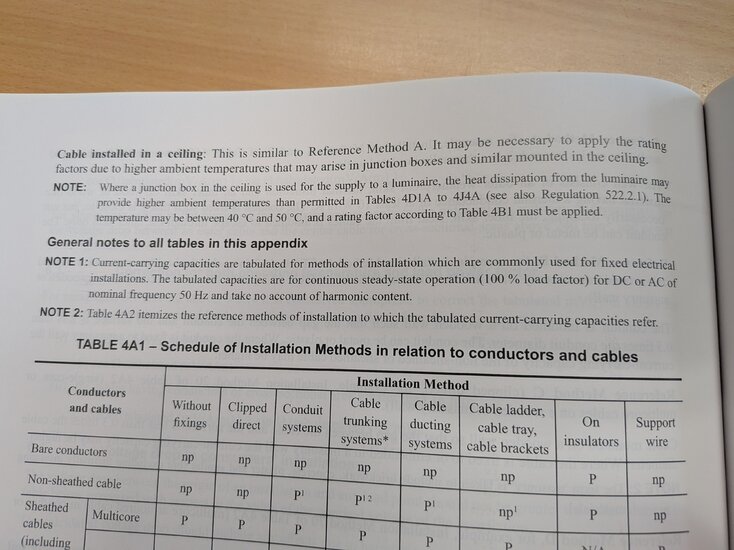
So according to table 4D5, 1.0mm t&e is rated for 10.5A installed according to method 101. But only 8A if method 103. It's on a 6A breaker, so no issues right? Well, given I installed a junction box as well, I'm lead to believe I should also apply a derating factor to account for the fact I've supplied luminaries via a junction box mounted in the ceiling:

Therefore meaning a derating factor of 0.71(again, worst case scenario) as per table 4B1.
This is fine if method 101 still applies (10.5 x 0.71 = 7.455A) but not if I treat it as method 103 (8A x 0.71 = 5.68A)
I know realistically these lights won't be pulling anywhere close to this, but I want to make sure it's 100% safe. Should I go back and cut the insulation along the top of that joist, pull it back away from the joist and clip the two cables along it, thereby making certain I've complied with method 101?
Thanks in advance for any advice you can give.
I'm a commercial electrician who was asked to install some lights by a family member, so domestic/lofts etc isn't really my area of expertise. Just wanted to clarify something about the regs in lofts and my cable calculations that came from it.
I've altered an existing lighting circuit to add another ceiling rose in a bedroom. The existing installation was in 1.0mm and I've ran additional cables in 1.5mm, but will for the purposes of the calcs treat the circuit as if all is wired in 1.0mm.
I interrupted the permanent feed in the loft space with a Wagobox, which now feeds each light using 3 plate wiring. This JB is uncovered by any insulation. Most of the cable runs are clipped direct to joists, with insulation adjacent to it (I'm going to assume the insulation is greater than 100mm as it's a 2024 new build)
Therefore I had been working to the idea this qualifies as reference method 101, as the cables were clipped direct to a joist where possible. Yet there was one section, around 1m wide where the insulation emerges from under a boarded section of the loft into an unboarded section, and as such is drooping over the top of the joist. In this instance I ran the 2 cables in the channel this created under the insulation. Therefore still touching the plasterboard surface, and still method 101. But given that it isn't clipped I can't guarantee contact with the plasterboard or joist along it's entire length. It will be in contact for most of its run, but some will likely be in free air underneath the insulation. This leads me to wonder if I may as well treat it as method 103 as a worst case scenario? Even if that does refer to stud walls.
So according to table 4D5, 1.0mm t&e is rated for 10.5A installed according to method 101. But only 8A if method 103. It's on a 6A breaker, so no issues right? Well, given I installed a junction box as well, I'm lead to believe I should also apply a derating factor to account for the fact I've supplied luminaries via a junction box mounted in the ceiling:
Therefore meaning a derating factor of 0.71(again, worst case scenario) as per table 4B1.
This is fine if method 101 still applies (10.5 x 0.71 = 7.455A) but not if I treat it as method 103 (8A x 0.71 = 5.68A)
I know realistically these lights won't be pulling anywhere close to this, but I want to make sure it's 100% safe. Should I go back and cut the insulation along the top of that joist, pull it back away from the joist and clip the two cables along it, thereby making certain I've complied with method 101?
Thanks in advance for any advice you can give.
Attachments
Last edited:


