Thanks, Archy. Got that bit, using the modulus of impedance then combining resistors in parallel and in series, came up with 332.53 ohms.

Though to calculate the power transferred is P=I^2xR so would I not need another value? The supply says 50Hz not 50V

It's just asking for a load resistance which will achieve mpt
 
Archy, Thanks for giving it a go, once i'm done with it believe me, I don't want to look at it for a long time! what value did you get out of interest?

Chr!s, The thevenin equivalent is no problem, but i'm assuming the question is asking for a value of the power transferred to the load in watts?

Do you think it is just asking for the load impedance only which will have to be equal to the circuits internal impedance for maximum power transfer? (as you say Rs=Rl). I hope so!

Yes load impedance only, it won't matter what the emf is, you have matched the two impedances so Rs=Rl
 
Nice one, It's starting to get clearer, alas, there's still some fog!

Determine the value of the load impedance that will dissipate the maximum power (Thevenin impedance equivalent of the circuit) DONE

And the value of this power? (Do you reckon its just the way its worded?)
 
Nice one, It's starting to get clearer, alas, there's still some fog!

Determine the value of the load impedance that will dissipate the maximum power (Thevenin impedance equivalent of the circuit) DONE

And the value of this power? (Do you reckon its just the way its worded?)

Well if Rs = Rl then the power dissipated in the load will be 50% of the total power dissipated in the circuit.
 
Fantastic!

Chr!s, thank you. I've been looking at how to get power as watts which will never work without the correct values. Never though of it as a percentage, which by definition is a value.

I've just sent you up to 100 thanks as well. Appreciate your time.
 
Fantastic!

Chr!s, thank you. I've been looking at how to get power as watts which will never work without the correct values. Never though of it as a percentage, which by definition is a value.

I've just sent you up to 100 thanks as well. Appreciate your time.

Your welcome. Good luck!
 
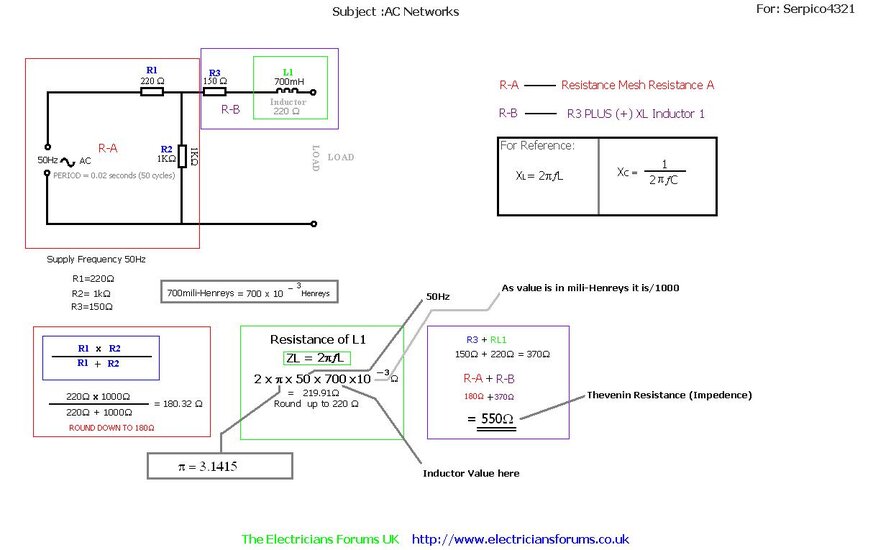
Thanks for the replies! I'm looking to get the maximum power transfer for the load impedance. View attachment 17445 To calculate the power surely requires either current or voltage to which I am only given the 50Hz supply and the calculated impedance. I've attached a drawing (yeah I know!) Chr!s, 'There are two methods, the trial and error to plot from 0 - 3 ohms, or the first derivative method' I've not heard of the trial and error plot, is there any chance (please!) you could elaborate on this. Using either of these applications you can find the maximum power from only Frequency & Impedance? Thanks
did this on microsoft paint from scratch, please excuse as was done at 2:30 Am as I was up :rolleyes2:
 

Attachments

  • AC Load Resistance for Maximum power.JPG
    AC Load Resistance for Maximum power.JPG
    86.5 KB · Views: 65
Last edited by a moderator:
grant,
There's an error in your solution.
The inductor is reactive so you can't just add it to the resistances.

X[SUB]L[/SUB] = j219.9

so Z[SUB]Th[/SUB] = 330.3 + j219.9

and Z=sqrt(R[SUP]2[/SUP] + X[SUP]2[/SUP])

Blame it on it being 2:30am! :-)
Good drawing btw.
 
Last edited by a moderator:

OFFICIAL SPONSORS

Back
Top