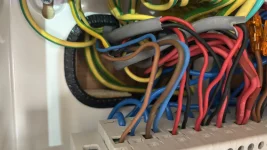
So big hole at rear of CU.. right next to nice dry timber. I feel like a C3 is appropriate, but is there any legitimacy in coding it a C2?
IMG_7856.webp
 
I would give it a C3. I would only give it a C2 if you could access that hole and actually get a finger inside, from the outside, which I doubt you can.
 
I would give it a C3. I would only give it a C2 if you could access that hole and actually get a finger inside, from the outside, which I doubt you can.
Yeah my finger can just barely reach the hole (I have a pic showing my finger tip peeping through), but certainly can't reach any live parts.

I'll see if anyone else has any contributions but otherwise I'll go with a C3 - cheers.
 
Yeah my finger can just barely reach the hole (I have a pic showing my finger tip peeping through), but certainly can't reach any live parts.

I'll see if anyone else has any contributions but otherwise I'll go with a C3 - cheers.
Remember that if you are designating it C3 then you are stating that it fails to comply with at least one Regulation, so perhaps ask yourself which specific Regulation(s) It contravenes.
 
Remember that if you are designating it C3 then you are stating that it fails to comply with at least one Regulation, so perhaps ask yourself which specific Regulation(s) It contravenes.
That's interesting, and a very good point if correct. I was considering giving it a C3 simply because the spark that installed it could've mounted it directly onto the plastered brick wall and used the cable entries along the top surface of the board - the way he's done it is less safe in terms of a fire spreading from the consumer unit (so I suggested improvement), but may not directly contravene a regulation. So you're saying that even though we probably all agree that it would be safer mounted a different way, if it doesn't contravene a reg it can't be coded?
 
Are the conductors actually contained within the enclosure?
 

AI-generated reply. more info

@Admin

On the facts you’ve given so far, I wouldn’t be coding this at all on an EICR.

Key points to check in your own mind:
  • Basic protection / enclosure: If no live parts are accessible with the standard test finger and all insulated conductors are still within the CU / back‑box arrangement, then Regulation 416.1 / 416.2 and 416.2.1 are effectively satisfied in practice. A fingertip just about reaching a small hole but not reaching live parts is not a non‑compliance in itself. That’s why many people are saying “no code”.
  • Fire spread concerns: BS 7671 coding is about non‑compliance with the Wiring Regulations, not about “it could have been installed in a better way”. Unless you can point to a specific clause (e.g. 421.1.x or 521.x) that is actually breached by the current mechanical arrangement, a C3 purely on the basis of “I’d have mounted it differently” is weak.
  • Regulation to quote if you really feel it needs a C3:
The only plausible angle would be something like 134.1.1 (workmanship, good practice) or 132.5 (accessibility / maintainability) if the arrangement causes a real, demonstrable issue (e.g. damaged enclosure, poor sealing so big gaps, evidence of overheating, etc.). From what you’ve described, that doesn’t sound to be the case.

So unless further inspection shows an actual accessible live part, damaged enclosure, or conductors clearly outside the enclosure, I’d describe it in the comments if you like, but leave it uncoded on the EICR.
 

OFFICIAL SPONSORS

Back
Top