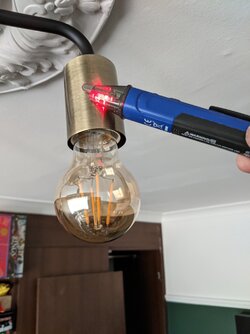
Recently bought a none contact voltage tester and decided to use it on a few things around the house but a metal bedroom light is lighting up red and beeping to say the light is live. I have tried it on all of the parts of the light and it lights up everywhere. I am too scared to touch the metal light now. I tried it on 2 other metal lights downstairs but it did not beep or light up. Can anyone help? Thanks
 

Attachments

  • PXL_20220702_132016401.jpg
    PXL_20220702_132016401.jpg
    416.9 KB · Views: 11
  • PXL_20220702_131241636.jpg
    PXL_20220702_131241636.jpg
    282.8 KB · Views: 11
Non contact voltage testers can give misleading indication however they generally do not indicate through metalwork to the contained conductors. Is it lighting on the black tubework.
 
These are not accurate.

Your best bet is to get someone out to have a look, but if you're interested in this sort of thing an actual voltage and continuity tester is a better investment.
 
These are not accurate.

Your best bet is to get someone out to have a look, but if you're interested in this sort of thing an actual voltage and continuity tester is a better investment.
Thanks for the reply. I do have a KEWTECH KT1780 if that would help double check if the metal part is live but not sure how to use it to check.
 
Recently bought a none contact voltage tester and decided to use it on a few things around the house but a metal bedroom light is lighting up red and beeping to say the light is live. I have tried it on all of the parts of the light and it lights up everywhere. I am too scared to touch the metal light now. I tried it on 2 other metal lights downstairs but it did not beep or light up. Can anyone help? Thanks
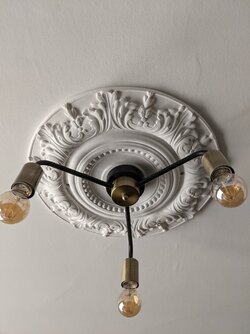
As @westward10 says, non contact voltage testers can only give an indication, which isn't always accurate unless you interpret them correctly.

That looks suspiciously like a LAP tester, which in my experience are not very good quality either so I wouldn't necessarily trust it, though it makes sense to be sure it is safe.

Is the ceiling light on in the picture, it's hard to tell? If it is, do you get the same reading with the light off?

Was it installed by someone who knew what they were doing? It's possible that it's been installed with reverse polarity, so that the neutral and live are crossed - which could mean it might detect the 'live' through the metal even with the light off - though likely only if the metal is thin, or perhaps not metal at all.

The only immediately dangerous option would be that if the earthed metal had become live, in which case it should be installed in a way that would trip the mcb or RCD in the consumer unit.

Is the lighting circuit on an RCD in the consumer unit/fusebox?

it's hard to diagnose any further without a 2 pole tester used correctly to get an accurate view of the installation. If you're unsure it may well be worth getting an electrician to pop in and check, particularly if the installation has never been tested.
 
Problem here is that you would need a known earth you use the tester and if the metalwork is actually live that suggests the fitting is not effectively earthed and other parts of the circuit may not be. Advising how to use your other tester isn't something I would be doing due to the hazards involved so you be best getting an electrician involved. It may be turn out to be the quirks on a non contact tester although as I say it is unusual for them to indicate through metalwork.
 
As @westward10 says, non contact voltage testers can only give an indication, which isn't always accurate unless you interpret them correctly.

That looks suspiciously like a LAP tester, which in my experience are not very good quality either so I wouldn't necessarily trust it, though it makes sense to be sure it is safe.

Is the ceiling light on in the picture, it's hard to tell? If it is, do you get the same reading with the light off?

Was it installed by someone who knew what they were doing? It's possible that it's been installed with reverse polarity, so that the neutral and live are crossed - which could mean it might detect the 'live' through the metal even with the light off - though likely only if the metal is thin, or perhaps not metal at all.

The only immediately dangerous option would be that if the earthed metal had become live, in which case it should be installed in a way that would trip the mcb or RCD in the consumer unit.

Is the lighting circuit on an RCD in the consumer unit/fusebox?

it's hard to diagnose any further without a 2 pole tester used correctly to get an accurate view of the installation. If you're unsure it may well be worth getting an electrician to pop in and check, particularly if the installation has never been tested.
Hi, it is a LAP tester.

The light is off and the tester lights up while its off. [The light does switch on and work]

The consumer unit has 2 rcds [1 for one half and the other for the rest] nothing has tripped.
 
Hi, it is a LAP tester.

The light is off and the tester lights up while its off. [The light does switch on and work]

The consumer unit has 2 rcds [1 for one half and the other for the rest] nothing has tripped.
Ok, the fact that you have RCDs is one reason to worry a little less, as I assume there have been no trips? However, the light may not have been installed correctly and an RCD not tripping is not a guarantee that things are safe.

The fact that it detects on this light when off, and not the others, suggests that something is not quite right and it would be best to get it accurately diagnosed.

It would take an electrician less than 30 minutes to confirm whether anything is wrong here and it sounds like it would be a worthwhile investment for peace of mind at least.
 
As @westward10 says, non contact voltage testers can only give an indication, which isn't always accurate unless you interpret them correctly.

That looks suspiciously like a LAP tester, which in my experience are not very good quality either so I wouldn't necessarily trust it, though it makes sense to be sure it is safe.

Is the ceiling light on in the picture, it's hard to tell? If it is, do you get the same reading with the light off?

Was it installed by someone who knew what they were doing? It's possible that it's been installed with reverse polarity, so that the neutral and live are crossed - which could mean it might detect the 'live' through the metal even with the light off - though likely only if the metal is thin, or perhaps not metal at all.

The only immediately dangerous option would be that if the earthed metal had become live, in which case it should be installed in a way that would trip the mcb or RCD in the consumer unit.

Is the lighting circuit on an RCD in the consumer unit/fusebox?

it's hard to diagnose any further without a 2 pole tester used correctly to get an accurate view of the installation. If you're unsure it may well be worth getting an electrician to pop in and check, particularly if the installation has never been tested.
Hi, it is a LAP tester.

The light is off and the tester lights up while its off. [The light does switch on and work]

It was installed
 
My little boy ran around once probing things with my fluke one and had I lighting up an some 5v items. I wouldn't be surprised if you have a broken cpc and see a voltage from the leakage from LED's.
 
Hi, thanks for all the replies. I just tried the tester on other cables [including unplugged appliances] and it is also beeping on them. So I think this tester is faulty but I will get an electrician to check for peace of mind. Thanks
 
Hi glad you'll check with a pro, these testers can sometimes be too sensitive, I have two and one of them lights up even when pointing at an appliance or my computer at about 10cm while the other one only does when you probe a wall socket or touch an actual live wire or faulty fixture.
 
Hi, it is a LAP tester.

The light is off and the tester lights up while its off. [The light does switch on and work]

The consumer unit has 2 rcds [1 for one half and the other for the rest] nothing has tripped.
For extra peace of mind in meantime, press the test buttons on the RCDs and check they work. They benefit from occasional exercise and I’ve known them to stick.
 

OFFICIAL SPONSORS

Back
Top