N

newtothis

I'd like to test, my house.
Pictured, is the DNO main earth in my house.

If I find the braiding is detriorated in anyway,
1. Can I replace with a 16mm earthing conductor ?
2. Or do I have to call the DNO ?
3. Should I just leave as is ?
4. What test could I do to prove it fit for purpose, or is it a case of looking up a table in the regs?
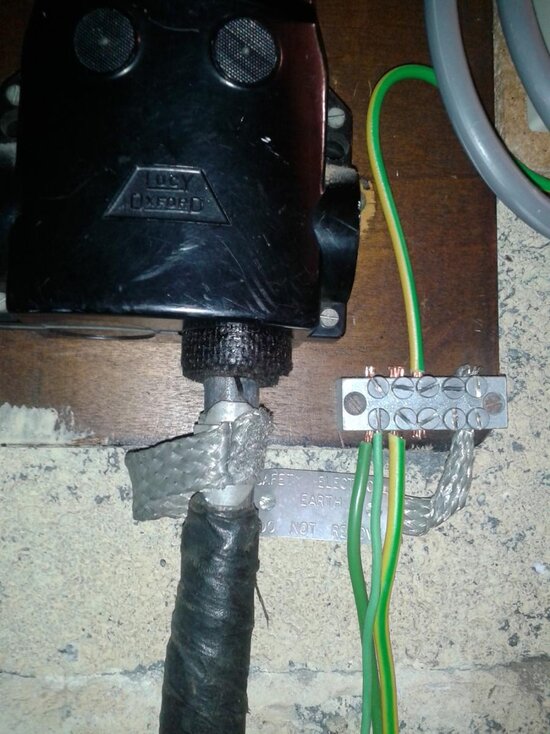
cu 013.jpg
 
leave it alone as long as your Ze is acceptable.
 
Was a bit worried when I detach it to do the ZE test it would crumble to dust or something LOL
 
I'd be inclined to disconnect the outgoing earths rather than the braid since there's only a couple if them.
Or else reterminate the braid with a ferrule where it goes into the earth block.

With the exception of a wiped joint that's possibly the best connection you'll get on a lead cable, those clamps are tensioned with a special tool and the braid will likely offer a better ccc than a 16mm earth
 
as dave says. diss. your outgoing earths/bondings , and get your Ze. from the block and the incomer L in your CU.

i'll guess at a Ze of < 0.3 Ω
 
Last edited:
as dave says. diss. your outgoing earths/bondings , and get your Ze. from the block and the incomer L in your CU.
i'll guess at a Ze of < 0.3 Ω
Could I Diss. the outgoing earths, croc clip on to the braid just south of the met.
Then L+N top of the main switch. ?
Excuse me for being dim, :smile5: why do you say L and not L+N ?
 
because your Ze is measured from L -E. pscc from L-N and pefc L-E. ( for these last 2, your earths/bonding needs reconnecting)
 
Could I Diss. the outgoing earths, croc clip on to the braid just south of the met.
Then L+N top of the main switch. ?
Excuse me for being dim, :smile5: why do you say L and not L+N ?

I normally clip onto the braid as it gets a good bite on it.

Only L because you don't need N for a high current loop test. You only need an N for anti trip/low current tests.
You should only ever use the low current test option when it is impossible to use the proper high current test.
 
( for these last 2, your earths/bonding needs reconnecting)
LOL Yes indeed ! I've been frog-marched (rightfully so) out of a practical assessment for almost energising a circuit, with the DNO earthing dissed. Costly and inconvenent lesson learned. :-)
 
I normally clip onto the braid as it gets a good bite on it.

Only L because you don't need N for a high current loop test. You only need an N for anti trip/low current tests.
You should only ever use the low current test option when it is impossible to use the proper high current test.

Yes thanks I understand, I will use the 2 lead option. If my rcd trips should I use the 3 lead test ?
 
Yes thanks I understand, I will use the 2 lead option. If my rcd trips should I use the 3 lead test ?

Your RCD won't trip when doing a ZE test as the installation will be isolated and you will have your probe on the incoming line of the main switch.
 
Yes thanks I understand, I will use the 2 lead option. If my rcd trips should I use the 3 lead test ?

You should be testing from the incoming L of your (open) main switch to the supply earth. So the test current will be entirely upstream of any RCDs and not cause them to trip.

The anti trip/low current test is necessary on RCD protected circuits because the normal test passes a current between L and E which is greater than the 30mA tripping current of an RCD
 
Your RCD won't trip when doing a ZE test as the installation will be isolated and you will have your probe on the incoming line of the main switch.
Sorry I have my wires crossed, :skull:
I'm thinking about the PFC PSSC after the ZE
Due to what Telectrix said.
 
Sorry I have my wires crossed, :skull:
I'm thinking about the PFC PSSC after the ZE
Due to what Telectrix said.

It's ok, you're learning so don't worry, just keep asking the questions and we'll do our best to help you.

You would still carry out those tests on the incoming side of the main switch so the test current will still be upstream of any RCDs
 

OFFICIAL SPONSORS

Back
Top