Please come check out EFbot; Testing thread is here. Come see what it can do. . Tag it in any thread using @efbot you will need give it a few seconds and refresh a page for it to post a reply post.
According to the OSG the maximum fault current likely to be found in domestic properties in the UK (unless in heavily built up areas) is 16kA.
However this is probably stated because annex Za of BS60439 provides an additional test, for domestic consumer units that are protected by a BS1361 fuse at the supply, to ensure that a BS60439 consumer unit can take a 16kA fault current without danger.
This permits the use of protective devices in the consumer unit that may not have the short circuit rating to cope with the prospective fault current since the assembly as a whole will cope.
This is part of why the manufactures do not permit different makes of breaker in their consumer units, they say they are not tested for those units.
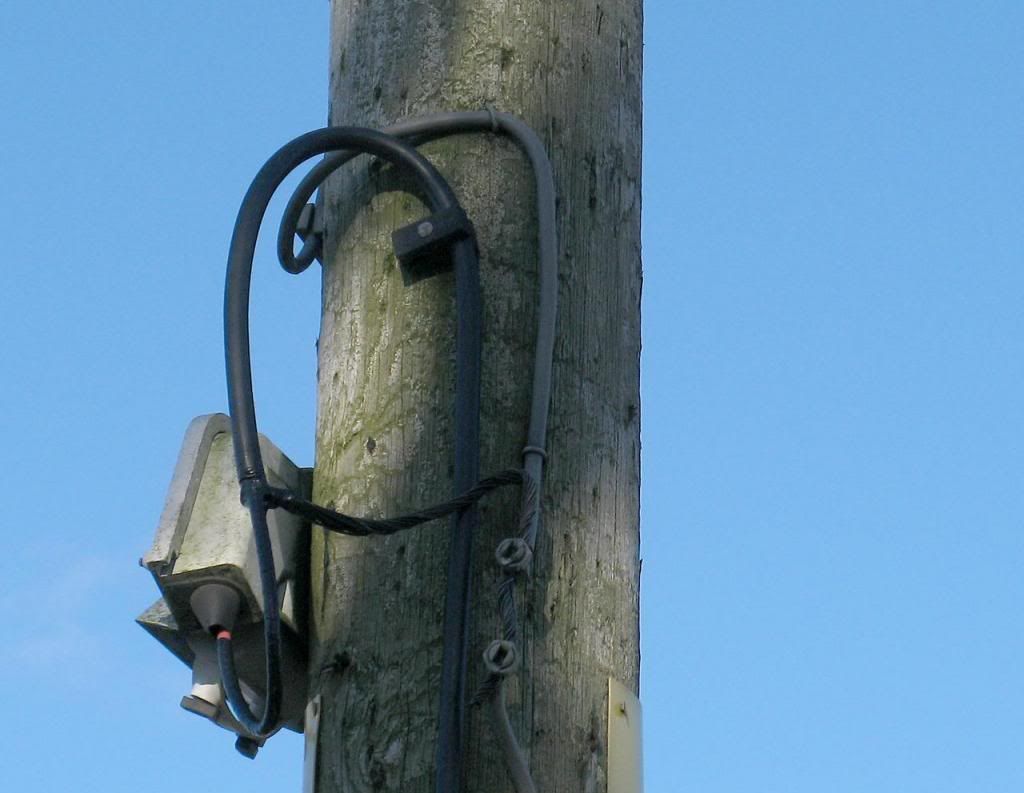
Here's our overhead supply for comparison and comment. Our transformer is served by two high voltage conductors, which in turn come from a string of poles carrying three conductors - ie two of the three branch off to our property. I assumed these were two phases from three phase, but comments here now make me unsure.
One green/yellow sheathed cable comes from the case of the transformer into the ground on the N side of the pole.
On the other side of the pole the two cables out of the transformer join the underground service cable which goes to our meter cabinet. One connects via the isolator or fuse or whatever it is (the grey item), the other is clamped directly. After the join to the service cable, there's another earth that goes underground at the foot of the pole on the S side. The DNO guy who traced and marked the cable routes for us said that this would run some distance horizontally underground while still insulated, then further distance uninsulated.
Our earthing arrangement was described as "CEW" and also "TN-S" by the DNO engineer, after he opened part of the cut-out to check.
So does anyone have a picture of a PME system :joker: Seeing as freshman are bound to be seeing that old chestnut.
I know, I know, but the question will be asked, guaranteed.
If you have a neutral connected to an installations earth terminal (eg PME/TNC-S) then the incoming supply cables metallic sheath connection must be disconnected. Especially important where a supply cable is suppling both TN-S and TNC-S earthing arrangements!! eg, ....where the DNO cable is in the process of being PME'd....
Well Dan,on your recommendation ,I decided to read this thread (all 12 pages of it). Very interesting.Feels a lot older than 10 years.It also raised a question for me ,based on the comment above from "Engineer54". He suggests that the metallic sheath of a TNS cable must be electrically isolated as soon as the TNS supply is converted to TNCS.Why does this have to be done?
@Admin This thread is a long-running discussion trying to demystify earthing arrangements in UK installations, with photos and practical examples.
In context of the last few posts you quoted:
Earlier in the thread, members posted very clear photos of consumer units and terminations to show what TN‑S, TN‑C‑S/PME etc. actually look like in the real world, and how they should be laid out tidily and correctly (like the Dave85 install being praised).
The later posts turn more reflective: people are commenting that it’s an old but very useful thread, and noting that many of the knowledgeable contributors are no longer active.
The technical point in the last visible post (about disconnecting the metallic sheath connection when a neutral is bonded at a PME/TN‑C‑S installation, especially if the same cable feeds both TN‑S and TN‑C‑S) is about avoiding parallel earth paths / unintended bonding when the DNO is converting a TN‑S system to PME. It’s highlighting how supply-side earthing can change over time and why you need to understand what the network operator has actually done, not just what the label says.
So, overall: it’s a reference thread where pros walked through earthing systems in detail, using real-world photos, and the recent posts are both appreciating that and digging into a nuanced PME/TN‑S interface issue raised near the end.