P

pprendeville

Can anyone tell me if there's a difference between single phase and 2 phase voltage supply?

I know that single phase consists of a supply from the brown phase conductor and the blue neutral (i.e. one of the three lines and neutral) as shown in the pic but I'm unsure if 2-phase is just another phrase for single phase or not?
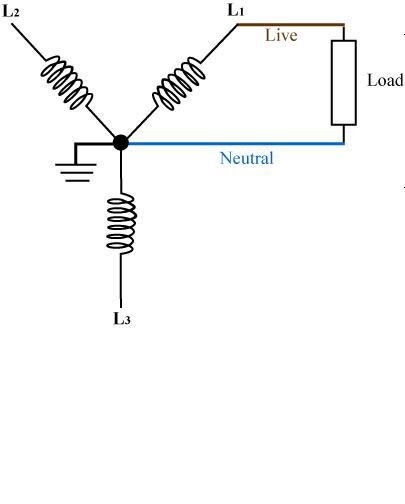
 

Attachments

  • Single Phase Supply.jpg
    Single Phase Supply.jpg
    12.6 KB · Views: 173
The voltage across any 2 phases will be 400V because they are 120 degree apart, but nothing to my knowledge runs on just 2 phases. Its either single phase (230 volts) or 3 phase (400 volts). What context is it in? Are they just talking about 2 separate 230V supplies to a property/business because of high demand?
 
The voltage across any 2 phases will be 400V because they are 120 degree apart, but nothing to my knowledge runs on just 2 phases. Its either single phase (230 volts) or 3 phase (400 volts). What context is it in? Are they just talking about 2 separate 230V supplies to a property/business because of high demand?


In villages, where 3 phase isn't available, a system called split phase can be found, when you measure the voltage between the phases, you get 480 Volts.

Basically, two 11kV lines feed the primary winding of the transformer, there are two windings on the secondary side, the middle is tapped to earth and you get two 230V phases 180 degrees out of phase from each other. giving you 460 Volts (in reality 480)

Its used to run larger equipment on farms, and its quite popular in my neck of the woods.

Also, 3 phase welders very often only use 2 phases, although they have a 3 phase plug on them
 
Last edited by a moderator:
did a hotel/leisure complex 20yr ago they only had 2 phase ltg & sml power ok but we had to use phase converters for lifts and ahu


yours benji
 
The voltage across any 2 phases will be 400V because they are 120 degree apart, but nothing to my knowledge runs on just 2 phases. Its either single phase (230 volts) or 3 phase (400 volts). What context is it in? Are they just talking about 2 separate 230V supplies to a property/business because of high demand?

I'm doing a course in Electrical Control Systems (formerly a mech design engineer but out of work now) so I'm trying to find out as much as I can and relate it to what I'm learning in the practical classes, hence all the silly questions.

Just says in the notes re. 2 phase supply.

2.3.2 Two phase systems
In some industrial applications loads are sometimes connected between two of the lines of the supply, as shown in Diagram (a), rather then the single phase connection between one of the lines and neutral.

picture.php


In this situation the voltage across the load is also a sine wave and has the same frequency as before (50 Hz) but is larger in size. The line voltage is 400V (as expected).

It doesn't actually give an application of where this system is used. Just want to check if anyone has used it before and if so, where and how?

By the way, can you have two seperate (or even 3 seperate or would this just be 3-phase) supplies to a business household. Why would you need this?

In villages, where 3 phase isn't available, a system called split phase can be found, when you measure the voltage between the phases, you get 480 Volts.

Basically, two 11kV lines feed the primary winding of the transformer, there are two windings on the secondary side, the middle is tapped to earth and you get two 230V phases 180 degrees out of phase from each other. giving you 460 Volts (in reality 480)

Its used to run larger equipment on farms, and its quite popular in my neck of the woods.

Also, 3 phase welders very often only use 2 phases, although they have a 3 phase plug on them

Would most farms be on a 3-phase supply so if they can get it?
 
Last edited by a moderator:
I'm doing a course in Electrical Control Systems (formerly a mech design engineer but out of work now) so I'm trying to find out as much as I can and relate it to what I'm learning in the practical classes, hence all the silly questions.


It doesn't actually give an application of where this system is used. Just want to check if anyone has used it before and if so, where and how?

By the way, can you have two seperate (or even 3 seperate or would this just be 3-phase) supplies to a business household. Why would you need this?


Would most farms be on a 3-phase supply so if they can get it?

I am just a beginner to this myself having spent 30 years elsewhere connected with science and am now studying this to keep me occupied

I am sure i have come across properties having 2 single phase supplies eg where they maybe have a small workshop at the back. They need more power than a single phase can supply but do not need 3 phase. Three single phase supplies is effectively a 3 phase supply. A common reason for wanting a 3 phase supply would be to run large motors - a 3 phase supply is more efficient than a single phase and allows balanced loads in certain circumstances so you can reduce the number of conductors.

Here is a LINK to some background about 2 phase supply - seems it was an early development. Interesting but not exactly what your notes are talking about with a 2 phase system .
 
The voltage across any 2 phases will be 400V because they are 120 degree apart, but nothing to my knowledge runs on just 2 phases. Its either single phase (230 volts) or 3 phase (400 volts). What context is it in? Are they just talking about 2 separate 230V supplies to a property/business because of high demand?

we have some demagnetisers machines that run off two phase 400v..:)
 

OFFICIAL SPONSORS

Back
Top