My oversight, sorry!!

Why are you isolating the 2 TT rod positions by not including the armour of the SWA at the workshop?? Two roded positions will always be better than one!! lol!! There is no need to isolate the house TT system from the workshop TT system, your over-all Ra value should, if installed correctly, be better than the existing Ra value!!
 
Risteard: Another Sparky mentioned it to me and said that the breakers in the new DB should be lower that the supply feed to avoid nuisance tripping.

Shocking_eg: Sorry I should have mention that the current supply is TT so yes the supply in the workshop will also be TT.

A fault is likely to take them both out. Fuses might be better for the submain as MCBs don't really discriminate well.
 
Lighting Vd is 3% of 230v= 6.9v and power is 5% of 230v=11.5v so your way over if lighting is involved which as its a workshop i presume it is
 
Lighting Vd is 3% of 230v= 6.9v and power is 5% of 230v=11.5v so your way over if lighting is involved which as its a workshop i presume it is

OP has stated an expected demand of 4kw. Which on a 16mm SWA @110m will give a volt drop of 5.6v,well within.

To the OP though I would re-think your expected load.....what about heating? I've lost count of the times I've seen projects where there will only be a 'few lights and machines' only for a water heater and a couple of convectors to appear after everythings been installed....."Oh..didn't we mention those?"
 
Thanks for all the input guys!

The supply voltage where I live is actually 240v, so my volt drop complies with the regs. The only light that will be used will be at the most 4 twin flourscents. I would like to say that no other circuits will be added such as heaters etc as I am telling the customer that the cable will not be suitable for more demand.

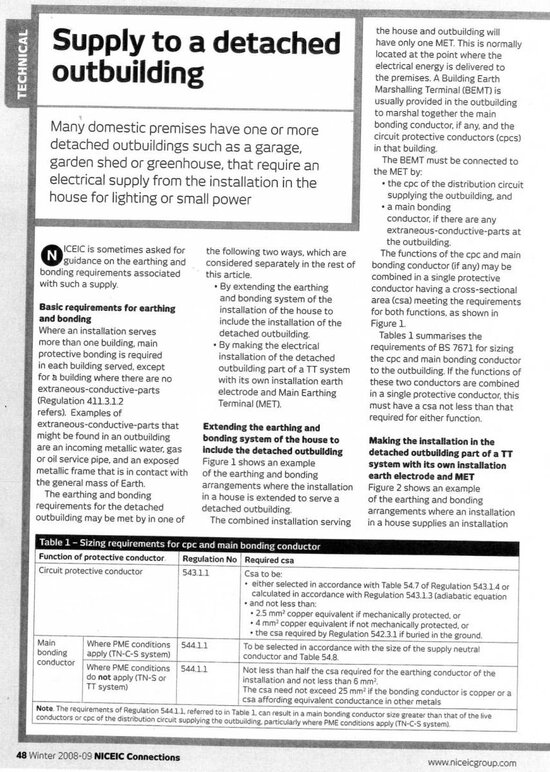
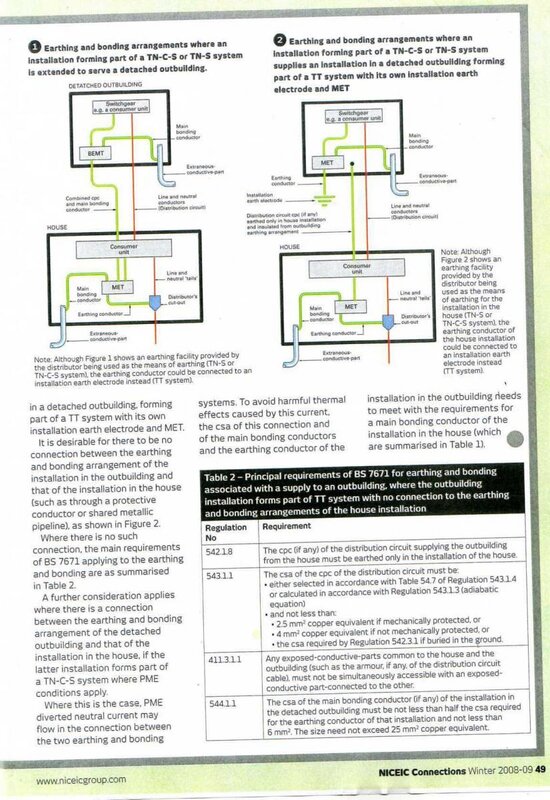
The reason for not connecting the MET of the house to the MET of the workshop is due to reading the attached article from the NICEIC Connections magazine.

img004.jpgimg005.jpg
 
Thanks for all the input guys!

The supply voltage where I live is actually 240v, so my volt drop complies with the regs. The only light that will be used will be at the most 4 twin flourscents. I would like to say that no other circuits will be added such as heaters etc as I am telling the customer that the cable will not be suitable for more demand.

The reason for not connecting the MET of the house to the MET of the workshop is due to reading the attached article from the NICEIC Connections magazine.

View attachment 19145View attachment 19146
and so it will be everywhere else n all....
230V is a nominal.....and a load of old poo as well.....
try measuring it...
bet you its more like 248V....
 
Thanks for all the input guys!

The supply voltage where I live is actually 240v, so my volt drop complies with the regs. The only light that will be used will be at the most 4 twin flourscents. I would like to say that no other circuits will be added such as heaters etc as I am telling the customer that the cable will not be suitable for more demand.

The reason for not connecting the MET of the house to the MET of the workshop is due to reading the attached article from the NICEIC Connections magazine.

View attachment 19145View attachment 19146
I love it !!
 
Yes your right parts of the island do experiance over 240v, the highest I've ever recorded was 253v. But I have measured the voltage at the house for the job and it is 241v.
 
=Squid_uk;781182]Thanks for all the input guys!

The supply voltage where I live is actually 240v, so my volt drop complies with the regs. The only light that will be used will be at the most 4 twin flourscents. I would like to say that no other circuits will be added such as heaters etc as I am telling the customer that the cable will not be suitable for more demand.

The reason for not connecting the MET of the house to the MET of the workshop is due to reading the attached article from the NICEIC Connections magazine.

View attachment 19145View attachment 19146

You'll have to enlighten me as to what is wrong with interconnecting the MET with the EMT on an all TT installation??
 
You'll have to enlighten me as to what is wrong with interconnecting the MET with the EMT on an all TT installation??

542.1.8 states...."where a number of installations have separate earthing arrangements...."
well, if the MET and EMT are joined by a common conductor thay are not separate are they?
 
542.1.8 states...."where a number of installations have separate earthing arrangements...."
well, if the MET and EMT are joined by a common conductor thay are not separate are they?

What the hell would it matter, when both the house and the outbuilding earthing system is TT??
 
What the hell would it matter, when both the house and the outbuilding earthing system is TT??

Sorry E54,probably no clear from my post that Iwas agreeing with you.....
Firstly if the buildings share a supply they are not separate installations,and secondly if there is a common conductor they are not separate earthing arrangements.

I think the NIC have misinterpreted 542.1.8,which would not apply to an outbuilding fed from another building,surely in the case described to which they refer to 542.1.8 it is simply part of the same installation using a common earthing system?
IMO 542.1.8 refers to separate installations with separate supplies sharing a common earth
 
Last edited by a moderator:
Do you think that maybe the method shown in the article is recommended if a time delay trip is not installed on the submain, to avoid nuscience tripping?
 

OFFICIAL SPONSORS

Back
Top