The instrument in the centre of my post above will not measure insulation resistance, only voltage and continuity in a limited sense, it is used by an electrician only to test if voltage is present any other tests are performed with the instrument on the right hand of the above pic, which is a MFT.
 
The instrument in the centre of my post above will not measure insulation resistance, only voltage and continuity in a limited sense, it is used by an electrician only to test if voltage is present any other tests are performed with the instrument on the right hand of the above pic, which is a MFT.
That's what I thought :(
not necessarily. you maynot have the neutral at the switch.
Interestingly, I just disconnected the two dimmer switches that are able to control the outside lights. Despite the fuses being off at the box, when I put started unscrewing the neutral in the first dimmer, the screwdriver lit up, which surprised me. But live wasn't live so I carried on unscrewing and was careful not to touch anything just in case. With both switches 'completely' disconnected, the remaining lights still don't work(!) BUT the fuse is no longer automatically tripping. Progress!? :)
 
The false indication on your screwdriver is why no electrician would ever use one, what you have proved is that with the circuit disconnected the lights don't work.

There is a need for a methodical regime of testing each part of the circuit to find the problem an electrician could probably do this in very much less time (3hrs 16mins) than it has taken to post all of these questions and answers and your lights would be back on.

Don't forget that if the problem is water ingress just replacing the cable will not prevent this happening again unless the water short circuit is also addressed, please get an electrician in to sort it for you.
 
Last edited:
The false indication on your screwdriver is why no electrician would ever use one, what you have proved is that with the circuit disconnected the lights don't work.

There is a need for a methodical regime of testing each part of the circuit to find the problem an electrician could probably do this in very much less time (3hrs 16mins) than it has taken to post all of these questions and answers and your lights would be back on.

Don't forget that if the problem is water ingress just replacing the cable will not prevent this happening again unless the water short circuit is also addressed, please get an electrician in to sort it for you.
You're right. Thanks everyone for all your help. We're decamping to my flat for a few days which gives someone an opportunity to look at it properly.
 
Hope that someone is an experienced electrician.

Replacing cables can be done without major work, an experienced electrician can run new cables alongside an existing cable without taking down the ceiling, in most case's above a ceiling, especially if the aforesaid is a drop false ceiling, which is generally the case in top floor apartments.
This is a converted Georgian mid terrace. No drop ceiling and the wires are not housed in tubes/pipes like regulations now dictate. There is obviously some space between flat ceiling and roof, but it's small, just big enough for the housings of each ceiling light. There are no choc boxes isolating any of the lights, they all seem to be wired together.
 
Conduits are not mandatory if using T&E, most electricians have a set of push pull rods that can follow the existing cables from one light to another, it is then easy to pull another cable through the void if needed without pulling down ceilings, possibly without making too many, if any, access points through the ceiling to get around possible obstacles. This would be a simple job for an experienced electrician without too much disruption.

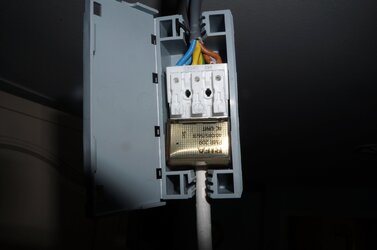
The only possible additional work could be the connections to the lights which may need to be changed to comply with regulations the individual lights should be connected with something like this, it is a Wago lighting box and Wago connector, ignore the gold coloured thing inside the box it's to help prevent flashing of LED's. Imports - 1 of 1 (2).jpeg
 
Last edited:
Late to the party, but I too believe this problem is moisture getting into the external lights, or rodent damage?

Get the handyman neighbour to fix it for a price, as he’s going to be there days replacing bits and pieces with no guarantee of success.

Also, first picture of board, I see a plug top with a short length of flex just cut off.
Remove the flex from the plug for safety.
 
I haven't read through this thread in detail, but I've seen that the immersion heater isn't working properly.
The lighting circuit fault could be a N - E fault (if I've skimmed that bit correctly), is on the same RCD as the immersion, and immersion heaters are prime candidates for having faults to earth.
Has anyone tried switching off the immersion heater at its double pole isolator.
 
Late to the party, but I too believe this problem is moisture getting into the external lights, or rodent damage?

Get the handyman neighbour to fix it for a price, as he’s going to be there days replacing bits and pieces with no guarantee of success.

Also, first picture of board, I see a plug top with a short length of flex just cut off.
Remove the flex from the plug for safety.

Good spot on the plug top and flex.
 
If you are having trouble convincing people that the next door guy is not the right person for the job,

ask if you will be provided with a minor works certificate (electrical safety check) to show that the fault is gone and the circuit is safe to energise and continue using.
 
I haven't read through this thread in detail, but I've seen that the immersion heater isn't working properly.
The lighting circuit fault could be a N - E fault (if I've skimmed that bit correctly), is on the same RCD as the immersion, and immersion heaters are prime candidates for having faults to earth.
Has anyone tried switching off the immersion heater at its double pole isolator.
The immersion heater problem was only mentioned three pages in, we are pulling teeth here.
 
Lay people don't understand the connection. If the RCD trips when the lights are turned on, then it must be the lights that are at fault in their minds. They think the immersion fault is just a coincidence.
I've had more than one late night 'phone call from customers over the years trying to explain the possibility of a connection between the two. "But the immersion heater is turned off" "Is it off at the ISOLATOR" "No, it's on a time switch, as isn't on now" "TURN IT OFF AT THE ISOLATOR" "Oh, the lights work now".
 

OFFICIAL SPONSORS

Back
Top